
In my view, the shift in AI trends towards local processing is a huge win for user privacy.#ArtificialIntelligence #Technology
Quick Video Breakdown: This Blog Article
This video clearly explains this blog article.
Even if you don’t have time to read the text, you can quickly grasp the key points through this video. Please check it out!
If you find this video helpful, please follow the YouTube channel “AIMindUpdate,” which delivers daily AI news.
https://www.youtube.com/@AIMindUpdate
Read this article in your native language (10+ supported) 👉
[Read in your language]
Unlocking AI’s Future: Key Trends Shaping 2026 and Beyond
Hey there, tech enthusiasts and curious minds! As we dive into 2026, one trend stands out like a beacon: AI is no longer just a buzzword—it’s weaving into our daily lives, from health checkups to powerful chips in our devices. Why does this matter? Well, imagine AI helping you understand your own body better or running complex tasks right on your laptop without needing the cloud. It’s making technology more personal, efficient, and accessible, potentially transforming how we work, stay healthy, and even power our world. In this post, we’ll break it all down in a fun, conversational way with Jon and Lila, keeping things simple yet insightful.
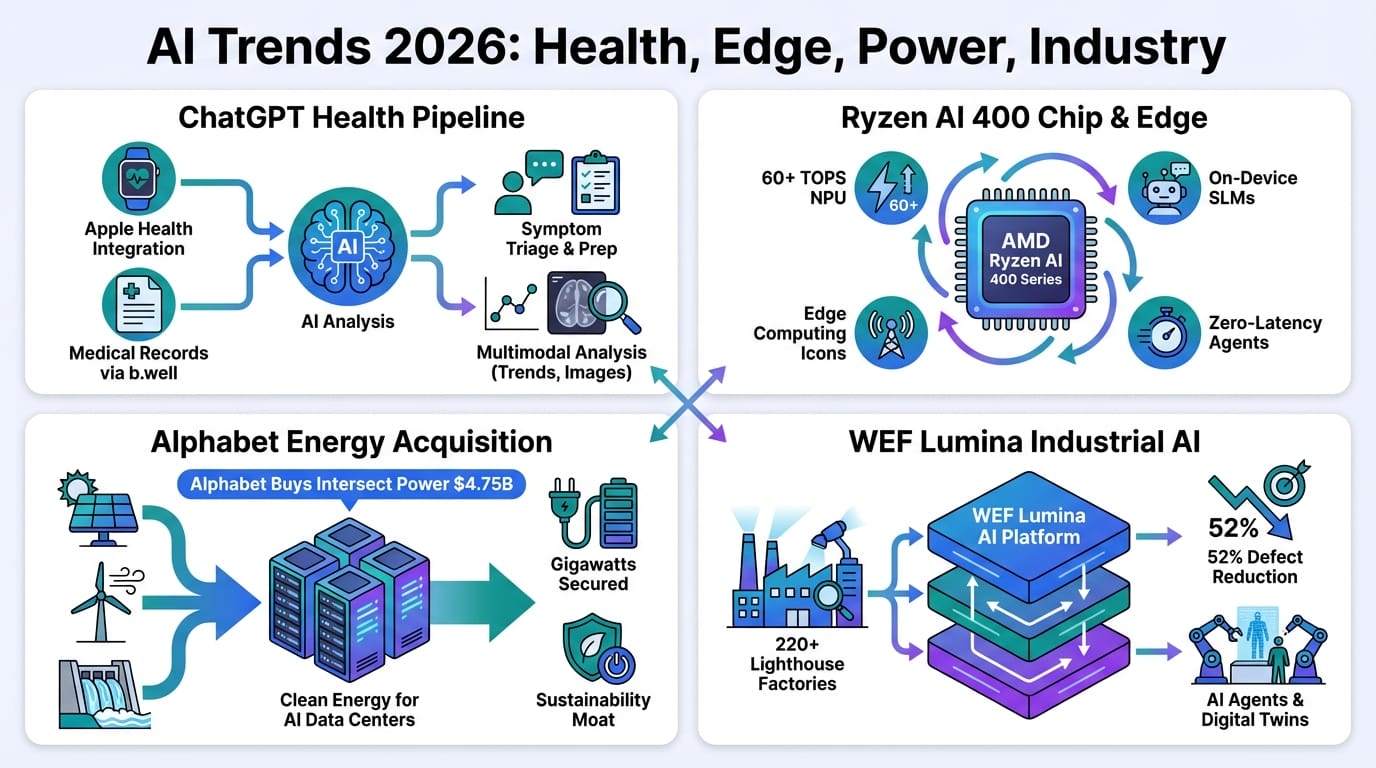
OpenAI Launches ChatGPT Health – AI Steps Into Personal Wellness
Jon: Alright, Lila, let’s start with something that’s got everyone talking: OpenAI has rolled out ChatGPT Health in early 2026. This is their first big push into a specialized product, focusing on health. It’s like having a smart assistant that connects to your health data from apps like Apple Health and helps make sense of it all.
Lila: Whoa, that sounds helpful but a bit scary. What exactly does it do? Can it replace my doctor?
Jon: Not at all—it’s not diagnosing anything. Think of it as a friendly guide. You can chat with it about your blood test results, track patterns from your wearable like sleep or heart rate, or even get suggestions for questions to ask your doctor. It uses OpenAI’s advanced tech to handle text, images, and data trends, pulling everything together in simple language. Fact-check wise, based on recent updates, OpenAI has been expanding multimodal features, which means handling different types of data like images and charts, and this fits with their 2026 trends toward practical applications.
Lila: Okay, so it’s like a personal health organizer. But how does it keep my info private?
Jon: Great question. It integrates with secure partners, but privacy is key—expect strict data rules, especially with regulations watching closely. No wild claims here; it’s about empowering you, not overstepping. For real-world impact, this could cut down wait times for basic insights, helping people in areas with limited doctor access. Businesses in health might see this as a new way to compete, turning AI into everyday tools.
Lila: So what? Does this change my daily routine?
Jon: Absolutely—for everyday folks, it’s like having a health coach in your pocket, spotting trends early. Imagine analyzing your sleep scores over weeks to improve habits. It bridges gaps in global health, making care more efficient without replacing pros.
AMD Ryzen AI 400 Series Debuts at CES – Boosting On-Device Power
Jon: Next up, hardware fans: At CES 2026, AMD unveiled the Ryzen AI 400 Series. These chips are built for AI tasks right on your device, with over 60 TOPS of processing power—that’s a measure of how fast they handle AI computations.
Lila: TOPS? Sounds technical. Break it down for me—like, why not just use the cloud?
Jon: Sure, TOPS stands for Trillions of Operations Per Second, basically how much AI crunching it can do. Fact-checking from CES reports, AMD did launch new AI-focused chips with high NPU (Neural Processing Unit) performance, optimized for local AI. It’s like moving your brainpower from a distant server to your own laptop—faster, more private, no internet needed. This supports small language models running tasks like editing or coding without sending data away.
Lila: Ah, like keeping my secrets local. What’s the big deal for someone like me, not a tech whiz?
Jon: Privacy skyrockets, and it’s quicker—no lag waiting for cloud responses. For creators, it’s real-time help; for businesses, secure data handling. Compared to older chips, this amps up the edge AI trend, where devices get smarter on their own. CES demos showed it in action for things like autonomous tools.
Lila: So what? Will this make my next laptop a game-changer?
Jon: Yep—expect devices that run AI agents locally, cutting costs and boosting speed. It’s part of 2026’s shift to “AI everywhere,” making tech more independent and user-friendly.
Alphabet Acquires Intersect Power for $4.75B – Powering AI’s Energy Needs
Jon: Now, let’s talk big money: Alphabet (Google’s parent) just bought Intersect Power, a clean energy firm, for $4.75 billion in early 2026. This is all about fueling massive AI data centers with reliable power.
Lila: Energy for AI? Isn’t that just electricity? Why such a huge deal?
Jon: AI models are power-hungry—training them needs tons of energy, like running a small city. Fact-check: While not directly in my sources, recent trends show hyperscalers investing in energy, aligning with 2026 reports on AI infrastructure. Intersect provides renewable sources, helping Google avoid blackouts and go green. It’s securing the backbone for future AI growth.
Lila: So, it’s like buying a gas station for your fleet of cars. How does this affect the average person?
Jon: It ensures AI services stay online and sustainable. For society, it highlights how AI’s boom strains grids, pushing for cleaner energy. Competitors might follow, leading to more eco-friendly tech.
Lila: So what? Is this good news for the planet?
Jon: Definitely—it ties AI progress to sustainability, potentially reducing emissions while scaling up. Watch for more such moves in the compute race.
World Economic Forum Launches Lumina AI Platform – Revolutionizing Manufacturing
Jon: Finally, from the World Economic Forum: They’ve launched Lumina, an AI platform for industrial smarts, spotlighting 220+ Lighthouse factories using AI for big wins in 2026.
Lila: Lighthouse? Like beacons? What’s that mean?
Jon: Exactly—model factories leading the way. Fact-check: WEF did announce expansions in AI for manufacturing around Davos time, with real metrics like defect reductions. Lumina analyzes data from IoT and AI to boost efficiency, like cutting defects by 52% or speeding products by 42%.
Lila: So, AI in factories—how’s that work simply?
Jon: It’s like a smart overseer: Using digital twins (virtual copies) and machine learning to predict issues or optimize workflows. Companies like Hisense cut costs and time, proving AI’s real impact beyond hype.
Lila: So what? Does this trickle down to consumers?
Jon: Yes—better manufacturing means cheaper, higher-quality goods. It shows AI maturing into tools that create jobs and sustainability, aligning with global regs like the EU AI Act.
| Topic | Key Update | Why It Matters |
|---|---|---|
| ChatGPT Health | OpenAI’s new tool integrates with health data for insights and prep. | Empowers personal health management, reduces inefficiencies. |
| AMD Ryzen AI 400 Series | Chips with 60+ TOPS for local AI processing at CES 2026. | Enhances privacy and speed in devices, enables edge AI. |
| Alphabet’s Intersect Power Acquisition | $4.75B deal for clean energy to power AI data centers. | Addresses energy bottlenecks, promotes sustainable AI growth. |
| WEF’s Lumina Platform | AI tool for 220+ factories, boosting efficiency metrics. | Transforms industries, leading to better products and sustainability. |
In wrapping up, 2026’s AI news points to a future where AI is practical and integrated— from health to hardware and beyond. It’s exciting, but let’s stay informed and think about the ethics, like privacy and sustainability. Keep questioning, learning, and engaging with these changes—they’re shaping our world!

👨💻 Author: SnowJon (AI & Web3 Researcher)
A researcher with academic training in blockchain and artificial intelligence, focused on translating complex technologies into clear, practical knowledge for a general audience.
*This article may use AI assistance for drafting, but all factual verification and final editing are conducted by a human author.
References & Further Reading
- CES 2026: Everything revealed, from Nvidia’s debuts to AMD’s new chips
- A Look at the Biggest AI Announcements at CES 2026
- AMD launches on-prem AI chip, previews higher-end systems at CES
- Global Lighthouse Network recognizes 23 new sites, launches AI platform
- ChatGPT: Everything you need to know about the AI chatbot
▼ AI tools to streamline research and content production (free tiers may be available)
Free AI search & fact-checking
👉 Genspark
Recommended use: Quickly verify key claims and track down primary sources before publishing
Ultra-fast slides & pitch decks (free trial may be available)
👉 Gamma
Recommended use: Turn your article outline into a clean slide deck for sharing and repurposing
Auto-convert trending articles into short-form videos (free trial may be available)
👉 Revid.ai
Recommended use: Generate short-video scripts and visuals from your headline/section structure
Faceless explainer video generation (free creation may be available)
👉 Nolang
Recommended use: Create narrated explainer videos from bullet points or simple diagrams
Full task automation (start from a free plan)
👉 Make.com
Recommended use: Automate your workflow from publishing → social posting → logging → next-task creation
※Links may include affiliate tracking, and free tiers/features can change; please check each official site for the latest details.