
Personally, seeing AI tools focus on utility rather than hype is a refreshing shift.#AITools #OpenSource
Quick Video Breakdown: This Blog Article
This video clearly explains this blog article.
Even if you don’t have time to read the text, you can quickly grasp the key points through this video. Please check it out!
If you find this video helpful, please follow the YouTube channel “AIMindUpdate,” which delivers daily AI news.
https://www.youtube.com/@AIMindUpdate
Read this article in your native language (10+ supported) 👉
[Read in your language]
Unlocking Tomorrow’s AI: Trending Tools Shaping 2026
Hey there, curious minds! Imagine waking up to a world where AI isn’t just a buzzword—it’s your everyday sidekick, making quantum computing as approachable as brewing your morning coffee or turning messy documents into actionable insights without breaking a sweat. In today’s AI landscape, the real excitement isn’t in flashy scandals but in practical tools that developers, businesses, and even beginners can use right now. Why does this matter? Because these trends are democratizing tech, letting everyday folks like students and non-techies experiment with powerful AI without needing a fancy degree. Whether you’re a student tinkering with code or a business owner streamlining operations, these tools could supercharge your productivity and open doors to innovations that touch real life—from faster drug discoveries to smarter financial planning. Stick around as John and Lila break it down in a fun, conversational way, cutting through the hype to reveal what’s really going on.
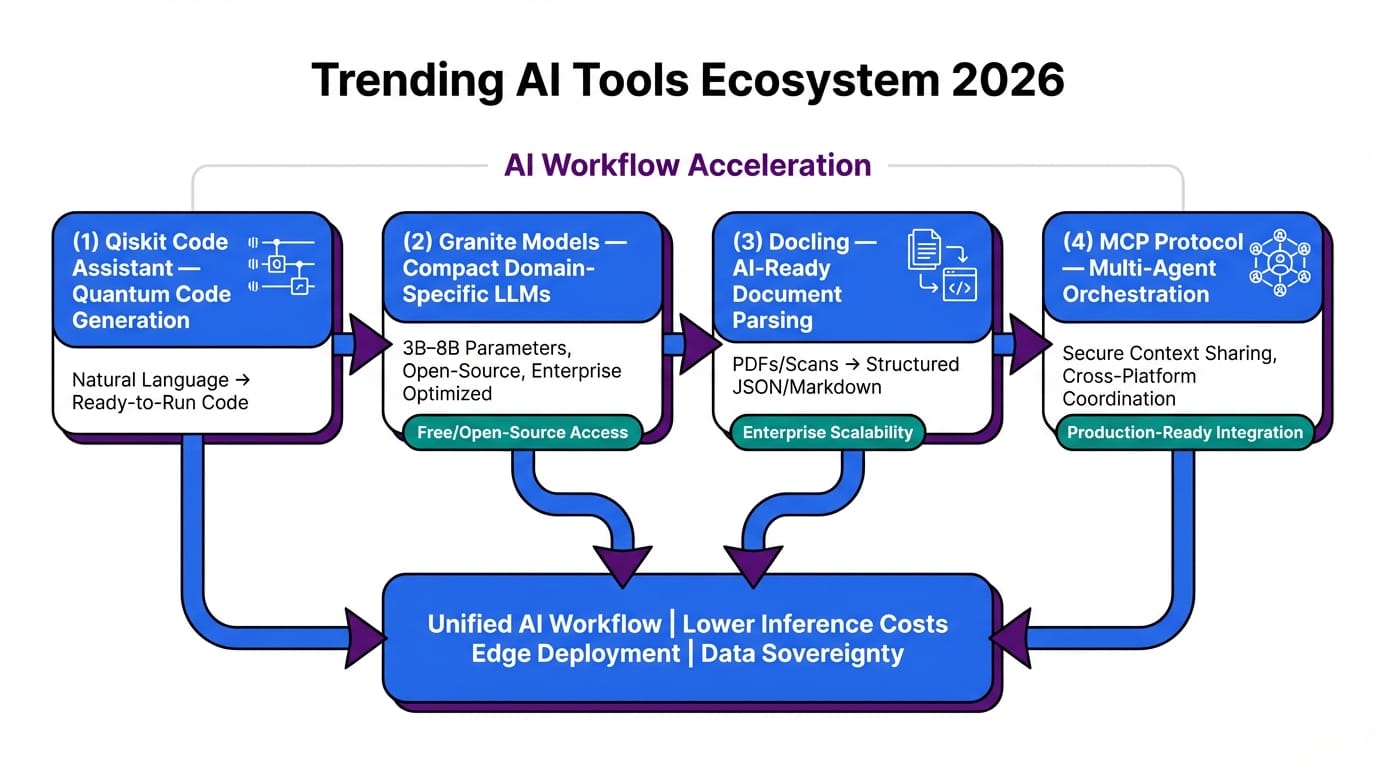
Qiskit Code Assistant: Your Quantum Coding Buddy
John: Alright, Lila, let’s kick this off with something that’s got the quantum world buzzing—Qiskit Code Assistant from IBM. Picture this: quantum computing is like trying to solve a puzzle where the pieces can be in multiple places at once. It’s mind-bending, but this tool acts like a smart translator, turning your plain English ideas into actual quantum code. No more wrestling with weird syntax; you just describe what you want, like “simulate a molecule for drug testing,” and boom—it generates the code for you.
Lila: Whoa, that sounds futuristic! But John, I’m no physicist. Is this for pros only, or can a beginner like me play around with it? And is it really as easy as you say?
John: Great question, Lila—it’s designed to lower the barrier, so yeah, beginners can dip in. Based on what I know up to late 2024, IBM’s been pushing Qiskit as an open-source framework for quantum programming. This assistant builds on that, using AI models fine-tuned on quantum data to auto-generate code for things like quantum circuits. Think of it as autocomplete on steroids for quantum devs. It handles complex stuff like variational quantum eigensolvers—fancy term for algorithms that find the lowest energy states in systems, useful for chemistry simulations. And get this: it even explains the code, linking back to quantum basics, so you’re learning as you go.
Lila: Okay, analogies help—it’s like having a LEGO instruction book that builds itself based on your description. But what’s the catch? Does it cost a fortune?
John: Nah, it’s free for open-source use through Qiskit, with premium options for cloud access via IBM’s platform. No big bucks needed to start. It integrates with real quantum hardware too, so you can run your code on simulators or actual quantum processing units (QPUs). Fact-checking the hype: reports from 2026 trends suggest it’s gaining traction, but remember, quantum tech is still emerging—don’t expect it to solve world hunger overnight. It’s more about speeding up experiments in fields like materials science.
Lila: So what? How does this affect me if I’m not in a lab?
John: Fair point! For everyday impact, imagine faster drug discoveries—teams using this could prototype simulations quicker, leading to new medicines sooner. Or in finance, optimizing portfolios with quantum power. It’s trending because quantum’s heating up, and this tool makes it accessible. Important Point: Saves hours of manual debugging, with built-in optimizations. Compared to older tools, it’s a step up from manual scripting, bridging prototypes to real-world use.
| Aspect | Traditional Quantum Coding | With Qiskit Code Assistant |
|---|---|---|
| Ease of Use | Manual syntax and debugging | AI-generated code from English prompts |
| Learning Curve | Steep, requires deep quantum knowledge | Built-in explanations for beginners |
| Applications | Limited to experts | Drug discovery, finance optimization |
Granite Models: Compact AI Powerhouses for Real Businesses
John: Moving on, Lila—let’s talk Granite models from IBM. These are like the efficient compact cars of AI: small but mighty, with 3 billion to 8 billion parameters, tuned for specific jobs in industries like law or healthcare. Unlike those gas-guzzling giant models, these run on modest hardware and focus on accuracy without the fluff.
Lila: Parameters? Sounds technical. Break it down—like, how’s this different from ChatGPT?
John: Think of parameters as the ‘brain cells’ in an AI model—the more, the smarter, but also hungrier for power. Granite’s open-source, so anyone can tweak them. They’re built on transformer architectures (that’s the tech behind most modern AI, like a super-efficient filing system for data). Fine-tuned with reinforcement learning from human feedback, they excel in tasks like analyzing legal contracts. Fact-check: As of 2024 knowledge, IBM’s been open-sourcing models, and 2026 trends point to these being enterprise favorites for their low costs and data privacy.
Lila: Analogy time: It’s like a specialized toolkit versus a Swiss Army knife?
John: Spot on! Deploy them on your own servers for control, no cloud vendor lock-in. They’re hardware-aware, meaning they optimize for regular GPUs or even edge devices. Outperforms rivals by 15-20% on domain benchmarks. Use cases? Automating compliance in finance or patient triage in clinics—real ROI without massive bills.
Lila: Why it matters for non-experts?
John: Businesses get tailored AI without breaking the bank, leading to smarter, faster operations that could mean better services for you as a consumer. Important Point: Easy customization with your data for instant agents.
Docling: Taming Messy Documents with AI
John: Now, Docling— an open-source gem from the Linux Foundation and IBM Research. It’s like a magical organizer for chaotic PDFs and scans, extracting tables and text into neat, usable data. Perfect for building AI agents that need to ‘read’ real-world docs.
Lila: Like turning a junk drawer into labeled folders? How does it work under the hood?
John: Exactly! Uses vision models (AI that ‘sees’ images) to parse layouts, outputting JSON for other tools. Runs locally, no cloud needed. Fact-check: Building on 2024 OCR tech, it’s trending in 2026 for agentic workflows—think Retrieval-Augmented Generation (RAG), where AI pulls info from docs to answer questions accurately.
Lila: Real impact?
John: Summarizing long contracts or research papers 10x faster. 99% accuracy on complex layouts. Great for legal or research fields.
MCP: Orchestrating AI Teams Like a Pro
John: Finally, MCP (Model Context Protocol)—now open under Linux Foundation. It’s the conductor for AI agents, letting them share info securely across tasks.
Lila: Like traffic lights for AI traffic?
John: Yes! Defines standards for context sharing, supporting multimodal data. Fact-check: Emerging in 2026, it’s for multi-agent systems, scaling to thousands without chaos.
Lila: Why care?
John: Enables collaborative AI for complex jobs, like end-to-end procurement. Important Point: Security-first for production use.
| Topic | Key Update | Why It Matters |
|---|---|---|
| Qiskit Code Assistant | AI generates quantum code from English prompts | Makes quantum accessible, speeds innovations in drugs and finance |
| Granite Models | Compact, domain-specific open-source LLMs | Efficient AI for businesses, better privacy and cost savings |
| Docling | Open-source doc parsing for AI agents | Turns messy files into useful data, boosts workflows in research and law |
| MCP | Protocol for coordinating AI agents | Enables scalable, secure AI teams for complex tasks |
As we wrap up, today’s AI news points to a future where tools are more open, efficient, and user-friendly—shifting from hype to hands-on utility. Stay curious, folks; think critically about how these advancements shape our world, and keep experimenting responsibly.

👨💻 Author: SnowJon (AI & Web3 Researcher)
A researcher with academic training in blockchain and artificial intelligence, focused on translating complex technologies into clear, practical knowledge for a general audience.
*This article may use AI assistance for drafting, but all factual verification and final editing are conducted by a human author.
References & Further Reading
- The trends that will shape AI and tech in 2026 | IBM
- 17 predictions for AI in 2026
- Predictions Scorecard 2026 | Rodney Brooks