
x402: The Internet-Native Payment Protocol – Revolutionizing How the Web Handles Money
John: Alright, folks, buckle up. If you’ve ever wondered why paying for stuff online feels like jumping through hoops—apps, logins, ads everywhere—meet x402. This isn’t some flashy crypto hype train; it’s the long-overdue activation of HTTP’s forgotten status code: 402 “Payment Required.” Launched in 2025 by heavyweights like Coinbase and Cloudflare, x402 is turning the internet into a seamless payment machine. But before we geek out on the engineering, let’s hook in the beginners with a simple analogy.
Lila: Imagine you’re at a vending machine. You want a snack—no app downloads, no loyalty cards, just drop a coin and grab your chips. That’s x402 in a nutshell. It lets devices, apps, and even AI agents pay for web resources instantly, without the middleman drama of traditional payment systems. No more “subscribe to read this article” walls; it’s micropayments on steroids, native to the internet itself.
John: Spot on, Lila. And for the engineers in the room, this is where it gets juicy. x402 isn’t just a protocol; it’s a spec that revives HTTP 402, enabling blockchain-based payments right in your API calls. Recent developments? Coinbase open-sourced it in May 2025, and now we’ve got integrations popping up everywhere—from Cronos’ PayTech Hackathon to Cloudflare’s agent docs. It’s fueling the machine economy, where AI agents pay each other autonomously. Industry buzz predicts it’ll unlock a $30 trillion market by making micro-transactions viable. But enough teaser—let’s dive into how this beast actually works.
How x402 Actually Works
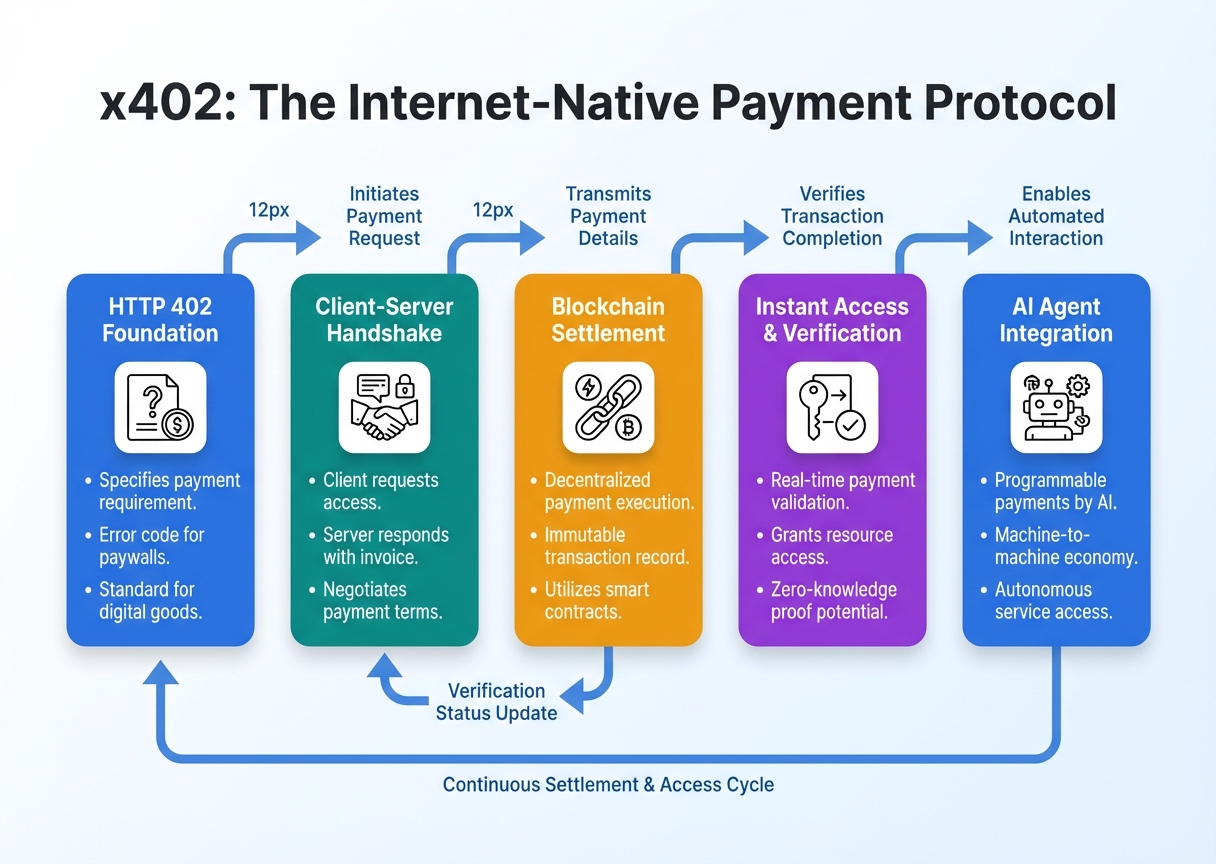
John: Okay, engineers, here’s the raw architecture. x402 builds on the HTTP protocol by standardizing the 402 response. When a client hits an endpoint, the server can respond with 402, including payment details like amount, wallet address, and supported chains (think Base Sepolia or BNB Chain). The client then initiates an on-chain transaction—boom, payment confirmed, resource unlocked. Why does it work? It’s stateless and scalable, leveraging blockchain for trustless verification without sessions or user accounts. No more OAuth dances or email verifications.
Lila: For beginners: Think of it like a toll booth on a highway. Traditional payments are like stopping at a cashier—slow and clunky. x402 is an E-ZPass: automatic, fast, and you keep driving. The “why” is efficiency—blockchain handles the heavy lifting for security, while HTTP keeps it web-native.
John: Exactly. Let’s break down the specs in a table for clarity. Here’s a quick comparison of traditional web payments vs. x402:
| Feature | Traditional Payments (e.g., Stripe, PayPal) | x402 Protocol |
|---|---|---|
| Setup Required | Accounts, APIs, KYC | Wallet + HTTP Request |
| Transaction Speed | Seconds to minutes | Near-instant on L2 chains |
| Use Case | E-commerce, subscriptions | Micropayments, AI agents, APIs |
| Fees | 2-3% + fixed | Gas fees (low on Base/BNB) |
| Security | Centralized trust | Blockchain immutability |
John: See that? x402 slashes latency because it’s embedded in HTTP—no extra layers. Recent pushes include BitsLab partnering with Questflow for multi-agent infrastructure, and AEON’s facilitator on BNB Chain. For AI fans, it’s a game-changer: Autonomous agents can pay for data or compute on-the-fly, no human intervention.
Current Developments and Why Engineers Should Care
Lila: If you’re new, developments mean real-world rollouts. As of late 2025, Cronos launched a hackathon for AI-directed payments, and Oasis Network is integrating x402 for secure web-native transactions.
John: Engineers, this is your playground. The protocol’s logic is brilliant because it uses existing web standards— no reinventing the wheel. Dive into the open-source repo on GitHub (check Coinbase’s x402 implementation at github.com/coinbase/x402-protocol). For building, grab libraries like the x402 SDK from Cloudflare or integrate with LangChain for AI agents. Want to experiment? Fine-tune a model like Llama-3-8B on Hugging Face to simulate agent payments—pair it with vLLM for fast inference.
Lila: And for beginners, start with the DEV Community tutorials; they’re beginner-friendly and explain setup step-by-step.
John: Wrapping up, x402 isn’t hype—it’s the engineering fix for a paywall-plagued web. Whether you’re a curious newbie or a seasoned dev, this protocol is rewiring the internet. Got questions? Drop ’em below!
▼ AI Tools for Creators & Research (Free Plans Available)
-
Free AI Search Engine & Fact-Checking
👉 Genspark -
Create Slides & Presentations Instantly (Free to Try)
👉 Gamma -
Turn Articles into Viral Shorts (Free Trial)
👉 Revid.ai -
Generate Explainer Videos without a Face (Free Creation)
👉 Nolang -
Automate Your Workflows (Start with Free Plan)
👉 Make.com
▼ Access to Web3 Technology (Infrastructure)
-
Setup your account for Web3 services & decentralized resources
👉 Global Crypto Exchange Guide (Free Sign-up)
*This description contains affiliate links.
*Free plans and features are subject to change. Please check official websites.
*Please use these tools at your own discretion.
References & Further Reading
- x402: The Internet-Native Payment Protocol (Original Blog)
- x402 Protocol: The Internet’s First Native Payment Layer
- x402 · Cloudflare Agents docs
- Coinbase’s AI Payment Protocol x402 Gets Major Push
- x402: A Web-Native Payment Protocol for Micropayments and Autonomous Agents