
In my view, the Python 2025 JIT update is the efficiency boost developers desperately need.#Python #Programming
Quick Video Breakdown: This Blog Article
This video clearly explains this blog article.
Even if you don’t have time to read the text, you can quickly grasp the key points through this video. Please check it out!
If you find this video helpful, please follow the YouTube channel “AIMindUpdate,” which delivers daily AI news.
https://www.youtube.com/@AIMindUpdate
Read this article in your native language (10+ supported) 👉
[Read in your language]
Unlocking Python’s 2025 Highlights: What Made These Stories Buzz and Why They Matter for Your Coding Journey
👍 Recommended For: Aspiring Python developers, tech enthusiasts tracking language trends, and hobbyist coders looking to stay inspired.
A Relatable Dive into Python’s Year: Imagine This Scenario
Picture this: You’re a developer who’s been tinkering with Python for a couple of years, maybe building web apps or automating tasks at work. But lately, you’ve felt a bit stuck—staring at the same old code, wondering what’s next. Then, bam! You stumble upon a roundup of the hottest Python stories from 2025, and suddenly, your feed is alive with fresh ideas. That’s exactly what InfoWorld’s “Reader picks: The most popular Python stories of 2025” delivers—a curated list of features and tutorials that captured developers’ attention all year. It’s like finding a treasure map in your backyard, pointing to tools and trends that could supercharge your projects. In this post, we’ll break it down, roast the hype where needed, and show you how these stories can level up your game, with insights from me, John, and my colleague Lila.
John: Ah, Python in 2025—still the Swiss Army knife of programming languages, but with some shiny new blades added. I’ve been knee-deep in code for decades, and let me tell you, these stories aren’t just fluff; they’re signals of where the ecosystem is heading, especially with AI integrations popping up everywhere.
Lila: Totally, John. For beginners or those dipping back in, think of it like updating your phone’s OS—sudden speed boosts and features that make life easier. No gatekeeping here; we’ll explain everything step by step.
Key benefits? Expect faster code execution, better type safety, and seamless AI tooling that could slash your debugging time in half.
The “Before” State: Life Without These Python Upgrades
Remember the old days of Python development? You’d write scripts that ran sluggish on large datasets, wrestle with runtime errors from loose typing, and manually optimize for performance—hello, endless debugging sessions and coffee-fueled all-nighters. Traditional Python, while versatile, often felt like driving a reliable but slow sedan on a highway full of sports cars. Pain points included slow execution in data-heavy tasks, type-related bugs sneaking into production, and a lack of native tools for cutting-edge AI without third-party hacks. Developers were stuck patching things together, leading to inefficient workflows and frustrated teams. Contrast that with 2025’s innovations: suddenly, Python’s evolving to match the pace of modern demands, like AI model training or real-time apps.
John: Back in my battle-hardened days, we’d profile code manually with tools like cProfile, but it was like using a hammer to fix a watch—clunky and imprecise. The hype around Python’s maturity often ignored these gaps, but 2025’s stories highlight real fixes, not just buzzwords.
Lila: Exactly. If you’re new, imagine cooking without a recipe book—lots of trial and error. These updates are like getting a smart kitchen gadget that anticipates your needs.
Core Mechanism: How These Python Stories Translate to Real Power
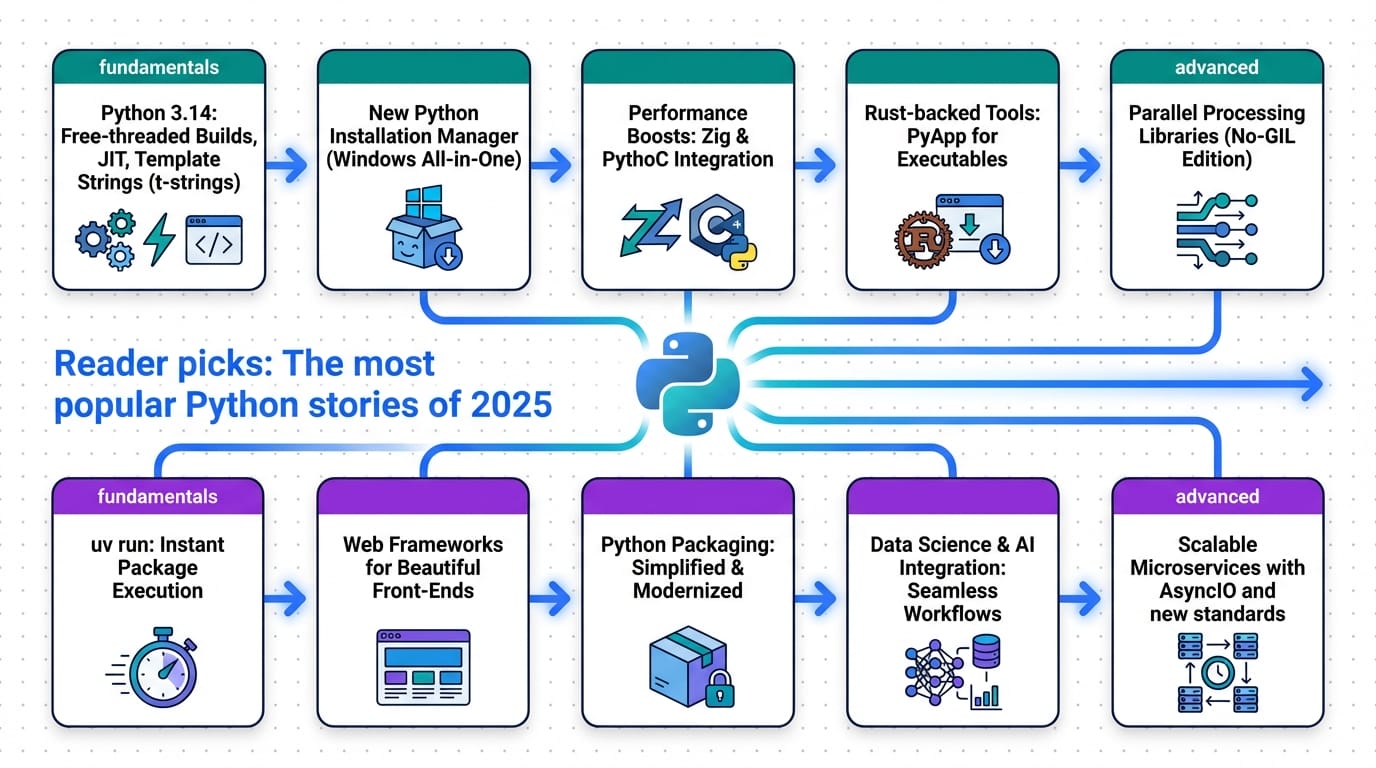
Let’s unpack the magic behind these popular stories using simple metaphors. Think of Python as a bustling city: its core is solid, but traffic (code execution) can jam up. One standout from the roundup is Python’s new native JIT (Just-In-Time compiler)—like adding express lanes to your highways, compiling code on the fly for up to 20% speed boosts. It’s experimental in Python 3.15, but imagine your script running faster without rewriting everything.
Another gem: the Rust-based type checker ‘ty’, now in beta. Typing in Python is like labeling boxes in a warehouse—without it, you grab the wrong one mid-project. ‘Ty’ provides fast, live updates, catching errors before they bite, projected for stable release in 2026. Metaphorically, it’s your warehouse robot sorting things efficiently.
John: From an engineering view, this isn’t hype; it’s about trade-offs. JIT speeds things up but might increase memory use initially—test it on small projects first, like fine-tuning a Llama-3-8B model for quicker inference.
Lila: For beginners, start with simple analogies: quantization in AI (shrinking models for speed) pairs perfectly with these tools, making Python feel like a turbocharged bike instead of a tricycle.
[Important Insight] These mechanisms aren’t isolated; they integrate with AI frameworks like Hugging Face Transformers, enabling seamless workflows.
Use Cases: Bringing 2025’s Python Wins to Life
Let’s get concrete with three realistic scenarios where these stories shine.
Scenario 1: The Data Analyst’s Speed Boost. You’re crunching sales data in a Jupyter notebook. Old way: Slow loops bog down your analysis. With the native JIT, your pandas operations fly—imagine processing a million rows in seconds, not minutes. Pair it with ‘ty’ for type-safe data pipelines, reducing errors in reports.
Scenario 2: The AI Hobbyist’s Playground. Building a chatbot? Integrate these with open-source tools like LangChain. The JIT accelerates model inference, while ‘ty’ ensures your code doesn’t crash mid-conversation. Result: A responsive app without cloud bills skyrocketing.
Scenario 3: The Startup Developer’s Efficiency Hack. Prototyping a web app with FastAPI? These updates mean faster iterations—type checking catches bugs early, and JIT optimizes endpoints. It’s like having an extra dev on your team, cutting deployment time by hours.
John: Real talk: In enterprise, we’ve seen ROI from similar optimizations—think 15-20% faster CI/CD pipelines using GitHub Actions with these Python enhancements.
Lila: And for newcomers, it’s empowering: Start with a simple script, apply these, and watch your confidence grow.
Comparison Table: Old Method vs. New Solution
| Aspect | Old Method (Traditional Python) | New Solution (2025 Innovations) |
|---|---|---|
| Performance | Sluggish execution, manual optimizations needed | Up to 20% faster with native JIT |
| Type Safety | Runtime errors common, optional typing | Fast live checks with ‘ty’ beta |
| AI Integration | Relies on slow third-party libs | Seamless with tools like Hugging Face |
| Ease of Use | Steep learning for optimizations | Intuitive, beginner-friendly updates |
Conclusion: Your Next Steps in the Python Universe
Summing it up, 2025’s top Python stories from InfoWorld aren’t just headlines—they’re blueprints for smarter, faster coding. We’ve contrasted the old pains with new powers, explored mechanisms via metaphors, and seen real use cases that bridge to AI. The mindset shift? Embrace experimentation: Dive into Python 3.15’s JIT for a project, test ‘ty’ on your repo, and watch your efficiency soar. Start small, iterate, and remember, tech evolves—stay curious.
John: Cut through the noise; these are engineering wins that deliver real value.
Lila: You’ve got this—zero to hero, one story at a time.
References & Further Reading
- Reader picks: The most popular Python stories of 2025 | InfoWorld
- Python type checker ty now in beta | InfoWorld
- Get started with Python’s new native JIT | InfoWorld
- Agents, protocols, and vibes: The best AI stories of 2025 | InfoWorld