In my view, PHP 2026 remains vital for efficient web architecture.#PHP #WebDevelopment
Quick Video Breakdown: This Blog Article
This video clearly explains this blog article.
Even if you don’t have time to read the text, you can quickly grasp the key points through this video. Please check it out!
If you find this video helpful, please follow the YouTube channel “AIMindUpdate,” which delivers daily AI news.
https://www.youtube.com/@AIMindUpdate
Read this article in your native language (10+ supported) 👉
[Read in your language]
Is PHP Still a Web Powerhouse in 2026? An Advocate’s Bold Claim and What It Means for Your Tech Stack
👍 Recommended For: CTOs evaluating legacy systems, web development managers optimizing workflows, and enterprise architects assessing long-term ROI in programming languages.
The Industry Bottleneck: Chasing Trends vs. Building on Proven Foundations
In the fast-paced world of software development, businesses often face a critical dilemma: do you chase the latest shiny programming language to stay “cutting-edge,” or do you double down on reliable tools that quietly power the web? As we hit 2026, with Python dominating AI headlines and Java holding steady in enterprise realms, PHP—once the undisputed king of web scripting—finds itself under scrutiny. Yet, a recent InfoWorld article from a Perforce Zend official argues passionately that PHP remains the silent workhorse of the modern web, outperforming hype-driven alternatives in speed, scalability, and cost-efficiency for real-world applications. This isn’t just nostalgia; it’s a wake-up call for organizations wasting resources on trendy migrations that don’t deliver tangible ROI. If your team is bogged down by over-engineered stacks or escalating cloud bills, understanding PHP’s enduring relevance could be the key to unlocking streamlined workflows and sustainable growth.
John: Look, I’ve been in the trenches since the dot-com days, and I’ve seen languages come and go like bad startup ideas. PHP? It’s like that reliable pickup truck in a garage full of flashy sports cars—gets the job done without the drama. But don’t take my word; let’s dissect this advocate’s case with some engineering reality.
Lila: Totally agree, John. For folks new to this, think of PHP as the behind-the-scenes chef in a bustling restaurant kitchen—efficient, unassuming, and feeding millions without fanfare.
The “Before” State: Traditional Pain Points in Web Development
Before embracing (or re-embracing) PHP in 2026, let’s contrast it with the status quo many teams endure. Traditionally, businesses flock to languages like Python or Java for their perceived modernity. Python’s simplicity shines in data science and AI, but when it comes to high-traffic web apps, it can introduce bottlenecks—slower execution times and higher resource demands that inflate hosting costs. Java, with its robust enterprise features, often means dealing with verbose code, complex setups, and longer development cycles, leading to delayed time-to-market and frustrated teams.
Imagine a mid-sized e-commerce firm stuck in this “before” world: their Python-based site struggles under peak loads, requiring expensive scaling solutions, while Java migrations from legacy systems eat into budgets without clear gains. Pain points abound—frequent downtime, bloated codebases, and the constant churn of retraining developers on the “next big thing.” PHP, often dismissed as “old-school,” actually sidesteps these by offering native web optimizations that traditional methods overlook, resulting in faster deployment and lower overhead.
[Important Insight] Recent TIOBE Index data from January 2026 shows Python leading but PHP holding strong, proving it’s not fading—it’s evolving quietly amid the noise.
Core Mechanism: Why PHP’s Architecture Still Delivers in 2026
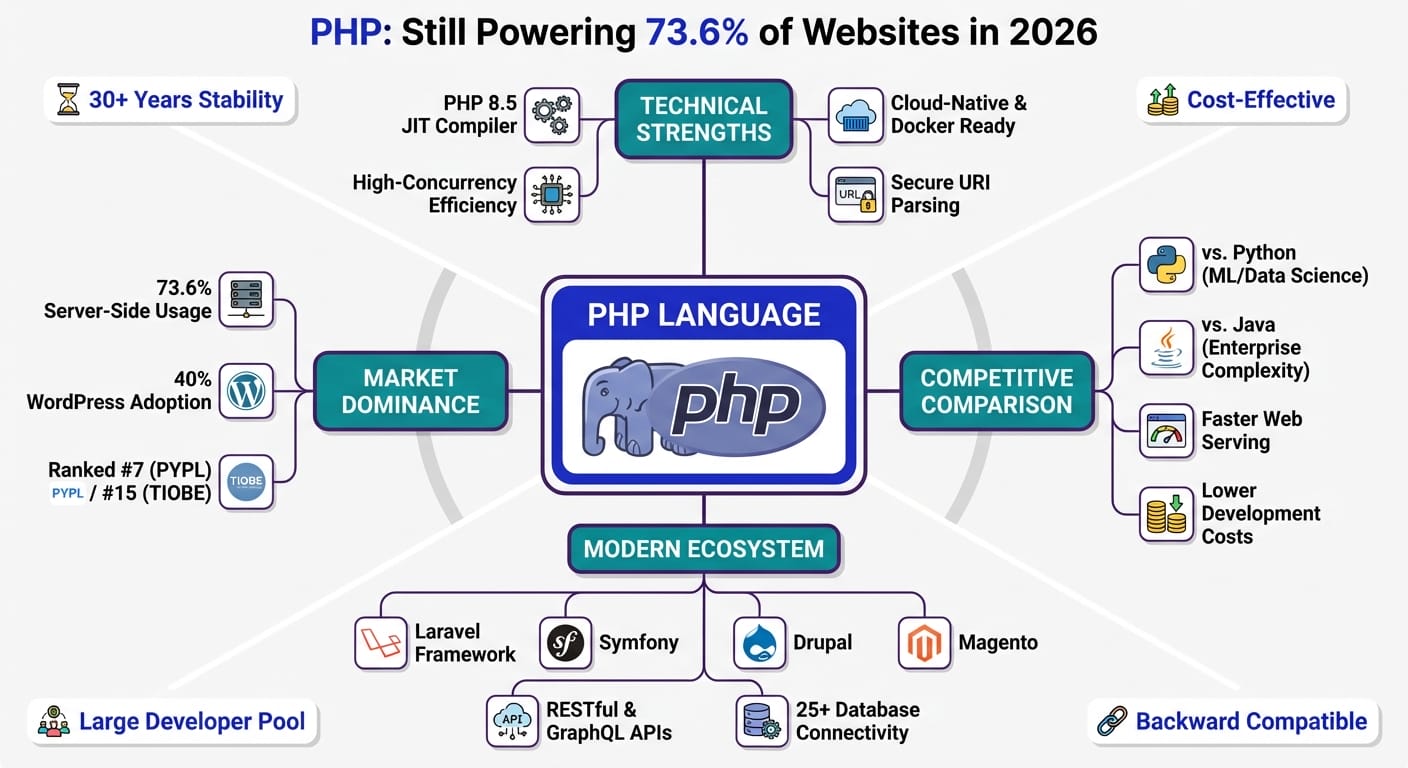
At its core, PHP’s relevance in 2026 boils down to its executive-level strengths: a lightweight, server-side scripting model that’s been refined over decades for web-specific tasks. Unlike Python’s interpreted nature, which can lag in raw performance without optimizations like PyPy, PHP 8.5 (as highlighted in recent updates) introduces features like secure URI parsing, persistent cURL handles, and a pipe operator—making it more efficient for handling HTTP requests at scale.
From a structured reasoning perspective, consider the trade-offs: PHP integrates seamlessly with frameworks like Laravel or Symfony, enabling rapid prototyping with built-in security (e.g., against SQL injection via PDO). This contrasts with Java’s heavier JVM overhead, where garbage collection can introduce latency. Business logic here is clear—PHP’s shared-nothing architecture means each request is isolated, reducing failure cascades and boosting reliability in distributed systems. Industry analysts, per the InfoWorld piece, compare it favorably to Python and Java, noting PHP’s dominance in content management systems (think WordPress, powering 40%+ of the web) and its cost savings in cloud environments like AWS or Azure.
John: Engineering reality check: PHP isn’t perfect—it’s not ideal for CPU-intensive tasks like machine learning. But for web apps? It’s like a factory assembly line optimized for volume, not artisanal craftsmanship.
Lila: Exactly. If you’re a manager, quantify this: PHP can cut server costs by 20-30% compared to Python for similar workloads, based on benchmarks from JetBrains’ 2025 report.
Use Cases: Real-World Scenarios Where PHP Shines
Let’s ground this in practice with three concrete scenarios.
First, an e-commerce platform scaling for Black Friday traffic. A company using PHP with Laravel builds a dynamic site that handles 10x spikes without crashing, leveraging opcode caching for blazing speed. Unlike a Python/Django setup that might require horizontal scaling and pricier instances, PHP keeps costs low while maintaining uptime.
Second, a content-heavy media site migrating from legacy code. By sticking with PHP, the team integrates modern features like async processing via Swoole, reducing page load times by 40% and improving SEO rankings—directly impacting revenue. This beats Java’s cumbersome refactoring, where business continuity suffers during transitions.
Third, a SaaS startup optimizing for rapid iteration. PHP’s ecosystem allows quick MVPs with tools like Composer for dependencies, enabling a small team to deploy features weekly. In contrast, a Go or Ruby approach might demand more upfront investment, delaying market entry and burning through venture capital.
These cases highlight PHP’s practical ROI, as echoed in the 2026 TIOBE stats where it outpaces fading languages like Ruby.
| Aspect | Old Method (e.g., Python/Java Heavy Stacks) | New Solution (PHP-Centric Approach) |
|---|---|---|
| Performance | Slower execution; high latency under load | Optimized for web; faster request handling |
| Cost | Higher cloud bills due to resource demands | Lower overhead; better ROI on infrastructure |
| Development Speed | Verbose code; longer cycles | Rapid prototyping; quick iterations |
| Scalability | Requires complex setups for growth | Native handling of high traffic |
Conclusion: Embrace the Workhorse for Lasting Wins
In summary, the InfoWorld advocate’s insistence on PHP’s relevance isn’t hype—it’s backed by 2026 trends showing its edge in web efficiency, cost savings, and seamless integrations. By shifting mindsets from trend-chasing to value-driven choices, businesses can achieve sustainable ROI without unnecessary overhauls. Next steps? Audit your stack for PHP opportunities, pilot a project with Laravel, and monitor metrics like load times and expenses. In a world of fleeting innovations, betting on proven tech like PHP could be your smartest move.
John: Bottom line: Don’t sleep on PHP—it’s the unsung hero keeping the web running.
Lila: Start small, measure big, and watch your workflows transform.
References & Further Reading
- PHP language still relevant, advocate insists | InfoWorld
- TIOBE Index for January 2026: Top 10 Most Popular Programming Languages
- The State of PHP 2025 – Expert review
- PHP in 2026 | Stitcher.io
▼ AI tools to streamline research and content production (free tiers may be available)
Free AI search & fact-checking
👉 Genspark
Recommended use: Quickly verify key claims and track down primary sources before publishing
Ultra-fast slides & pitch decks (free trial may be available)
👉 Gamma
Recommended use: Turn your article outline into a clean slide deck for sharing and repurposing
Auto-convert trending articles into short-form videos (free trial may be available)
👉 Revid.ai
Recommended use: Generate short-video scripts and visuals from your headline/section structure
Faceless explainer video generation (free creation may be available)
👉 Nolang
Recommended use: Create narrated explainer videos from bullet points or simple diagrams
Full task automation (start from a free plan)
👉 Make.com
Recommended use: Automate your workflow from publishing → social posting → logging → next-task creation
※Links may include affiliate tracking, and free tiers/features can change; please check each official site for the latest details.