
Personally, the NVIDIA Rubin platform proves that robots are finally ready for the real world.#NVIDIA #Robotics
Quick Video Breakdown: This Blog Article
This video clearly explains this blog article.
Even if you don’t have time to read the text, you can quickly grasp the key points through this video. Please check it out!
If you find this video helpful, please follow the YouTube channel “AIMindUpdate,” which delivers daily AI news.
https://www.youtube.com/@AIMindUpdate
Read this article in your native language (10+ supported) 👉
[Read in your language]
Today’s AI Buzz: NVIDIA’s Big Leap into the Future of Robots and Smart Systems
Hey everyone, welcome to another exciting dive into the world of AI! Today, the spotlight is on NVIDIA’s massive announcement at CES 2026 – they’re launching something called the Rubin platform, which is basically a super-powered setup for AI that’s set to revolutionize how robots and smart systems work in the real world. Why does this matter to you? Well, imagine robots that can actually learn from touching and seeing things like we do, making everything from factories to hospitals smarter and safer. It’s not just tech talk; this could change jobs, healthcare, and even how we farm. Stick around as Jon and Lila break it down in simple terms!
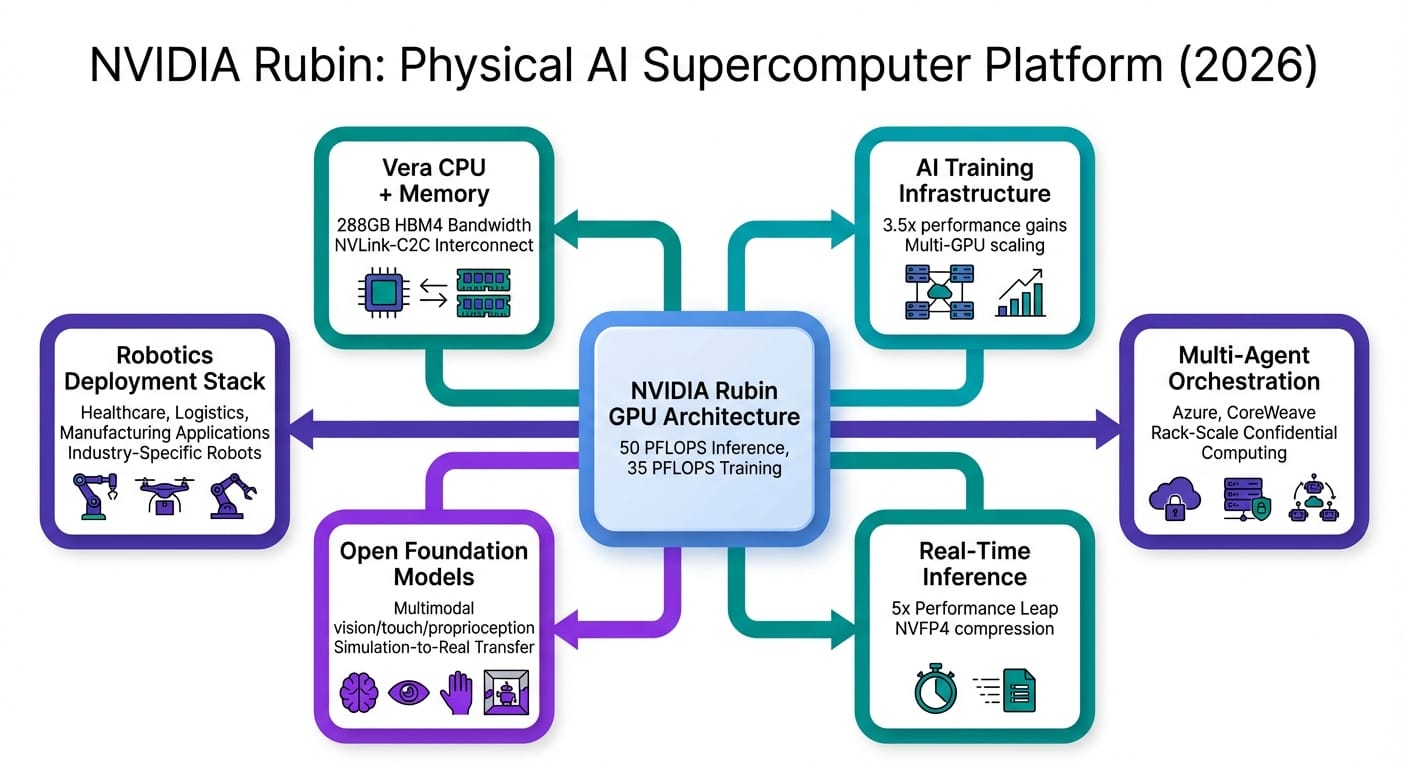
NVIDIA Kicks Off Rubin Platform and Physical AI Revolution
Jon: Alright, Lila, let’s start with the headline-grabber from CES 2026. NVIDIA, the tech giant known for powering everything from video games to supercomputers, just unveiled their Rubin platform. It’s not just a new chip; it’s a whole ecosystem designed to supercharge AI, especially for “physical AI” – that’s AI that interacts with the real world, like robots that can pick up objects or navigate rooms without bumping into everything.
Lila: Physical AI? That sounds cool but a bit sci-fi. Can you explain it like I’m five? Why is this Rubin thing such a big deal?
Jon: Totally! Think of physical AI like teaching a puppy new tricks, but instead of treats, we’re using super-smart computers. Traditionally, robots learn in simulations – fake digital worlds – because real-world training is messy and expensive. But NVIDIA’s Rubin changes that. It’s a platform with six new chips, including advanced GPUs (that’s Graphics Processing Units, the brains for handling tons of data quickly), designed for both training AI models on huge datasets and running them in real-time on robots.
Lila: Okay, got it. So, these chips are like the engine in a car, making everything faster and more efficient. But I heard something about open models and robots for different industries. What’s that about?
Jon: Spot on! NVIDIA is releasing open models – these are pre-trained AI brains that anyone can use and tweak. They’re trained on multimodal data, meaning not just images, but also touch, movement, and senses like how your body knows where your arms are (that’s proprioception). This helps robots handle unpredictable real-world stuff, like a warehouse with boxes everywhere or a hospital room full of equipment.
Lila: Multimodal data? Like how I use my eyes, hands, and balance to cook dinner without burning the house down?
Jon: Exactly! And they’ve got frameworks to bridge the “sim2real gap” – that’s the challenge of moving from simulated training to actual reality without the robot freaking out. Partners are already showing off robots: think surgical assistants that help doctors with precision, autonomous forklifts for warehouses, or even farming bots that pick crops without damaging them. The Rubin platform integrates hardware, software, and cloud services for easy deployment.
Lila: Wow, so this isn’t just for big tech labs? How does it affect everyday people?
Jon: Huge impact! For businesses, it means faster prototyping of robot fleets – no more starting from scratch. In manufacturing, logistics, or healthcare, this could cut costs and boost safety. Imagine fewer workplace injuries because robots handle the heavy lifting. Developers are buzzing on social media; it’s like Christmas for robotics fans. But fact-check time: Based on the latest from CES, Rubin is set for release in the second half of 2026, promising up to 5x greater inference performance and 10x lower cost per token compared to their previous Blackwell platform. It’s not vaporware; it’s in full production mode.
Lila: Inference performance? Break that down.
Jon: Sure – inference is when an AI model uses what it’s learned to make decisions, like a robot deciding how to grab a tool. Rubin makes this faster and cheaper, so more companies can afford it. Why it matters: This pushes AI from digital assistants to physical helpers, potentially creating jobs in robot maintenance while automating repetitive tasks. But we should watch for regulations on safety, especially as these hit real workplaces.
Agentic AI Trends Heating Up for 2026 with Multi-Agent Orchestration
Jon: Next up, let’s talk agentic AI. This is AI that acts like a smart agent – not just answering questions, but planning, deciding, and executing tasks autonomously. Recent reports are calling it a breakout trend for 2026, with a focus on multi-agent systems. It’s like the microservices revolution in software, but for AI.
Lila: Agentic AI? Sounds like secret agents, but for computers. What’s the simple analogy here?
Jon: Haha, close! Imagine a team of specialists: one plans your vacation, another books flights, a third checks the weather. That’s multi-agent orchestration – instead of one massive AI trying to do everything (which can be inefficient), you have specialized “agents” working together. Each handles a niche, like planning or verification, communicating via protocols like Anthropic’s MCP or Google’s A2A, which are like standardized languages for agents to chat.
Lila: So, not one superhero AI, but a squad? Why is this heating up now?
Jon: Yep! Single mega-agents are clunky for complex tasks. Multi-agents are more scalable. Gartner reports a 1,445% spike in inquiries, and the market could grow from $7.8 billion today to $52 billion by 2030. Trends include protocol standardization for easy plug-and-play, bounded autonomy (limits to prevent rogue behavior), and using cost-optimized small models like DeepSeek R1 for efficiency.
Lila: Bounded autonomy? Like putting training wheels on a bike?
Jon: Precisely! It manages risks, especially in real-world use. For businesses, this means rethinking workflows – startups are building agent-native tools, while big players provide the infrastructure. Developers, imagine architecting systems where agents handle low-stakes automation, like scheduling, with humans overseeing high-risk stuff. Fact-check: This is based on 2026 forecasts, but industry observers expect 40% of enterprise apps to embed agents by year-end. It’s moving from pilots to scale, but governance debates are hot – how much human-in-the-loop (HITL) do we need?
Lila: So what? How does this change my life?
Jon: For you, it could mean smarter apps that automate boring tasks, like an AI team managing your finances or work projects. But it raises questions about jobs and ethics – full automation for simple stuff, human-led for complex. It’s exciting, but we need to think critically about oversight.
AI’s Higher Ed Predictions Signal Institutional Shifts
Jon: Finally, let’s look at AI in higher education. Predictions for 2026 suggest AI will reshape universities, focusing on empowering teachers and students rather than replacing them. It’s about practical integration, like AI tutors and admin tools.
Lila: AI in college? Like robot professors? Tell me more without the jargon.
Jon: Not quite robots, but close! Think of AI as a super-assistant: handling rote tasks like grading multiple-choice quizzes, freeing professors for one-on-one mentoring. Predictions include personalized learning paths – AI tailors lessons to your style, whether you’re a visual learner or need extra math help. Also, automated admin to reduce burnout, data analytics to spot at-risk students early, and upskilling programs to teach everyone how to collaborate with AI.
Lila: Personalized learning? Like Netflix recommending shows, but for classes?
Jon: Exactly! It scales education for diverse needs. Fact-check: These are 2026 forecasts from education experts, emphasizing ethical deployment – no AI deciding grades without human checks. Emphasis on training faculty to use AI as a tool, not a threat. Campuses are adopting faster, with governance to ensure fairness.
Lila: Why does this matter to students or parents?
Jon: It could make education more accessible and effective, reducing dropout rates through early warnings and custom support. For teachers, less paperwork means more time inspiring students. But there’s caution – mixed excitement on social media about job impacts. Overall, it’s a shift toward AI as a collaborator in learning.
| Topic | Key Update | Why It Matters |
|---|---|---|
| NVIDIA Rubin Platform | Launch of AI supercomputer with six chips, open models for physical AI, industry robots demoed. | Accelerates real-world AI in jobs, safety, and efficiency; makes robotics accessible beyond labs. |
| Agentic AI Trends | Rise of multi-agent systems, market growth to $52B by 2030, focus on orchestration and autonomy. | Smarter automation for daily tasks; sparks debates on ethics, jobs, and human oversight. |
| AI in Higher Education | Predictions for personalized learning, admin automation, and ethical AI integration. | Makes education more tailored and efficient; empowers teachers and students while addressing burnout. |
In wrapping up today’s AI news, we’re seeing a clear direction: AI is moving from digital brains to physical actions, team-based smarts, and everyday tools like in education. It’s an exciting time, but remember to stay informed and think about how these techs fit into society – what benefits us all? Keep questioning, learning, and maybe even tinkering with some open AI models yourself!

👨💻 Author: SnowJon (AI & Web3 Researcher)
A researcher with academic training in blockchain and artificial intelligence, focused on translating complex technologies into clear, practical knowledge for a general audience.
*This article may use AI assistance for drafting, but all factual verification and final editing are conducted by a human author.
References & Further Reading
- NVIDIA Rubin Platform Announcement
- 7 Agentic AI Trends to Watch in 2026
- 5 Predictions on How AI Will Shape Higher Ed
- NVIDIA CES 2026 Presentation on Rubin
- Nvidia Launches Vera Rubin at CES 2026