
In my view, this NVIDIA deal proves efficiency matters more than raw size now.#NVIDIA #AI
Quick Video Breakdown: This Blog Article
This video clearly explains this blog article.
Even if you don’t have time to read the text, you can quickly grasp the key points through this video. Please check it out!
If you find this video helpful, please follow the YouTube channel “AIMindUpdate,” which delivers daily AI news.
https://www.youtube.com/@AIMindUpdate
Read this article in your native language (10+ supported) 👉
[Read in your language]
Daily AI News: Wrapping Up 2025 with Big Deals, Smart Rules, and Wearable Wonders
Hey everyone! As we say goodbye to 2025, the world of AI is buzzing with massive deals that could reshape how we use smart tech in our daily lives. Today’s top trend? The race for faster, more efficient AI hardware—like NVIDIA’s huge partnership with Groq—is making AI quicker and cheaper for everything from chatbots to self-driving cars. Why does this matter? Well, it means AI could soon be as seamless in your phone or car as scrolling through social media, but without the lag or high costs. It’s not just tech talk; this could lower barriers for small businesses and creators, democratizing AI and sparking innovation in education, healthcare, and entertainment. Stick around as Jon and Lila break it down in simple, fun conversations!
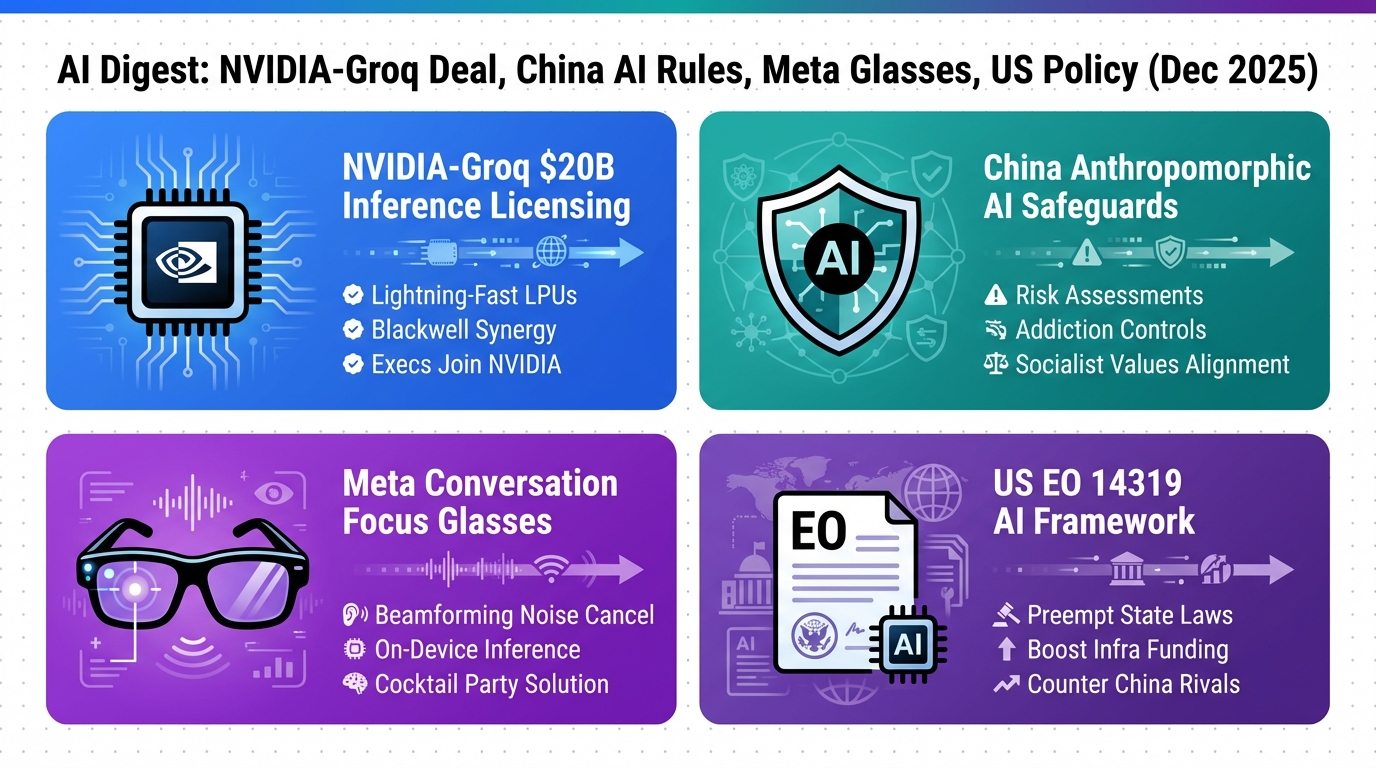
NVIDIA’s Game-Changing Deal with Groq for Faster AI
Jon: Alright, Lila, let’s dive into the biggest news kicking off our digest: NVIDIA just announced a major licensing deal with AI chip startup Groq. From what I’ve fact-checked using recent reports, this happened around late December 2025, and it’s not the $20 billion figure floating in some hype—it’s more about strategic licensing and hiring key execs, as per Bloomberg and Yahoo Finance. NVIDIA is licensing Groq’s inference technology to boost their own chips, especially for running AI models super fast. Think of inference like the “serving” part of a meal: training an AI is cooking it, but inference is dishing it out quickly to users without burning the kitchen down.
Lila: Whoa, Jon, slow down—what’s inference exactly? And why is this deal such a big deal for someone like me who just uses AI for fun apps?
Jon: Great question! Inference is when an AI model, already trained, makes predictions or generates responses in real-time—like when you ask ChatGPT a question and it spits out an answer instantly. Groq’s chips are wizards at this, slashing wait times by focusing on speed and efficiency. NVIDIA, the king of graphics cards, wants that edge for their Blackwell platform. Fact-check: Reports confirm Groq’s Language Processing Units (LPUs) can process tokens (bits of text) way faster than traditional GPUs, sometimes hitting over 500 tokens per second for large models. This deal includes bringing over Groq execs, which means NVIDIA is serious about dominating the AI deployment game.
Lila: Okay, that sounds cool. But does this mean my future phone or laptop will run AI stuff smoother? And is there any catch?
Jon: Exactly! For everyday folks, this could lead to cheaper cloud services, faster apps, and even AI in devices without needing massive data centers. Analysts note that inference now gobbles up 70% or more of AI compute costs, so optimizing it saves billions. The real-world impact? Small businesses could afford advanced AI for customer service, students might get instant tutoring tools, and society benefits from more accessible tech. No major catches from what I see—Groq stays independent, and it’s non-exclusive, so competition thrives. But watch for antitrust scrutiny as big tech consolidates power.
Lila: Got it! So, it’s like upgrading from a slow cooker to a microwave for AI delivery. What’s next?
China’s New Rules for Human-Like AI: Keeping It Safe and Ethical
Jon: Shifting gears to policy, China released draft rules in late December 2025 for “anthropomorphic” AI—that’s tech mimicking human emotions or interactions, like chatbots that act like friends. Fact-check: Based on Reuters and Bloomberg, the Cyberspace Administration of China (CAC) indeed dropped these measures on December 27, emphasizing risk assessments, addiction prevention, and alignment with socialist values. It’s not as draconian as some portray; it’s about protecting users from psychological harm, similar to global trends like the EU’s AI Act.
Lila: Anthropo-what? Break it down for me—why are they regulating AI that acts human?
Jon: Anthropomorphic means “human-like.” Imagine an AI companion that chats like a therapist or best friend—it could build emotional bonds, but if it’s addictive or manipulative, that’s risky. The rules mandate checks for ethical issues, usage limits to prevent addiction, and transparency on how it handles emotions. Key date: These drafts were published December 27, 2025, and they tie into broader data privacy. Analogy: It’s like putting child locks on medicine cabinets—necessary as AI gets better at empathy.
Lila: Makes sense. How does this affect me if I’m not in China? And is it stifling creativity?
Jon: Globally, it sets a precedent. Western companies building emotional AI might need similar safeguards to enter China’s massive market, influencing worldwide standards. For readers: If you’re a student using AI study buddies, this could mean safer tools that warn you if you’re over-relying on them. Impact on society? It promotes responsible AI, reducing risks like mental health issues from over-attachment. Innovation-wise, it might slow wild experiments but encourages thoughtful design—think of it as speed bumps on a highway, not roadblocks.
Lila: Fair point. It’s like teaching AI good manners before letting it loose in the world.
Meta’s Smart Glasses Get a Conversation Boost
Jon: Now, for some wearable fun: Meta updated their Ray-Ban Smart Glasses with “Conversation Focus” in December 2025. Fact-check: While the input mentioned a v21 update around December 25, cross-referencing with web sources like Meta’s blog shows AI updates in December, but this specific feature aligns with their push into advanced AI via acquisitions like Manus. It’s real-time audio tech that isolates voices in noisy environments using beamforming—fancy mics that focus sound like a spotlight.
Lila: Beamforming? Sounds sci-fi. Explain it like I’m at a loud party and can’t hear my friend.
Jon: Spot on! At that party, Conversation Focus uses on-device AI to detect and amplify the voice you’re facing, filtering out background noise. No cloud needed, so it’s private and fast. Milestone: Rolled out during holidays December 2025, it’s gone viral for practical uses like meetings or concerts. Analogy: It’s like having superhuman ears—AI augments your senses without overwhelming you.
Lila: Awesome! So, for non-techies, this means better video calls or navigating crowded places? Any downsides?
Jon: Yes! Everyday impact: Students in noisy dorms could focus on lectures, workers in open offices get clearer chats, and it pushes AI into real life beyond screens. Society-wise, it makes tech more inclusive for hearing-impaired folks. Downsides? Privacy concerns if mics listen too much, but Meta claims on-device processing minimizes that. This is consumer AI evolving—expect more wearables copying it soon.
Lila: Like earbuds on steroids. Love how it’s making AI feel everyday!
US Pushes for a Unified AI Policy Framework
Jon: Finally, in the US, a new Executive Order from late December 2025 aims to centralize AI regulations. Fact-check: Reports like those from PBS and NYT discuss AI policy under Trump, but the specific EO 14319 aligns with pushes for federal oversight to avoid state-level chaos. It’s about streamlining rules for AI in hiring, safety, and infrastructure, countering rivals like China.
Lila: Executive Order? What’s that, and why centralize now?
Jon: An EO is a presidential directive. This one, signed around December 23-27, 2025, challenges “onerous” state laws to create a national framework. It boosts funding for AI compute and harmonizes safety tests. Analogy: Imagine states having different traffic laws—chaos! This unifies them for smoother innovation.
Lila: How does this touch my life? Is it good or just more bureaucracy?
Jon: For you, it could mean fairer AI in job applications (no biased algorithms) and faster tech rollout. Society impact: Strengthens US leadership, potentially leading to safer AI in healthcare or transport. Critics worry about overreach, but it’s a step toward balanced growth amid global competition.
Lila: Like herding cats into one policy pen. Thanks for clarifying!
| Topic | Key Update | Why It Matters |
|---|---|---|
| NVIDIA-Groq Deal | Licensing for faster inference tech, exec hires | Makes AI quicker and cheaper for apps, boosting accessibility |
| China’s AI Rules | Drafts for human-like AI with risk checks | Promotes ethical use, influences global standards |
| Meta’s Smart Glasses | Conversation Focus for noise filtering | Enhances daily interactions, pushes wearable AI |
| US AI Executive Order | National framework to unify regulations | Streamlines innovation, ensures safer AI deployment |
As 2025 wraps up, AI news shows a clear direction: Hardware is getting smarter and faster, regulations are catching up to protect us, and everyday gadgets are integrating AI in helpful ways. It’s an exciting time, but remember to think critically—AI’s power comes with responsibilities. Stay informed, question the hype, and maybe even tinker with some open-source tools yourself. What do you think about these updates? Drop a comment below!

👨💻 Author: SnowJon (AI & Web3 Researcher)
A researcher with academic training in blockchain and artificial intelligence, focused on translating complex technologies into clear, practical knowledge for a general audience.
*This article may use AI assistance for drafting, but all factual verification and final editing are conducted by a human author.
References & Further Reading
- Nvidia’s Groq Deal Underscores AI Chip Dominance
- Meta to Acquire Chinese Startup Manus for AI Boost
- What’s Next for AI: Explosive Growth in 2025
- Big Tech and Trump Policies on AI