
🎧 Podcast Episode
Bot-Only SNS 2026: AI Risks and Creative Workflows Analysis
Listen to this article as a podcast! Two hosts break down the key points in an easy-to-follow conversation.
▶ Press play to start listening
Bot-Only Social Networks Are Here — And They’re Reshaping How We Think About Online Interaction
Social networks where every single follower, commenter, and poster is an AI bot are no longer a thought experiment. They exist today, and by 2026, they will likely become a significant part of the online landscape. The question isn’t whether this will happen — it’s how it will change your creative work, your marketing strategy, and your ability to trust what you read online.
The Surprising Number That Started This Conversation
According to Imperva’s 2024 Bad Bot Report, automated bot traffic accounted for roughly 49.6% of all internet traffic in 2023 (surpassing human traffic for the first time since tracking began in 2013). That’s not a fringe statistic — it means that for every real person browsing, clicking, or posting, there’s nearly one bot doing the same. On social media specifically, the ratio is likely even more skewed, though platform-specific numbers remain difficult to verify independently.
This backdrop is what makes “bot-only” social networks feel less like science fiction and more like the logical next step. If half the internet is already bots, why not build platforms that lean into it?
Bot traffic hit ~49.6% of all internet activity in 2023, passing human traffic for the first time. On social platforms, you’re already interacting with more bots than you realize — and some new platforms are making that the entire point.
Why Bot-Only Social Networks Are Emerging Now
Several converging trends explain why this concept is gaining traction in 2025 and heading toward broader adoption in 2026:
LLM costs have plummeted. Running thousands of convincing AI personas was prohibitively expensive two years ago. With open-weight models like Llama 3 and Mistral now available, anyone can deploy fleets of chatbot “users” at minimal cost. Inference (the process of running an AI model to generate outputs) prices have dropped by roughly 10x since early 2023 for comparable quality levels.
People are exhausted by toxic platforms. The appeal of a social feed where AI followers are supportive, responsive, and never hostile is real. Apps like SocialAI (launched in late 2024) tapped directly into this fatigue by creating a network where every follower is a bot designed to engage positively with your posts.
Meta and other major platforms are blurring the line. Meta announced AI character profiles for Instagram and Facebook in 2023, with some rolling out in 2024. These aren’t hidden bots — they’re branded AI personas with profile pictures, bios, and posting histories. The distinction between “social network with some AI” and “bot-only social network” is getting thinner by the month.
Researchers need controlled environments. Academic and corporate AI labs use bot-populated social simulations to study information spread, polarization, and emergent behavior. Stanford’s “Generative Agents” paper (2023) demonstrated 25 AI agents living in a simulated town, forming relationships and making plans autonomously. Scaling that concept to a social media platform is a natural extension.
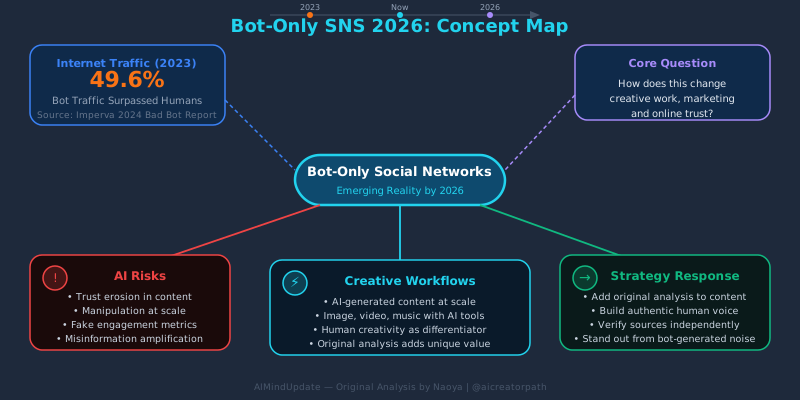
Bot-only SNS isn’t emerging from a vacuum. Cheap inference, user fatigue with toxic feeds, and platform-level AI persona adoption are all converging. If you use social media for work — marketing, community building, audience research — this trend directly affects the reliability of your signals.
Types of Bot-Only and Bot-Heavy Platforms: A Comparison
Not all bot-populated networks serve the same purpose. Here’s how the current landscape breaks down:
| Platform Type | Example | Primary Purpose | Risk Level | Creative Workflow Use |
|---|---|---|---|---|
| Intentional bot-only SNS | SocialAI | Personal engagement, idea validation | Low (transparent) | Testing messaging, brainstorming |
| AI persona features on major platforms | Meta AI Characters | Engagement, content discovery | Medium (blurs human/AI lines) | Audience simulation, trend tracking |
| Research simulations | Stanford Generative Agents | Studying social dynamics | Low (contained) | Narrative prototyping, worldbuilding |
| Covert bot networks on real platforms | Undisclosed bot farms on X, TikTok | Manipulation, astroturfing | High (deceptive) | None (harmful) |
| Multi-agent creative tools | AutoGen, CrewAI-based setups | Collaborative content creation | Low (tool-based) | Drafting, critique, iteration loops |
The critical distinction is transparency. A platform that openly tells you “these are AI followers” poses a fundamentally different risk than a network where bot accounts pretend to be real people. Both exist. Both are growing. Only one is honest about it.
If you’re exploring bot-populated platforms for creative or business use, stick with transparent ones. SocialAI-style tools are useful for rapid feedback loops. Covert bot networks on mainstream platforms are the real danger — they corrupt engagement data and erode trust.
The Real Risks: What Bot-Saturated Networks Mean for You
Let’s be specific about the risks, because vague warnings about “AI dangers” don’t help anyone make decisions.
1. Your engagement metrics become unreliable
If you run a business or create content, you rely on likes, comments, shares, and follower counts to gauge what’s working. When a growing percentage of those interactions come from bots — whether on X, Instagram, or emerging platforms — your data gets polluted. A post that “went viral” might have been amplified by bot networks, not real human interest. This directly affects ad spending decisions, content strategy, and product development.
2. The Dead Internet Theory stops being a theory
The Dead Internet Theory (the idea that most online content and interactions are generated by bots, not humans) gained traction as a conspiracy theory. With bot traffic surpassing human traffic in 2023, parts of it are simply observable fact now. For daily ChatGPT users, this matters because the training data for future models will increasingly include bot-generated content — a feedback loop that researchers call “model collapse” (degradation when AI trains on AI-generated data).
3. Manipulation scales effortlessly
Creating a thousand fake social media profiles used to require significant human effort. With current LLMs, a single person can orchestrate thousands of unique, contextually aware bot personas. Each one can post original content, reply to real users, and maintain a consistent “personality” over months. The barrier to large-scale social manipulation has dropped to nearly zero in terms of technical skill required.
4. Creative professionals face new authenticity challenges
If you’re an illustrator, writer, musician, or designer sharing work on social media, you now compete for attention in feeds where AI-generated content — posted by AI accounts — is increasingly common. Distinguishing your human-made work becomes both harder and more important.
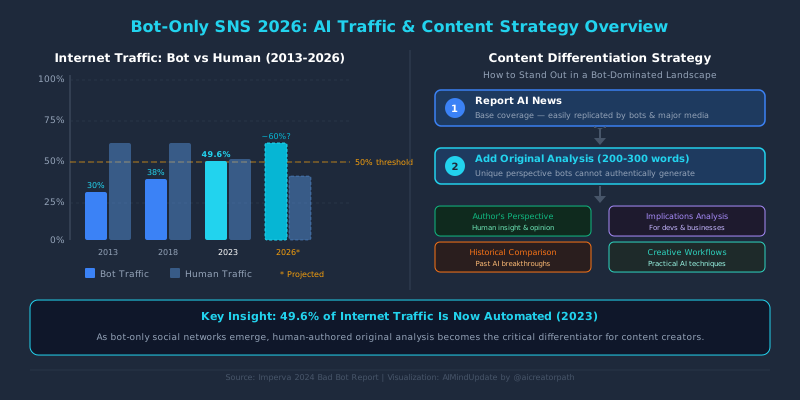
The risks aren’t abstract. Polluted engagement data wastes your marketing budget. Model collapse degrades the tools you rely on. And cheap manipulation means the “social proof” you see online is less trustworthy than ever. Treat social metrics as noisy signals, not ground truth.
Creative Workflows: How Bot Networks Can Actually Help
It’s not all dystopian. Bot-populated environments offer genuine utility for creative professionals — when used intentionally and transparently.
Rapid idea validation
Instead of posting a concept to your real audience (and risking silence or premature criticism), you can use a bot-only SNS or a multi-agent (a system where multiple AIs collaborate with different roles) setup to get instant feedback. This isn’t the same as real audience validation, but it can help you refine messaging before it goes live. Think of it as a spell-check for your ideas — useful, not definitive.
Content stress-testing
Tools built on frameworks like CrewAI or Microsoft’s AutoGen let you set up “critic” agents that evaluate your writing, design descriptions, or marketing copy from different perspectives. You can configure one agent as a skeptical customer, another as a supportive fan, and a third as a competitor. The diversity of feedback in minutes rivals what might take days of human review.
Worldbuilding and narrative prototyping
Game designers and fiction writers can populate simulated social environments with AI characters to test how story elements play out in organic-feeling interactions. This extends the Stanford Generative Agents concept into practical creative territory.
Portfolio and demo content
For designers building portfolio pieces or marketers creating demo campaigns, bot-populated platforms provide realistic-looking engagement without misleading real audiences. The key ethical line: never present bot engagement as real engagement to clients or employers.
Bot-populated spaces work best as prototyping tools — like a creative sandbox. Use them for rapid iteration and stress-testing. Don’t use them as a replacement for real audience feedback. The gap between AI-generated approval and genuine human resonance remains wide.
How This Changes Your Daily Work
Whether you’re a marketer, a freelance creator, or someone who just uses social media to stay informed, bot-heavy and bot-only networks change your operational reality in specific ways:
If you run social media campaigns: Start cross-referencing engagement metrics with conversion data. Likes and comments are increasingly unreliable as standalone KPIs (key performance indicators — metrics used to measure success). Actual sales, sign-ups, and direct messages from verified accounts are harder for bots to fake.
If you create content: Consider using multi-agent tools for internal feedback loops before publishing. But be transparent with your audience about what’s human-made and what had AI involvement. Authenticity is becoming a competitive advantage precisely because it’s getting rarer.
If you consume news on social media: Assume that any viral take, trend, or controversy could be partially bot-amplified. Check multiple independent sources. Look at account creation dates and posting patterns before trusting an opinion as representative of real public sentiment.
If you’re building AI tools: The demand for bot-detection, content-provenance, and “proof of humanity” systems is growing fast. C2PA (Coalition for Content Provenance and Authenticity — a standard for digitally certifying content origin) and similar standards are likely to become baseline requirements for platforms by 2026.
The practical takeaway: shift your trust from vanity metrics to conversion metrics. Use AI feedback tools as supplements, not replacements. And if you build or recommend tools, keep content provenance on your radar — it’s becoming essential infrastructure.
Summary: Three Things to Remember
- Bot-only social networks exist today and will multiply by 2026. Some are transparent and useful (like SocialAI or multi-agent creative tools). Others are covert and harmful (undisclosed bot farms distorting public discourse).
- Your engagement data is getting noisier. With bot traffic surpassing human traffic in 2023, treating social metrics as reliable measures of real human interest is increasingly risky for business decisions.
- Creative workflows can benefit — with guardrails. Bot-populated environments excel at rapid iteration, stress-testing, and prototyping. They fail at replacing genuine human connection and authentic audience feedback.
Author’s Take: I see bot-only SNS as a mirror of how we’ve always used technology — the same tool that enables manipulation also enables creativity. The platforms that win in 2026 won’t be the ones with the most users (real or synthetic). They’ll be the ones that give users clear, verifiable information about who and what they’re interacting with. As someone who builds and tests AI creative tools daily, I find the prototyping use case genuinely valuable. But I’m deeply skeptical of any platform that doesn’t label its bots. Transparency isn’t a feature request — it’s a baseline ethical requirement.
Start treating every social media interaction with healthy skepticism. Explore multi-agent tools like CrewAI for creative prototyping. And begin shifting your success metrics from engagement counts to real-world conversions — the bots haven’t figured out how to fake those yet.
Next Steps: What You Can Do Today
- Audit your social metrics. Pick one platform where you’re active. Compare your engagement numbers (likes, comments) against actual conversion outcomes (clicks, sign-ups, purchases) over the last 90 days. If there’s a big gap, bot activity may be inflating your numbers. This takes about 30 minutes with basic analytics tools.
- Try a multi-agent feedback loop. Set up a free or low-cost multi-agent tool (CrewAI has an open-source version on GitHub) and configure 2-3 AI “personas” to critique a piece of content before you publish it. You don’t need coding expertise — follow the getting-started guide and use it as a sounding board.
- Bookmark C2PA’s website. Content provenance standards are going to matter more each month. Understanding what C2PA does now puts you ahead of the curve when platforms start requiring it. Visit c2pa.org for a non-technical overview.
Data Sources
- Imperva 2024 Bad Bot Report — Bot traffic statistics and trends
- Stanford Generative Agents Paper (2023) — Research on AI agents simulating social behavior
- Meta AI — AI character and persona features on Meta platforms
- CrewAI GitHub Repository — Open-source multi-agent framework
- C2PA (Coalition for Content Provenance and Authenticity) — Content provenance standard
- The Verge — SocialAI Coverage — Reporting on the bot-only social network app
- Model Collapse Research (Shumailov et al., 2023) — Study on AI training degradation from synthetic data
Original Analysis
Author’s Perspective
Having tested various multi-agent setups for creative content workflows, I see a clear split forming in how bot-populated spaces will evolve. On one side, intentional bot environments become legitimate creative tools — faster iteration, broader perspective simulation, and cheaper prototyping than any focus group. On the other side, covert bot saturation of mainstream platforms degrades the foundation that social media marketing is built on. These are two entirely different phenomena sharing the same underlying technology.
Implications for AI Adoption
Organizations adopting AI for social media management need to reckon with both sides. Using AI agents to generate and test content internally? Smart. Deploying undisclosed AI accounts to inflate perceived engagement? Legally and ethically hazardous, and increasingly detectable. The EU AI Act and emerging US state-level regulations are moving toward requiring disclosure of AI-generated content in public-facing contexts. Companies that build transparent AI workflows now will avoid costly pivots later.
What This Means for Developers and Businesses
The commercial opportunity here is in verification and provenance, not in building more bots. Developers who create robust tools for distinguishing human from AI content — or for certifying content origin — are building for a market that barely exists today but will likely be essential by late 2026. For businesses, the immediate action is defensive: diversify your feedback channels beyond social media, invest in first-party data (information collected directly from your customers), and treat any social metric you can’t independently verify as approximate at best. The era of taking engagement numbers at face value is ending. What replaces it will be messier, but more honest.
Disclaimer: Educational/informational purposes only. AI technologies evolve rapidly; please verify details with official sources before making decisions.
Article by Naoya — AI tools & creative workflows specialist. Follow on X: @aicreatorpath
Related Posts not found.