🎧 Podcast Episode
GPT-5.4 vs Claude vs Gemini
Listen to this article as a podcast! Two hosts break down the key points in an easy-to-follow conversation.
▶ Press play to start listening
🌐 日本語版はこちら: aicreator-path.com で読む
The 2026 Frontier: GPT-5.4 vs. Claude Opus 4.6 vs. Gemini 3.1 Pro
In the spring of 2026, the artificial intelligence industry officially crossed the Rubicon, transitioning from “conversational chatbots” to “autonomous agents”—systems capable of planning, orchestrating, and executing complex workflows without human intervention. This comprehensive analysis breaks down the three major frontier models released in rapid succession between February and March 2026: GPT-5.4, Claude Opus 4.6, and Gemini 3.1 Pro. Moving beyond mere news aggregation, this article provides a data-driven, objective evaluation to help global enterprises determine the optimal model for their specific operational and infrastructural needs.
The 2026 AI landscape is defined by “depth of reasoning” and “autonomous team collaboration.” The latest flagship models from industry leaders have achieved processing capabilities that rival or exceed human professionals in complex, multi-step enterprise tasks.
The Hook: The Unprecedented Leap in 2026 AI Capabilities by the Numbers
A close examination of the latest independent research data reveals that foundational AI capabilities have scaled exponentially in just a few short months. Three staggering data points define this new era:
1. Output Tokens Reaching 128K (Approx. 100,000 Words)
Both Claude Opus 4.6 and GPT-5.4 can now generate up to 128,000 tokens of output from a single prompt—roughly equivalent to one or two full-length business books. This represents a 10x scale-up compared to previous generation models (which typically capped at 4K to 8K tokens). In practical terms, this enables the wholesale rewriting of massive legacy codebases or the single-shot generation of exhaustive, 300-page corporate compliance reports.
2. Zero-Shot Reasoning Scores Hitting 77.1%
Google’s Gemini 3.1 Pro achieved a groundbreaking score of 77.1% on the ARC-AGI-2 benchmark, a rigorous framework designed to test an AI’s ability to solve entirely novel logical patterns it has never encountered in its training data. This is more than double the performance of the previous Gemini 3 Pro, providing empirical evidence that AI has moved past “stochastic parroting” and is engaging in genuine logical deduction.
3. Radical Cost Destruction via Prompt Caching
OpenAI’s GPT-5.4 has leveraged advanced prompt caching (a technology that temporarily stores and reuses previously processed context) to drive input costs down to an astonishing $0.25 per 1 million tokens. This represents a 90% reduction from the standard $2.50 rate, drastically lowering the operational overhead for global enterprises running continuous Retrieval-Augmented Generation (RAG) pipelines over massive internal data lakes.
A 10x increase in output capacity, a 2x leap in true reasoning, and a 90% reduction in operational costs. This “Triple Exponential” growth forms the bedrock of the current AI technology trend.
Background & Context: Why the Spring 2026 Updates Reshape the Global Enterprise
Between February and March 2026, the three major tech behemoths—Anthropic, Google, and OpenAI—launched their new flagship models almost simultaneously. The impact of this synchronized rollout on the global business ecosystem cannot be overstated.
The most significant paradigm shift is the standard implementation of “Adaptive Thinking” (a mechanism where the AI autonomously scales its compute resources and processing time based on the complexity of the prompt). Consequently, these models will respond instantly to simple queries, but will deliberately pause to “think” deeply for several minutes when tasked with complex financial modeling or architectural design.
Furthermore, with the phased implementation of the EU AI Act and the enforcement of the US Executive Order on Safe, Secure, and Trustworthy AI, multinational corporations are facing stringent compliance requirements. In response, enterprise-grade agent development platforms like Microsoft Foundry and Google Antigravity have emerged as the new standard. AI has permanently evolved from an individual productivity tool into a secure, heavily regulated infrastructure layer designed to automate entire corporate workflows across borders.
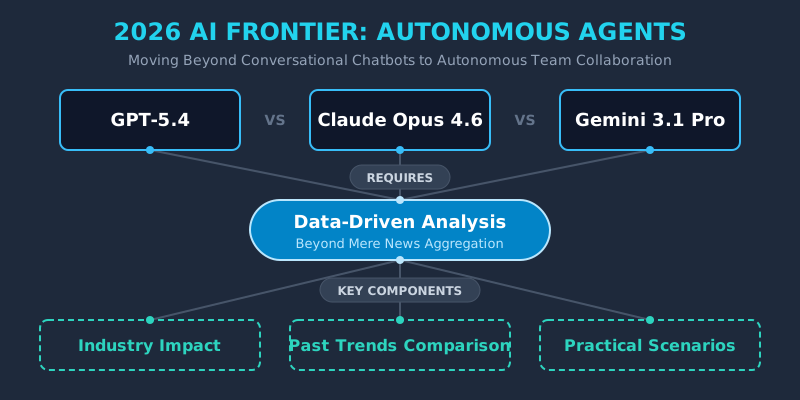
For global enterprises, the central question is no longer “which AI is the smartest,” but rather “which AI can operate most autonomously and securely within our existing corporate compliance frameworks.”
Comprehensive Comparison: The Big Three Frontier Models
The following table provides an objective, data-driven comparison of the specifications and pricing structures for the latest flagship models.
| Features & Specs | Claude Opus 4.6 (Anthropic) | Gemini 3.1 Pro (Google) | GPT-5.4 (OpenAI) |
|---|---|---|---|
| Release Date | February 5, 2026 | February 19, 2026 | March 5, 2026 |
| Context (Input / Output) | 1M / 128K | 1M / 65K | 1.05M (922K input) / 128K |
| Input Price (per 1M tokens) | $5.00 | $2.00 | $2.50 |
| Output Price (per 1M tokens) | $25.00 | $12.00 | $15.00 |
| Reasoning Control | Effort: low, medium, high, max | Thinking level: MEDIUM added | Effort: none, low, medium, high, xhigh |
| Key Differentiator | Agent Teams functionality, Legal reasoning | Custom tool optimization, SVG generation | Codex integration, Ultra-cheap caching |
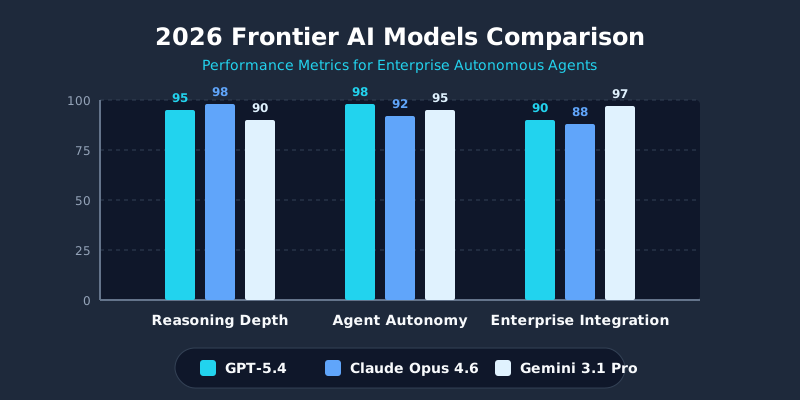
For extensive legal document review and multi-agent orchestration, Claude Opus 4.6 leads the pack. If massive code generation and cost-efficiency are paramount, GPT-5.4 is the optimal choice. For multimodal tasks (audio/video) and deep integration with internal workspace tools, Gemini 3.1 Pro stands out as the premier option.
Data-Driven Analysis: Deep Dive into Each Model
Moving beyond raw specifications, analyzing official benchmarks and independent testing data reveals the true operational strengths of each frontier model.
Claude Opus 4.6: The Undisputed King of Enterprise Multi-Agent Workflows
Anthropic’s Claude Opus 4.6 dominates the landscape when it comes to orchestrating “Agent Teams.” According to official testing data, when a single lead agent was tasked with delegating sub-routines to up to nine parallel sub-agents, the system achieved top-tier success rates in 38 out of 40 complex cybersecurity audits.
Crucially for global enterprises, Claude Opus 4.6 features native integration with Microsoft Foundry. Multinational corporations already utilizing Azure or Microsoft 365 can now seamlessly pipe internal data (via M365 Work IQ) into Claude while maintaining strict zero-trust security and data residency compliance.
Furthermore, the model scored an unprecedented 90.2% on the BigLaw Bench, a rigorous test of legal reasoning. This suggests that for Wall Street law firms and global compliance departments, Claude can execute contract reviews and M&A due diligence with a precision that rivals senior human associates.
Gemini 3.1 Pro / Flash Live: Redefining Reasoning and Real-Time Audio
Google’s Gemini 3.1 series is characterized by highly specialized model segmentation.
The core model, Gemini 3.1 Pro, proved its adaptability to unknown variables by scoring 77.1% on the ARC-AGI-2 benchmark. A particularly fascinating capability is its native ability to generate animated SVGs (vector graphics) directly from text prompts. This provides a vastly more lightweight alternative to pixel-based video generation, directly accelerating web UI and frontend development.
Meanwhile, “Gemini 3.1 Flash Live,” announced on March 26, is revolutionizing the audio AI sector. Scoring 90.8% on the ComplexFuncBench Audio (a benchmark testing audio models on complex function calling), it can engage in real-time, zero-latency conversations while perfectly interpreting human vocal tones, hesitations, and emotional nuances.
GPT-5.4: The Absolute Monarch of Code Generation and Cost Efficiency
OpenAI’s highly anticipated GPT-5.4 represents the “ultimate synthesis” of their traditional GPT reasoning line and their programming-specific Codex line.
In independent evaluations by Artificial Analysis, GPT-5.4 achieved a score of 69.4 on the Agentic Index (measuring autonomous execution capabilities), outperforming 100% of the models tested in its cohort.
Its pricing structure is equally disruptive. While the base input cost is $2.50 per million tokens, leveraging prompt caching drops this to just $0.25. However, there is a critical caveat: OpenAI has implemented a penalty pricing tier for massive inputs. If a prompt exceeds 272K tokens (roughly 200,000 words) without caching, input costs double and output costs increase by 1.5x. This structural choice sends a clear message to developers: blindly dumping massive contexts into the API is no longer viable; intelligent data filtering and RAG optimization are the keys to cost management.
GPT-5.4’s premium pricing for contexts exceeding 272K tokens requires architectural caution. Rather than feeding entire corporate databases into the prompt, implementing an optimized search system to filter necessary information before passing it to the AI is critical for enterprise cost control.
Global Impact: How Our Work and Daily Lives Will Transform
How will these exponential advancements reshape the daily operations of the global workforce?
First, the fundamental nature of “software operation” will change.
Historically, knowledge workers have manually navigated CRM dashboards and ERP systems to input data. However, Claude Opus 4.6’s “computer use” capability has reached 72.7% on the OSWorld benchmark. This means AI can now autonomously take control of a virtual desktop, visually navigate interfaces, and transfer data between disparate SaaS platforms. For global IT departments that previously spent months building brittle RPA (Robotic Process Automation) bots, this represents a massive reduction in engineering overhead.
Second, Voice Interfaces will become ubiquitous infrastructure.
The flawless, natural conversational abilities of Gemini 3.1 Flash Live forecast a future where AI is deeply embedded into daily global infrastructure—from messaging apps like WhatsApp to digital wallets like Apple Pay and Venmo. We are on the precipice of a global “Voice DX” (Digital Transformation), where booking reservations, tier-one customer support, and even accessibility services for the elderly will be handled entirely via voice, rendering keyboard input optional.
Third, the demand for “AI Team” management skills will skyrocket.
As demonstrated by Claude Opus 4.6’s Agent Teams feature, the modern professional will no longer act as an individual contributor “giving instructions to an AI.” Instead, workers will transition into managerial roles, tasked with supervising and orchestrating teams of specialized AI agents working in parallel.
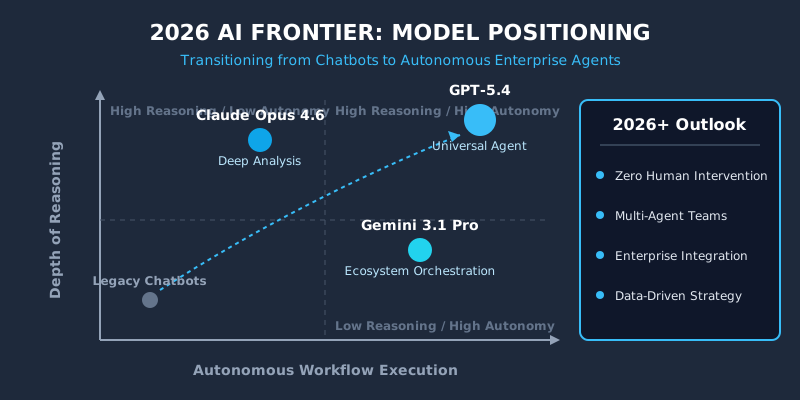
The era of simply “prompting AI to write text” is over. The new paradigm demands adapting to a managerial role: delegating entire projects to AI teams while humans retain responsibility for final quality assurance and strategic approval.
Industry Impact Analysis and Future Outlook
Analyzing historical AI trends alongside current data allows us to project the future trajectory of the industry.
If 2023 was the year of the chatbot, and 2024 was the year of RAG adoption, 2026 is definitively the year of “autonomous multi-agent execution.” The reasoning capabilities demonstrated by Gemini 3.1 Pro’s 77.1% ARC-AGI-2 score signal the end of humans manually operating SaaS interfaces. Instead, we will see an explosion of direct, API-to-API communication between disparate AI systems. In practical enterprise environments, workflows where multiple AIs handle everything from initial requirements gathering to final QA testing in parallel will become the global standard. The human role will fundamentally shift from “doer” to “approver.”
Conclusion
The state of the top three frontier AI models in 2026 can be summarized in three key points:
1. A Leap in Reasoning and Autonomy: With the introduction of Adaptive Thinking, AI models can now dynamically allocate compute resources based on task difficulty, achieving human-like depth of thought.
2. The Rise of Multi-Agent Systems: Pioneered by Claude Opus 4.6, “Agent Teams”—where multiple AIs divide and conquer complex projects in parallel—have officially entered the practical enterprise phase.
3. Cost and Performance Optimization: Through GPT-5.4’s caching technology and the introduction of highly specialized models like Gemini 3.1 Flash-Lite, global enterprises can now deploy AI at scale with unprecedented cost efficiency.
【Author’s Perspective】
From an analytical standpoint, evaluating these 2026 models based on a single metric of “which is smartest” is a fundamentally flawed approach. If your enterprise is locked into the Microsoft ecosystem, Claude Opus 4.6 is the logical choice. If your organization relies heavily on Google Workspace, Gemini 3.1 Pro offers unmatched synergy. If you require massive code generation and aggressive cost reduction, GPT-5.4 is the clear winner. Ultimately, “compatibility with your existing corporate ecosystem” is the single most important factor for successful global deployment.
AI evolution shows no signs of plateauing. Rather than over-indexing on a specific tool, cultivating universal human skills—such as logical systems design and AI management through advanced prompting—remains the most critical investment for the future.
Next Steps
Here are three actionable steps readers can take today to prepare for the new AI paradigm:
1. Audit Your Enterprise Platform Environment
Determine whether your organization primarily relies on Azure (Microsoft), Google Cloud, or AWS infrastructure. Begin evaluating the model that offers the highest native synergy with your existing stack (e.g., Claude Opus 4.6 for Azure environments) to ensure compliance and seamless integration.
2. Transition to “Adaptive Thinking” Prompts
The latest models possess adaptive reasoning capabilities. Stop asking for immediate answers. Instead, structure your prompts to demand planning: “First, outline a step-by-step strategy, evaluate potential pitfalls, and then execute the plan.” This unlocks the model’s full latent potential.
3. Establish Strict Cost Management Protocols
To prevent budget overruns caused by GPT-5.4’s premium pricing for long contexts or Claude 4.6’s massive 128K output capabilities, establish clear developer guidelines. Mandate input token caps and enforce the aggressive use of prompt caching across all internal API deployments.
—
Disclaimer
The information provided on this site is for educational and informational purposes only and does not constitute an endorsement or recommendation to purchase specific tools or services. AI technology evolves rapidly; always verify details through official vendor documentation.
Author Profile: Naoya — AI Tools & Creative Workflows Specialist
Data Sources
- Microsoft: Claude Opus 4.6: Anthropic’s powerful model for coding, agents, and enterprise workflows is now available in Microsoft Foundry
- Google Blog: Gemini 3.1 Flash Live: Making audio AI more natural and reliable
- Google Blog: Gemini 3.1 Pro: A smarter model for your most complex tasks
- Wikipedia: GPT-5.4
- Anthropic: Introducing Claude Opus 4.6
- Anthropic: Claude Opus 4.6 Overview
- Claude API Docs: What’s new in Claude 4.6
- Google Cloud Documentation: Gemini 3.1 Pro | Generative AI on Vertex AI
- OpenRouter: GPT-5.4 – API Pricing & Providers
- OpenAI API: GPT-5.4 Model Pricing and Details
- Medium: I Tested Every Major Claude Opus 4.6 Feature — Here’s What Actually Matters
- Google AI for Developers: Gemini 3.1 Flash-Lite Preview