
Read this article in your native language (10+ supported) 👉
[Read in your language]
Weighing the benefits of AWS Lambda’s durable functions
As of 2026-02-04T17:12:44.782Z.
Jon: Lila, AWS just rolled out durable functions for Lambda, letting serverless code run for hours with automatic checkpoints and retries. It’s like giving your cloud functions a safety net for long-haul jobs that used to crash and burn.
Lila: Sounds handy, but why does this hit crypto devs where it hurts? We’re always wrestling with unreliable nodes and flaky oracles.
Jon: In crypto terms, imagine building a Cosmos SDK chain—where modules like staking or governance need rock-solid state transitions. Durable functions could offload heavy computations from your validators, like crunching IBC (Inter-Blockchain Communication, secure token transfers between chains) proofs without dropping blocks. No more manual restarts on failures; AWS handles orchestration.
Lila: So readers care because it bridges serverless ease to blockchain’s always-on demands? By the end, we’ll verify how to test this for a Cosmos app without vendor lock-in.
Lila: Takeaway: Durable Lambdas promise reliability for crypto workloads. Next, what’s the core problem they solve in our world?
The Crypto Problem (The Why)
Jon: Crypto builders face the “long-running reliability trap.” Validators on Cosmos SDK chains must process state changes deterministically via ABCI (Application Blockchain Interface, socket protocol linking app logic to consensus). But off-chain tasks—like oracle feeds or cross-chain IBC relaying—can timeout, leading to forks or lost data.
Lila: Plain English: Chains demand perfect uptime, but real-world jobs like data aggregation take minutes or hours. One flake, and your PoS (Proof of Stake, validators securing via staked tokens) slashing kicks in.
Jon: Exactly, like a factory line where one jammed machine halts the whole shift. Durable functions auto-save progress, resume from checkpoints, perfect for DeFi simulators or MEV (Maximal Extractable Value, profit from transaction ordering) bots that can’t afford downtime.
Lila: Got it—solves flaky long jobs without babysitting. Teaser: How does it actually wire into Cosmos modules?
Under the Hood: How it Works
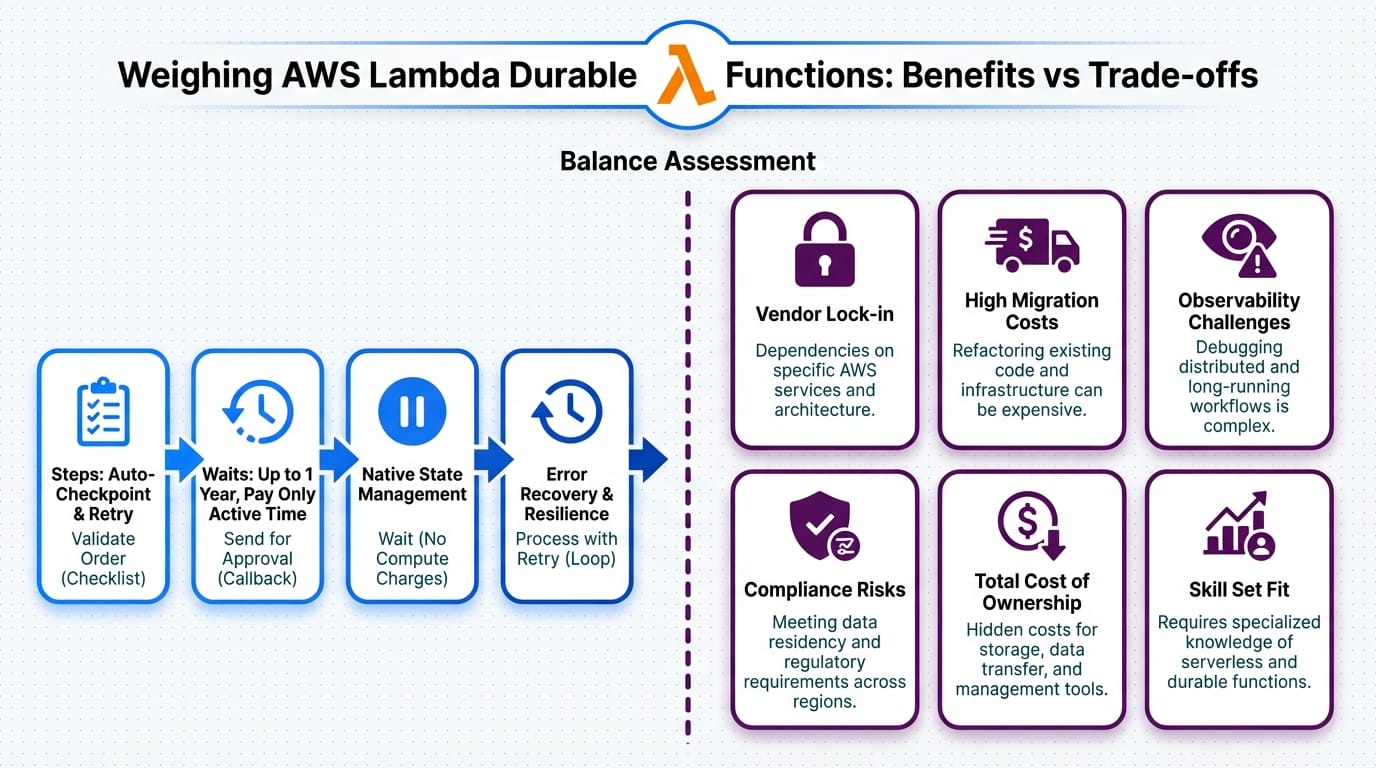
Jon: Durable functions extend Lambda with orchestration: you write async code, AWS adds state persistence via DynamoDB snapshots every few seconds. In Cosmos terms, picture checkpointing a custom x/module during IBC packet processing—resume if AWS retries on outage.
Lila: What must be true for this to work in blockchain? Like, idempotency for retries?
Jon: Spot on: Functions must be idempotent (safe to rerun without side effects), matching Cosmos SDK’s deterministic state transitions. Security assumes AWS custody for checkpoints—not on-chain yet.
Lila: What can break it? Vendor outages or state bloat?
Jon: Breaks if your logic isn’t retry-safe, or costs explode from frequent snapshots. For Cosmos, bridge risk if piping data to CometBFT (Cosmos consensus engine).
- Common misunderstanding: Durable functions replace blockchains—they’re off-chain helpers, not sovereign validators.
- Common misunderstanding: “Free reliability”—still pay per invocation; no magic for crypto’s finality needs.
- Common misunderstanding: Fully decentralized—AWS is centralized custody for state.
- Decision Lens: Does it fit Cosmos SDK? Check if your app-state is small, retryable.
- Pros: Scales heavy lifts like governance sims; cons: Latency from AWS layers.
- Security: Use IAM roles tightly; verify against oracle risks.
- Interoperability: Pairs well with IBC for hybrid apps.
- Cost: Monitor for long runs; start with testnets.
Lila: Takeaway: Checkpoints enable reliable off-chain for Cosmos modules, but demands idempotent design. Up next: Verification steps.
On-Chain & Reality Checks
Lila: How do we verify this isn’t hype for crypto builders?
Jon: Start with AWS console tests, then hybrid Cosmos proofs. Concrete checks below.
5-min checks:
- Deploy sample durable Lambda via AWS CLI; trigger timeout—confirms auto-resume.
- Check DynamoDB snapshots: Verify state persistence post-failure.
15-min checks:
- Integrate with Cosmos SDK starport: Run mock IBC relay, simulate outage.
- Mint test ATOM on localnet; process via durable func—scan explorer for consistency.
- Monitor CloudWatch: Fees, latency vs direct node calls.
Weekly checks:
- Load test with 1000 txns; measure TVL (Total Value Locked, assets in protocol) stability.
- Scan active addresses on Cosmos Hub explorer (e.g., mintscan.io); cross-check Lambda outputs.
- Audit logs for anomalies; compare vs pure on-chain runs.
Lila: Takeaway: Quick console tests prove basics; Cosmos explorers validate integration. Who’s using it today?
Use Cases & Who Actually Uses It
Lila: So who uses this—traders, builders, normal users?
Jon: Builders first: Cosmos devs offloading governance vote tallies or IBC light-client verifications. Improves liquidity by reliable bridges without bloating validators.
Lila: Everyday angle? Like DeFi dashboards crunching volatility data.
Jon: Yes—spot vs derivatives feeds without node crashes. Traders get real-time catalysts; no ROI hype, just uptime.
Lila: Takeaway: Powers devs and apps, boosts market structure reliability. Now, risks?
Risk Map + Invalidation Signals
Jon: [Important Insight] Risks: Smart-contract risk—not applicable (off-chain). Bridge risk: High if feeding Cosmos state. Oracle risk: AWS as trusted feeder. Custody risk: Centralized snapshots. Regulatory: Cloud compliance audits. Geopolitical: AWS outages. Headline risk: Vendor breach.
Jon: Falsifiers: 1) AWS outage >1hr with data loss. 2) Cost >2x on-chain equiv. 3) Failed idempotency in Cosmos testnet. 4) IBC packet drops post-integration. 5) No uptime gain vs cron jobs.
Lila: Takeaway: Hybrid risks demand tests; watch for those red flags.
Educational Action Plan
Level 1 – Research / Observation
Jon: Read AWS docs, fork Cosmos SDK examples. Observe Lambda metrics on sample workloads.
Level 2 – Hands-on (Minimal-risk learning)
Jon: Spin local Cosmos testnet + durable Lambda. Use sandboxes; emphasize security hygiene—no mainnet funds. Verify via explorers.
Lila: Takeaway: Observe first, test safely—builds real skills.
Conclusion & Future Outlook
Jon: Durable functions offer tangible uptime for Cosmos SDK off-chain tasks, balancing ease with blockchain sovereignty.
Lila: True, but crypto volatility and centralization risks remain—verify everything on-chain.
Mini Glossary (3 Terms)
Lila: Quick one—what does IBC mean here?
Jon: IBC is the protocol letting Cosmos chains securely shuttle tokens and data. Why it matters here: Enables durable functions to relay proofs without trust. How to verify: Check hub.mintscan.io for channel stats.
Lila: Got IBC.
Lila: What’s ABCI?
Jon: ABCI sockets app logic to consensus like CometBFT. Why it matters here: Durable Lambdas mimic its determinism off-chain. How to verify: Cosmos docs on github.com/cosmos/cosmos-sdk.
Lila: ABCI clear.
Lila: Define idempotent?
Jon: Idempotent ops rerun safely without extra effects. Why it matters here: Core for Lambda retries in crypto state. How to verify: Test in AWS console with duplicate triggers.
Lila: Takeaway: IBC, ABCI, idempotent—verified via explorers and docs.
Editorial note: This article is for educational purposes. We focus on verifiable sources and on-chain checks, not investment advice.
References & Further Reading
- Weighing the benefits of AWS Lambda’s durable functions
- What is the Cosmos SDK – Cosmos Docs
- Why Cosmos SDK is a powerful framework to build custom blockchains
- Deep Dive into Cosmos Inter Blockchain Communication Protocol
▼ AI tools to streamline research and content production (free tiers may be available)
Free AI search & fact-checking
👉 Genspark
Recommended use: Quickly verify key claims and track down primary sources before publishing
Ultra-fast slides & pitch decks (free trial may be available)
👉 Gamma
Recommended use: Turn your article outline into a clean slide deck for sharing and repurposing
Auto-convert trending articles into short-form videos (free trial may be available)
👉 Revid.ai
Recommended use: Generate short-video scripts and visuals from your headline/section structure
Faceless explainer video generation (free creation may be available)
👉 Nolang
Recommended use: Create narrated explainer videos from bullet points or simple diagrams
Full task automation (start from a free plan)
👉 Make.com
Recommended use: Automate your workflow from publishing → social posting → logging → next-task creation
※Links may include affiliate tracking, and free tiers/features can change; please check each official site for the latest details.