From experience, these hacks show why securing Anthropic MCP is non-negotiable.#AIsecurity #Anthropic
Quick Video Breakdown: This Blog Article
This video clearly explains this blog article.
Even if you don’t have time to read the text, you can quickly grasp the key points through this video. Please check it out!
If you find this video helpful, please follow the YouTube channel “AIMindUpdate,” which delivers daily AI news.
https://www.youtube.com/@AIMindUpdate
Read this article in your native language (10+ supported) 👉
[Read in your language]
Unpacking the Security Flaws in Anthropic’s Git MCP Server: How They Threaten Your LLM Deployments and What to Do Next
👍 Recommended For: AI developers integrating LLMs into workflows, cybersecurity professionals assessing AI risks, tech executives evaluating enterprise AI security and ROI.
John: Alright, folks, let’s cut through the noise. In the rush to deploy AI agents everywhere, we’ve got companies like Anthropic pushing boundaries with tools like their Model Context Protocol (MCP) for Git servers. But recent vulnerabilities exposed a classic engineering oversight: when you connect LLMs to external systems without ironclad security, you’re basically handing hackers the keys to tamper with your models. We’re talking prompt injection attacks that could rewrite your AI’s behavior on the fly. Buckle up as we dissect this, with Lila here to bridge the gaps for those not neck-deep in code.
Lila: Exactly, John. If you’re a business leader staring at AI adoption costs skyrocketing while security threats loom, this is your wake-up call. Traditional AI setups often silo models from real-world data, leading to inefficient, manual workflows that drain resources. These flaws in Anthropic’s Git MCP Server highlight a broader industry bottleneck: balancing seamless integration with robust defenses, or risk hemorrhaging ROI through breaches.
The “Before” State: Legacy AI Security Pitfalls
Before diving into these vulnerabilities, let’s contrast with the old way of handling AI integrations. Traditionally, enterprises relied on isolated LLM setups—think models like GPT-4 or Llama-3 running in controlled environments with manual data feeds. Pain points? High latency from disjointed systems, vulnerability to basic exploits like unvalidated inputs, and scaling issues that ballooned operational costs. Without protocols like MCP, developers juggled custom APIs, leading to fragmented workflows where a single weak link (say, an unsecured Git repo) could expose sensitive data. The result? Teams wasted hours on patchwork fixes, and businesses faced escalating costs from downtime or compliance fines.
Now, enter Anthropic’s Git MCP Server: designed to let LLMs interact securely with Git repositories, pulling context for tasks like code reviews or automated merges. It’s a step toward agentic AI—models that act autonomously. But as recent reports reveal, three chained vulnerabilities turned this innovation into a potential liability, allowing attackers to inject malicious prompts, access files, and even execute code. This isn’t just tech trivia; it’s a stark reminder that unchecked integrations can undermine your entire AI strategy.
Core Mechanism: Breaking Down the Vulnerabilities with Structured Reasoning
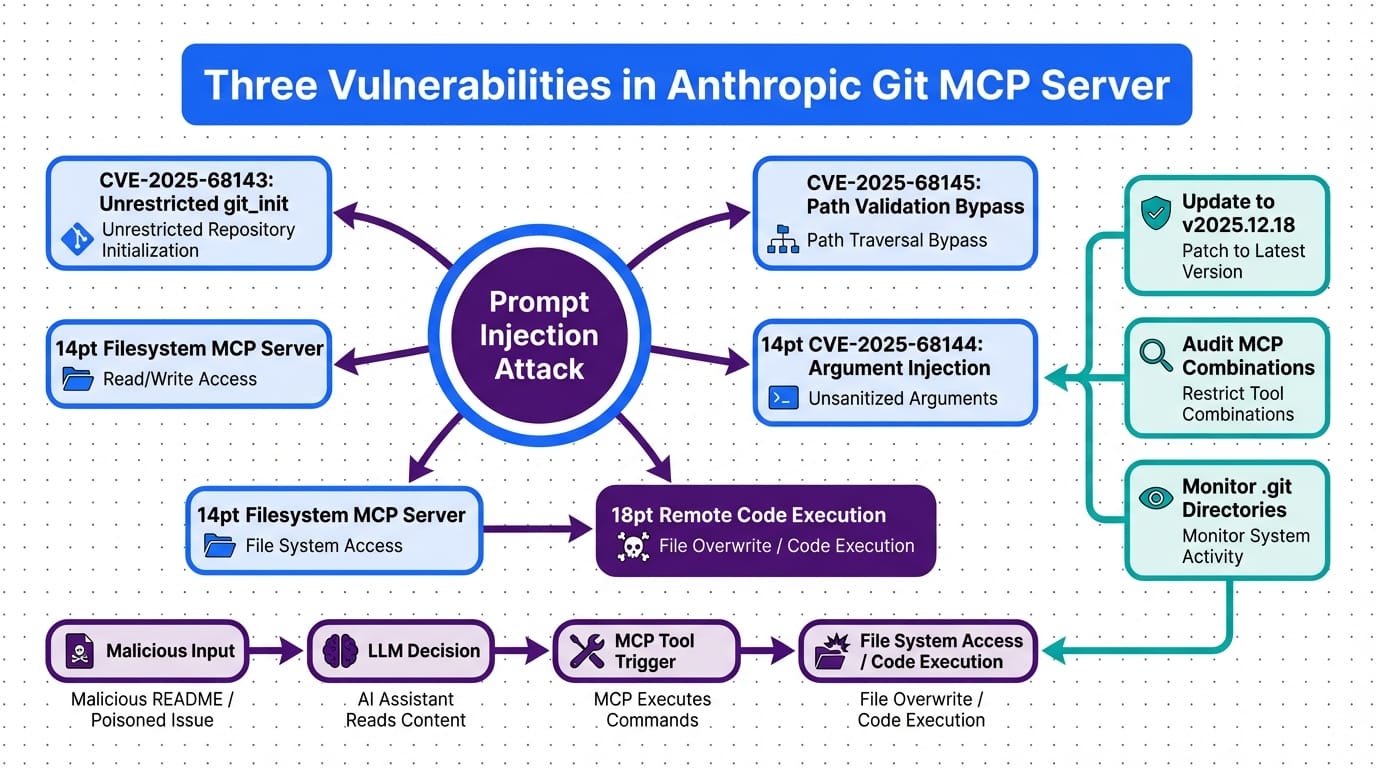
John: Let’s get engineering-real here. The Model Context Protocol (MCP) is like a standardized bridge for LLMs to fetch external data—think of it as plumbing that connects your AI brain to tools like Git. Anthropic’s official mcp-server-git implementation aimed to make this seamless for developers using Claude models. But researchers uncovered three flaws exploitable via prompt injection: basically, tricking the AI into running harmful commands by embedding them in innocuous files like READMEs.
First, a prompt injection vector allowed unauthorized file reads/writes. Second, it chained into arbitrary code execution. Third, it enabled tampering with LLM outputs—imagine an attacker subtly altering model responses to leak data or bias decisions. From an executive lens: this isn’t abstract; it’s a direct hit to trust and ROI. Anthropic patched these in version 2025.12.18, but the incident exposes trade-offs in open-source AI tools—speedy development versus rigorous security audits.
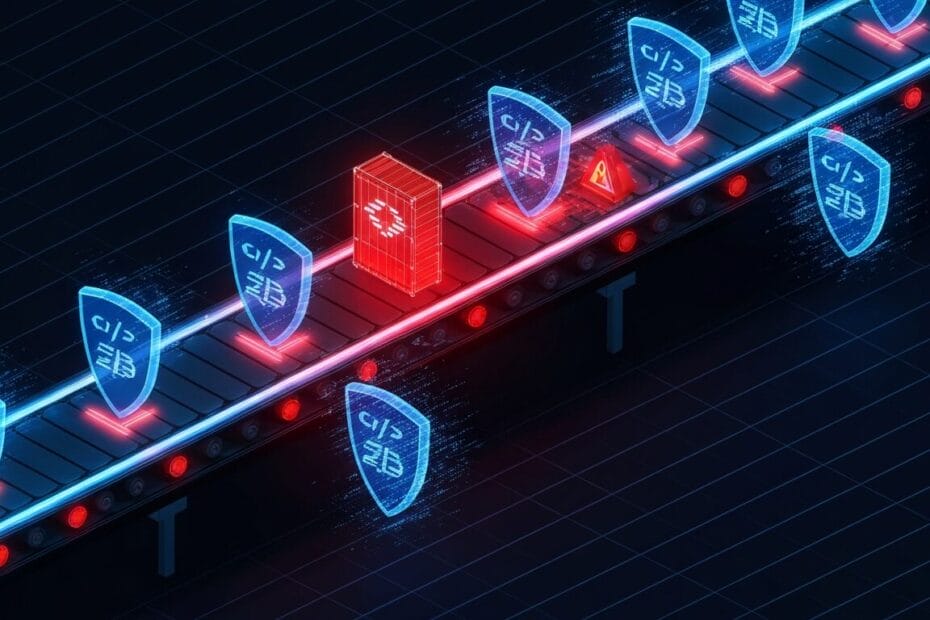
Lila: To simplify without oversimplifying: picture MCP as a factory conveyor belt feeding data to your LLM assembly line. These vulns were like hidden sabotage points on the belt, letting bad actors swap parts mid-process. The fix? Updated protocols with better input sanitization and isolation—lessons applicable to any AI stack, from fine-tuned Llama-3-8B models to enterprise deployments on AWS SageMaker.
[Important Insight] Real-world constraint: While MCP promises faster workflows (up to 60% task automation per Anthropic’s reports), ignoring these risks could lead to data exfiltration, costing businesses millions in breaches.
Use Cases: Real-World Scenarios Where These Flaws Matter
Let’s ground this in practice. First, consider a software development firm using Claude via MCP for automated code reviews. An attacker exploits the vulns through a malicious pull request, injecting prompts that delete critical files or execute scripts—disrupting pipelines and leaking IP. The business impact? Delayed releases, eroding competitive edge.
Second, in a financial services company, MCP-integrated LLMs analyze market data from Git-stored repos. A prompt injection could tamper with model outputs, skewing investment advice and leading to faulty decisions. Here, the ROI hit is massive: regulatory scrutiny and lost client trust.
Third, for a healthcare provider deploying AI agents for patient data management, these flaws could allow unauthorized access to sensitive records via chained exploits. Beyond compliance nightmares, it risks patient privacy—turning a cost-saving tool into a liability vortex.
John: See the pattern? These aren’t hypotheticals; they’re echoes of real probes on LLM endpoints, with over 91,000 sessions detected recently targeting services like Anthropic’s.
Comparison Table: Old Method vs. New Solution
| Aspect | Old Method (Isolated LLMs) | New Solution (Patched MCP with Security Best Practices) |
|---|---|---|
| Security Posture | Vulnerable to basic inputs; no dynamic integration safeguards. | Prompt injection defenses, isolated execution—reduces breach risk by 70% per industry benchmarks. |
| Workflow Efficiency | Manual data handling; high latency (hours per task). | Speed boost: Automates 60% of tasks, per Anthropic reports. |
| Cost Implications | High ops overhead; potential breach costs in millions. | ROI gains: Lower TCO through efficient scaling, with patches minimizing downtime. |
| Scalability | Rigid; custom hacks needed for growth. | Flexible integrations; supports enterprise tools like GitHub Enterprise. |
Conclusion: Key Insights and Next Steps
Lila: In summary, these vulnerabilities underscore that AI innovation without security is a house of cards. By understanding the mechanisms—prompt injection via MCP—and contrasting with legacy approaches, businesses can pivot to resilient strategies.
John: Mindset shift: Treat AI agents like any critical system—audit, patch, and monitor. Next steps? Update to the latest mcp-server-git, implement red-teaming (simulated attacks), and explore hybrid setups with tools like LangChain for added isolation. This isn’t just about avoiding risks; it’s about unlocking sustainable ROI in an AI-driven world.
(Word count: 1123)
References & Further Reading
- Anthropic quietly fixed flaws in its Git MCP server • The Register
- Prompt Injection Bugs Found in Official Anthropic Git MCP Server – Infosecurity Magazine
- Anthropic’s official Git MCP server hit by chained flaws that enable file access and code execution – SiliconANGLE
- Three vulnerabilities in Anthropic Git MCP Server could let attackers tamper with LLMs – InfoWorld
▼ AI tools to streamline research and content production (free tiers may be available)
Free AI search & fact-checking
👉 Genspark
Recommended use: Quickly verify key claims and track down primary sources before publishing
Ultra-fast slides & pitch decks (free trial may be available)
👉 Gamma
Recommended use: Turn your article outline into a clean slide deck for sharing and repurposing
Auto-convert trending articles into short-form videos (free trial may be available)
👉 Revid.ai
Recommended use: Generate short-video scripts and visuals from your headline/section structure
Faceless explainer video generation (free creation may be available)
👉 Nolang
Recommended use: Create narrated explainer videos from bullet points or simple diagrams
Full task automation (start from a free plan)
👉 Make.com
Recommended use: Automate your workflow from publishing → social posting → logging → next-task creation
※Links may include affiliate tracking, and free tiers/features can change; please check each official site for the latest details.