
In my view, AI coding requires us to become managers of logic rather than just writers of syntax.#AIcoding #softwaremanagement
Quick Video Breakdown: This Blog Article
This video clearly explains this blog article.
Even if you don’t have time to read the text, you can quickly grasp the key points through this video. Please check it out!
If you find this video helpful, please follow the YouTube channel “AIMindUpdate,” which delivers daily AI news.
https://www.youtube.com/@AIMindUpdate
Read this article in your native language (10+ supported) 👉
[Read in your language]
Why AI Coding is Turning Developers into Strategic Managers in 2026
👍 Recommended For: Software development managers seeking to optimize teams, CTOs evaluating AI’s ROI in engineering workflows, Developers transitioning from coding to oversight roles
Navigating the AI-Driven Bottleneck in Software Development
In 2026, software development teams are grappling with a profound shift: AI tools are automating routine coding tasks at an unprecedented scale, but this productivity boost comes with hidden challenges. Industry reports indicate that while AI can handle 40-55% of repetitive work, such as generating boilerplate code or debugging simple errors, development leaders face bottlenecks in adoption, security, and quality assurance. Without strategic management, teams risk accumulating technical debt, as “vibe coding” — where developers rely on loose prompts without rigorous oversight — leads to inefficient, hard-to-maintain systems. This evolution demands that developers evolve from pure coders to managers who orchestrate AI effectively, ensuring speed, cost savings, and strong ROI. As one recent analysis from IT Pro highlights, the focus is shifting from rapid AI-assisted coding to robust quality control in enterprise environments.
John: Look, I’ve been in the trenches for years, leading teams through the AI hype cycle. The real bottleneck isn’t the tech itself — it’s how we manage it. Developers who treat AI like a magic wand end up with spaghetti code that costs a fortune to fix later.
Lila: Exactly, John. For business leaders, this means rethinking team structures. If AI is your new junior developer, who’s the senior overseeing it? That’s the challenge we’re unpacking here.
The “Before” State: Traditional Coding’s Pain Points Exposed
Before AI’s widespread adoption, software development was a labor-intensive process dominated by manual coding. Developers spent hours on mundane tasks like writing repetitive functions, troubleshooting syntax errors, and integrating libraries — often leading to burnout and delayed project timelines. In a typical pre-2026 workflow, a team might allocate 70% of their time to low-level implementation, leaving little room for innovation or strategic planning. Pain points included high error rates from human fatigue, scalability issues in large codebases, and escalating costs as hiring more coders became the only way to meet deadlines. Forbes reports from early 2026 note that traditional methods resulted in only marginal productivity gains, with enterprise AI pilots failing 95% of the time due to poor integration. Contrast this with today’s AI-augmented reality: tools like Claude Code or fine-tuned models based on Llama-3-8B are shrinking routine jobs, but without managerial oversight, they amplify risks like security vulnerabilities or inconsistent outputs.
The “before” state was rigid and inefficient, akin to assembling a car by hand in a factory without automation. Now, AI introduces assembly lines, but developers must manage the machines to avoid breakdowns. This transition highlights why management skills are crucial — to harness AI’s potential without sacrificing code quality.
Core Mechanism: Structured Reasoning for AI Management
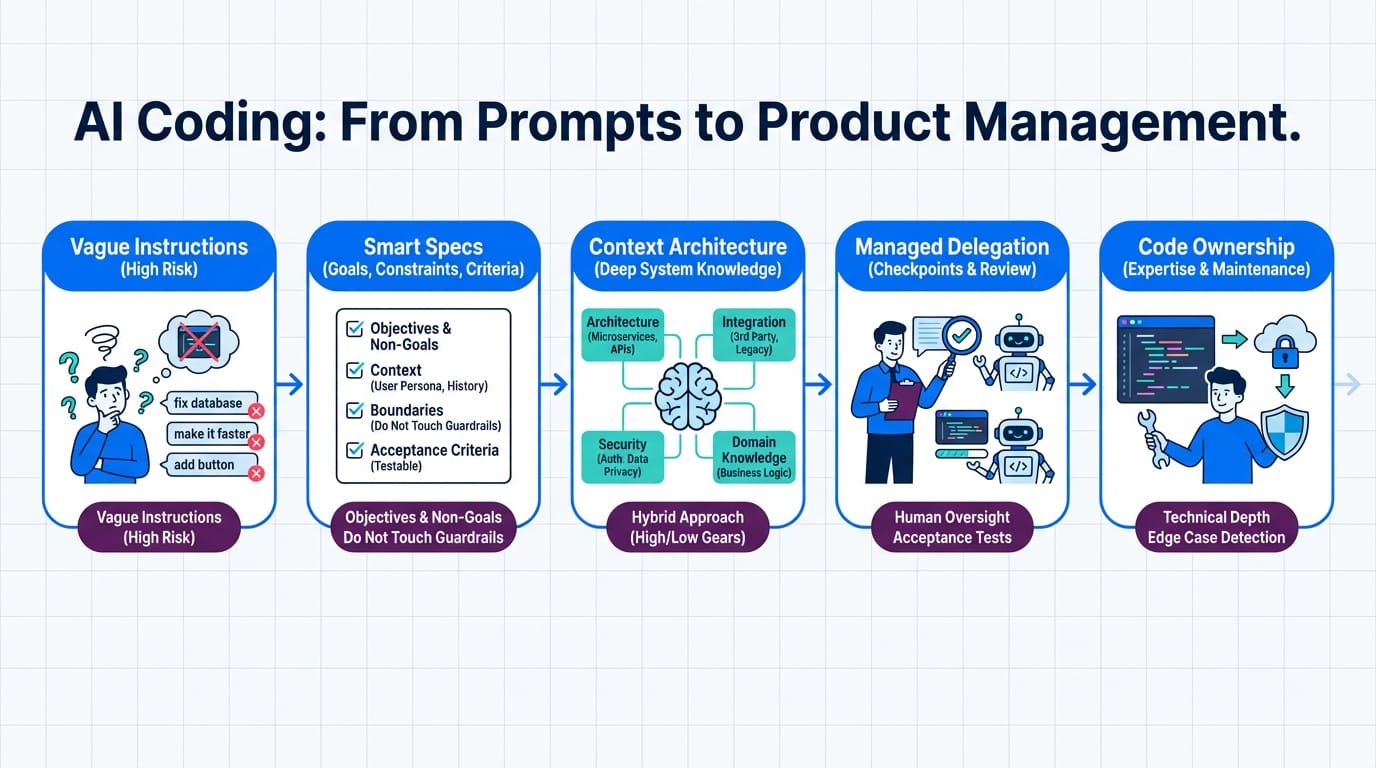
At its core, AI coding transforms developers into managers by shifting their role from creators to curators. Executive-summary logic breaks this down into three pillars: prompt engineering, quality governance, and strategic integration.
First, prompt engineering — think of it as giving precise instructions to a highly capable but literal intern. Instead of vague requests, managers use structured prompts to guide AI tools like those from Anthropic or open-source frameworks such as Hugging Face’s Transformers library. This ensures outputs align with business goals, reducing rework by up to 50%, per recent DevOps.com research.
Second, quality governance involves implementing checks like automated code reviews and human-in-the-loop validation. Here, developers act as overseers, using tools for quantization (shrinking models for faster, cheaper inference) while monitoring for biases or errors. Structured reasoning means evaluating trade-offs: AI excels at speed but may compromise on maintainability, so managers must enforce standards to avoid the “exponential technical debt” warned about in Forbes analyses.
Third, strategic integration ties AI into broader workflows, such as DevOps pipelines with CI/CD automation. By 2026, industry analysts expect this to boost overall productivity by 14-55% at the task level, but only if managed well. The mechanism isn’t about replacing humans; it’s about augmentation, where developers focus on architecture and innovation.
John: Here’s the engineering reality: Fine-tune a model like Llama-3-8B on your codebase, but without managerial oversight, you’re just automating bad habits. I’ve seen teams cut deployment times in half by treating AI as a managed resource.
Lila: For those new to this, imagine AI as a sous-chef — great at chopping veggies, but you still need to direct the recipe to avoid a kitchen disaster.
[Important Insight] The key trade-off? AI delivers speed and cost reductions, but unmanaged, it erodes long-term ROI through poor scalability.
Use Cases: Real-World Applications of AI Management
Let’s explore three concrete scenarios where developers-as-managers unlock value.
1. **Enterprise App Development:** A fintech company uses AI tools to generate initial code for a mobile banking app. The lead developer, now manager, oversees prompt refinement and integrates security scans, reducing development time from 6 months to 3 while ensuring compliance. This yields a 40% cost saving, as per Zaigo Infotech’s 2026 insights.
2. **Legacy System Modernization:** In healthcare, a team migrates outdated systems using AI-assisted refactoring. The developer-manager focuses on strategic decisions, like selecting quantized models for edge deployment, preventing disruptions in critical infrastructure. MIT Technology Review notes this approach minimizes risks in high-stakes sectors.
3. **Startup Prototyping:** A small team prototypes a SaaS product with AI handling UI components. The founder-developer manages iterations, emphasizing quality over quantity, accelerating time-to-market by 55% and improving investor ROI. As seen in Ryz Labs’ top tools list, this empowers lean operations.
These cases demonstrate how managerial skills amplify AI’s benefits across scales.
| Aspect | Old Method (Traditional Coding) | New Solution (AI with Management) |
|---|---|---|
| Productivity Focus | Manual coding; 70% time on routines | AI handles 40-55% routines; focus on strategy |
| Risk Management | High human error, no built-in checks | Oversight reduces technical debt and security issues |
| Cost & ROI | Escalating due to hiring and delays | Lower costs, up to 55% productivity gains |
| Skill Requirements | Deep coding expertise only | Management, integration, and oversight skills |
Conclusion: Embrace the Managerial Mindset Shift
In summary, AI coding in 2026 isn’t about diminishing developers’ roles — it’s about elevating them to strategic managers who drive efficiency and innovation. By addressing adoption challenges and focusing on quality, teams can realize substantial speed, cost, and ROI benefits. The next steps? Assess your team’s AI readiness with tools like those from Ryz Labs, invest in prompt engineering training, and implement governance frameworks. Shift your mindset from “coding everything” to “managing outcomes” — it’s the key to thriving in this new era.
John: Cut the hype; start small, measure results, and scale wisely. That’s engineering wisdom.
Lila: And remember, if you’re just starting, experiment with open-source AI to build confidence without the risks.
References & Further Reading
- AI could truly transform software development in 2026 – but developer teams still face big challenges with adoption, security, and quality control | IT Pro
- AI coding is now everywhere. But not everyone is convinced. | MIT Technology Review
- Developers Use AI Coding Tools To Get Started, Not Finish The Job – Forbes
- Impact of AI on Software Development in 2026 Explained – Zaigo Infotech
- Best of 2025: AI in Software Development: Productivity at the Cost of Code Quality? – DevOps.com
▼ AI tools to streamline research and content production (free tiers may be available)
Free AI search & fact-checking
👉 Genspark
Recommended use: Quickly verify key claims and track down primary sources before publishing
Ultra-fast slides & pitch decks (free trial may be available)
👉 Gamma
Recommended use: Turn your article outline into a clean slide deck for sharing and repurposing
Auto-convert trending articles into short-form videos (free trial may be available)
👉 Revid.ai
Recommended use: Generate short-video scripts and visuals from your headline/section structure
Faceless explainer video generation (free creation may be available)
👉 Nolang
Recommended use: Create narrated explainer videos from bullet points or simple diagrams
Full task automation (start from a free plan)
👉 Make.com
Recommended use: Automate your workflow from publishing → social posting → logging → next-task creation
※Links may include affiliate tracking, and free tiers/features can change; please check each official site for the latest details.