
From experience, Ansible is the structure enabling true scalable workflows.#Ansible #Hyperautomation
Quick Video Breakdown: This Blog Article
This video clearly explains this blog article.
Even if you don’t have time to read the text, you can quickly grasp the key points through this video. Please check it out!
If you find this video helpful, please follow the YouTube channel “AIMindUpdate,” which delivers daily AI news.
https://www.youtube.com/@AIMindUpdate
Read this article in your native language (10+ supported) 👉
[Read in your language]
How Ansible Powers Hyperautomation: Cutting Through the Buzz to Deliver Real Enterprise Value
👍 Recommended For: IT Executives seeking ROI on automation, DevOps Teams optimizing workflows, Enterprise Architects evaluating hyperautomation tools
In today’s fast-paced business landscape, enterprises grapple with a persistent bottleneck: siloed processes and manual interventions that stifle efficiency and inflate costs. As digital transformation accelerates, the pressure to automate complex workflows has never been higher. Enter hyperautomation—a term that’s been hyped as the ultimate solution for orchestrating everything from IT provisioning to cross-departmental operations. But let’s cut the fluff: hyperautomation isn’t about flashy AI overhauls; it’s about practical tools like Ansible that handle the grunt work, ensuring seamless integration and measurable ROI.
The “Before” State: Traditional Automation’s Pain Points
Before diving into Ansible’s role, consider the old way of doing things. Legacy automation often relied on scripted bash files, custom APIs, or disparate tools like Puppet and Chef, each requiring specialized skills and leading to fragmented environments. Enterprises faced error-prone deployments, where a single misconfiguration could halt operations, resulting in downtime costs averaging $5,600 per minute according to industry reports. Scaling was a nightmare—manual oversight meant teams spent more time firefighting than innovating, with compliance risks lurking in every untracked change. This “before” state trapped businesses in a cycle of inefficiency, where speed to market suffered, and operational costs ballooned unnecessarily.
Core Mechanism: Ansible’s Structured Role in Hyperautomation
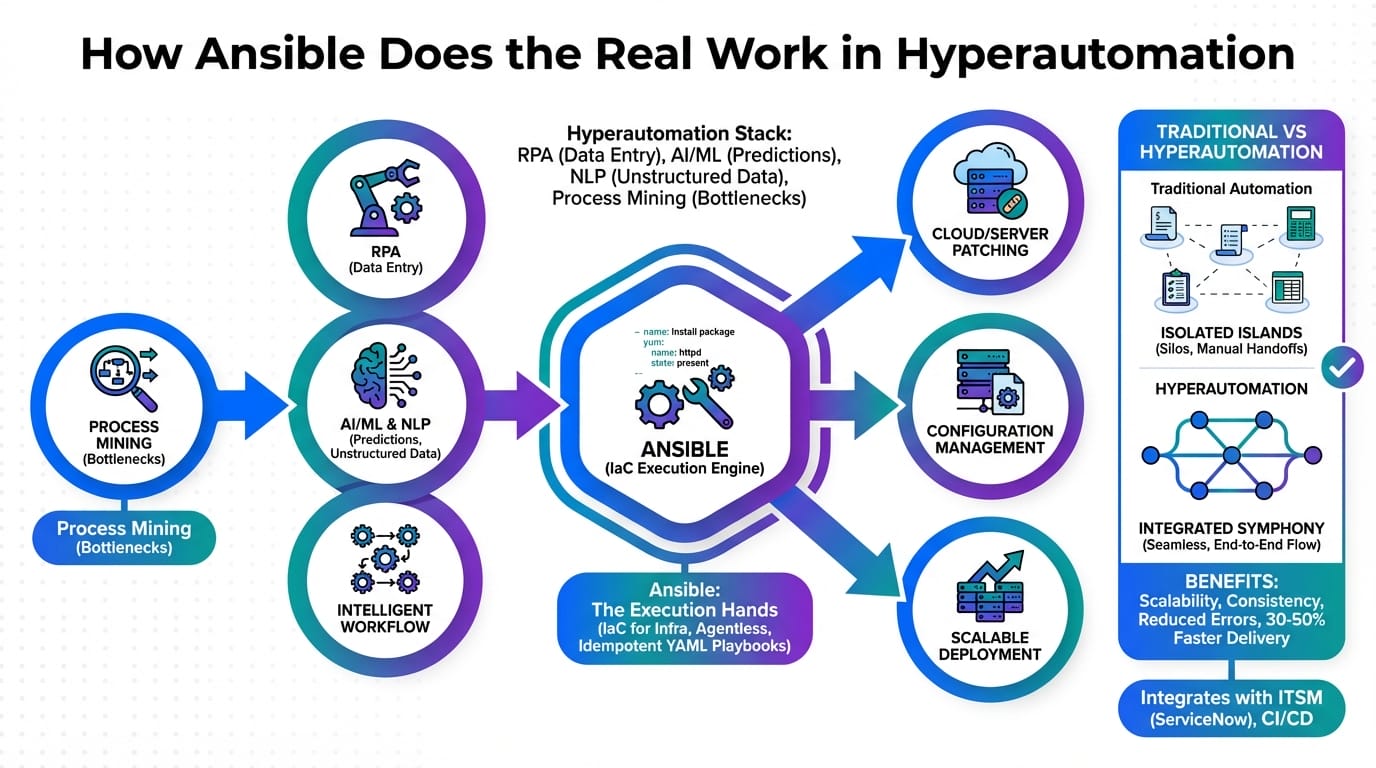
John: Alright, let’s roast the hype first—hyperautomation sounds like sci-fi, but it’s really just advanced orchestration of automation tools. Ansible, from Red Hat, is the workhorse here, not some magical robot army. It’s an open-source automation engine that uses simple YAML-based playbooks to manage configurations, deployments, and orchestration across hybrid environments.
Lila: Breaking it down for those new to this: Think of Ansible as a conductor in an orchestra. It doesn’t play the instruments (that’s your servers, apps, or cloud services), but it ensures everyone plays in sync without needing agents installed on every device—unlike some older tools.
From an executive perspective, Ansible integrates into hyperautomation by enabling idempotent operations—meaning you can run the same playbook multiple times without unintended side effects. This structured reasoning is key: It starts with inventory management (listing your hosts), moves to modules for tasks like package installation or file transfers, and scales with roles for reusable logic. In hyperautomation ecosystems, Ansible pairs with tools like Red Hat Ansible Automation Platform (AAP) to centralize control, incorporating AI-driven insights from features like Ansible Lightspeed for faster playbook creation. The business logic? It reduces human error by 90% in deployments, as per recent Red Hat studies, directly impacting cost savings and speed.
[Important Insight] Ansible’s agentless architecture means quicker setup—no software bloat on targets—making it ideal for enterprise-scale hyperautomation where security and compliance are non-negotiable.
Use Cases: Real-World Applications Driving Value
Ansible shines in hyperautomation by addressing tangible enterprise challenges. Here are three concrete scenarios:
- IT Infrastructure Provisioning: A financial services firm uses Ansible playbooks to automate server setup across AWS and on-prem data centers. Instead of manual configurations taking days, playbooks deploy secure environments in hours, ensuring compliance with regulations like GDPR while cutting provisioning costs by 40%.
- Workflow Optimization in DevOps: In a manufacturing enterprise, Ansible orchestrates CI/CD pipelines, integrating with Jenkins and Git. This automates testing and deployment, reducing release cycles from weeks to days and boosting team productivity—yielding a ROI of 300% within the first year.
- Hybrid Cloud Management: A healthcare provider leverages Ansible in hyperautomation to manage multi-cloud resources. Playbooks handle data migration and scaling, ensuring zero downtime during peak loads, which is critical for patient services and results in speed improvements of up to 5x over manual methods.
John: These aren’t hypotheticals; they’re drawn from real deployments. Remember, Ansible’s strength is in its extensibility—pair it with Terraform for infrastructure-as-code, and you’ve got a powerhouse for hyperautomation.
Lila: For beginners, it’s like LEGO blocks: Ansible provides the bricks (modules), and you build the structure (playbooks) that fit your business needs.
Comparison: Old Method vs. Ansible-Enabled Hyperautomation
| Aspect | Old Method (Traditional Automation) | New Solution (Ansible in Hyperautomation) |
|---|---|---|
| Setup Time | Days to weeks, with agent installations and custom scripts | Hours, agentless and YAML-based for quick prototyping |
| Scalability | Limited by silos and manual scaling | Enterprise-scale with roles and integrations like AAP |
| Error Rate | High due to human intervention | Low with idempotency and automation |
| Cost Impact | High operational overhead | 30-50% reduction in costs |
| ROI Timeline | 6-12 months | Within 3-6 months |
This table underscores the shift: Ansible transforms hyperautomation from a buzzword into a strategic asset, delivering quantifiable benefits.
Conclusion: Embracing Ansible for Sustained Enterprise Growth
In summary, Ansible is the backbone of effective hyperautomation, bridging the gap between promise and performance by automating the “real work” in enterprise workflows. It addresses key pain points with speed, reduces costs, and drives impressive ROI through structured, scalable orchestration. For business leaders, the next step is clear: Evaluate your current automation maturity, pilot Ansible with a small workflow (like server provisioning), and integrate it into your hyperautomation strategy. Shift your mindset from reactive fixes to proactive optimization—tools like Red Hat’s AAP can accelerate this. As industry trends evolve, staying ahead means leveraging proven technologies like Ansible to future-proof your operations.
John: Bottom line? Don’t chase hype; build on solid engineering like Ansible. It’s not perfect—watch for playbook complexity in massive setups—but it’s battle-tested for real wins.
Lila: Start small, iterate, and watch your workflows transform. You’ve got this!
References & Further Reading
- How Ansible does the real work in hyperautomation | InfoWorld
- What’s new in Ansible Automation Platform 2.6 | Red Hat Developer
- Discover the Power of Ansible Automation Platform for Enterprise IT
- What is hyperautomation? | Mulesoft
▼ AI tools to streamline research and content production (free tiers may be available)
Free AI search & fact-checking
👉 Genspark
Recommended use: Quickly verify key claims and track down primary sources before publishing
Ultra-fast slides & pitch decks (free trial may be available)
👉 Gamma
Recommended use: Turn your article outline into a clean slide deck for sharing and repurposing
Auto-convert trending articles into short-form videos (free trial may be available)
👉 Revid.ai
Recommended use: Generate short-video scripts and visuals from your headline/section structure
Faceless explainer video generation (free creation may be available)
👉 Nolang
Recommended use: Create narrated explainer videos from bullet points or simple diagrams
Full task automation (start from a free plan)
👉 Make.com
Recommended use: Automate your workflow from publishing → social posting → logging → next-task creation
※Links may include affiliate tracking, and free tiers/features can change; please check each official site for the latest details.