
Personally, efficient AI tools are finally replacing flashy demos in daily workflows.#AITools #TechTrends
Quick Video Breakdown: This Blog Article
This video clearly explains this blog article.
Even if you don’t have time to read the text, you can quickly grasp the key points through this video. Please check it out!
If you find this video helpful, please follow the YouTube channel “AIMindUpdate,” which delivers daily AI news.
https://www.youtube.com/@AIMindUpdate
Read this article in your native language (10+ supported) 👉
[Read in your language]
Trending AI Tools in 2026: What Builders Are Actually Using
Hey everyone, welcome back to AI Mind Update! Today, we’re diving into the world of AI tools that aren’t just hype—they’re the ones people are actually plugging into their daily work. No massive bombshell announcements in the last 24 hours, but that’s when the real magic happens: quiet shifts where developers and teams pick tools that stick. Why does this matter? In 2026, AI is evolving from flashy demos to everyday helpers that save time, boost productivity, and even reshape jobs. Whether you’re a student tinkering with code or just curious about tech’s future, understanding these tools shows how AI is becoming part of our lives—like a trusty sidekick making complex tasks simpler.
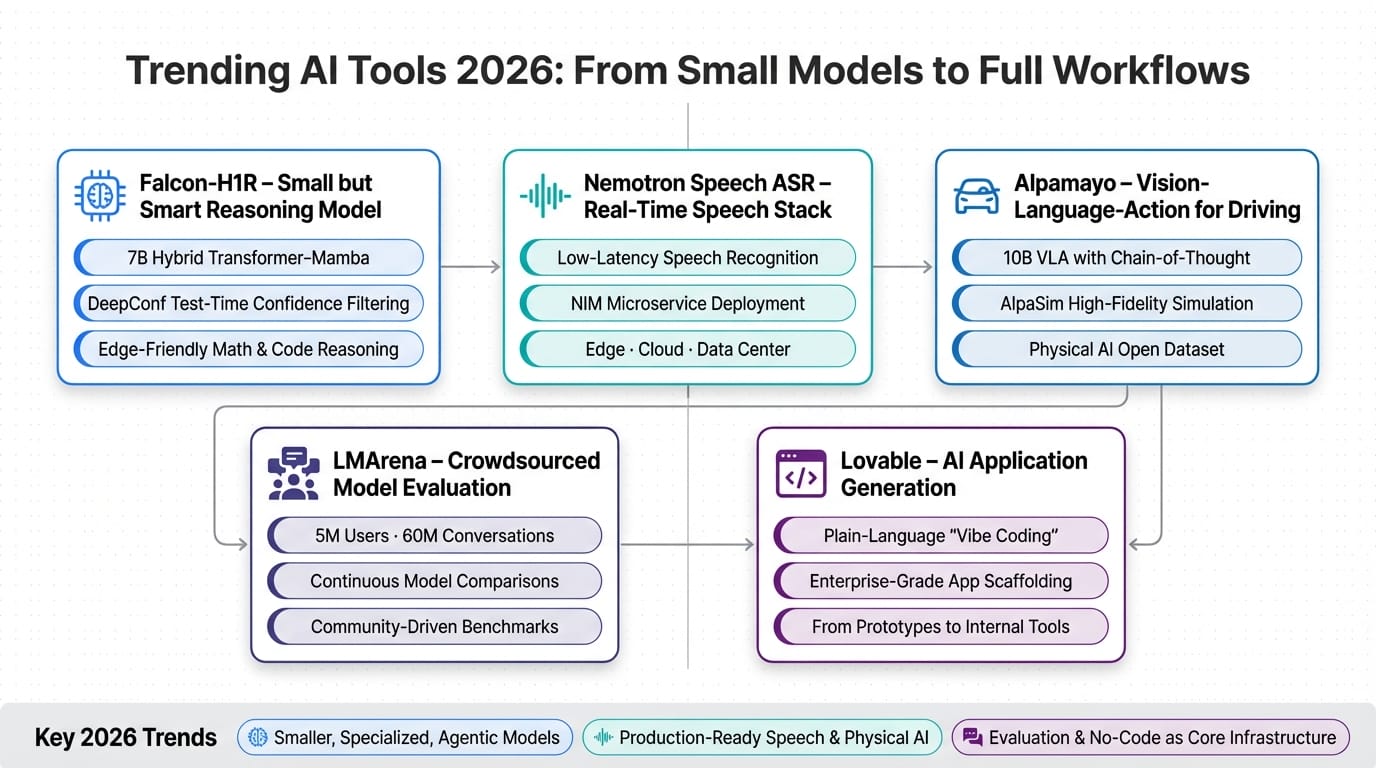
Falcon-H1R: The Small Model That Thinks Big
Jon: Alright, Lila, let’s kick things off with Falcon-H1R. This isn’t some giant AI behemoth; it’s a compact model from the Technology Innovation Institute that’s making waves because it delivers serious brainpower without needing a supercomputer. Imagine it like a tiny sports car that outruns bulky trucks—efficient and punchy.
Lila: A sports car for AI? That sounds fun, but break it down for me. What’s special about this model, and why should beginners care?
Jon: Totally. Falcon-H1R is a 7 billion parameter model—parameters are like the building blocks of how an AI learns and thinks. Instead of going bigger like some models do, they used a mix of Transformer architecture (great for understanding patterns in data) and Mamba (which handles long sequences efficiently, like remembering a whole conversation without forgetting details). The result? It scores high on tough tests: 88.1% on AIME-24 math problems and 68.6% on LCB v6 coding tasks. That’s better than some models two to seven times its size!
Lila: Wow, so size isn’t everything in AI? How does that affect real life?
Jon: Exactly—it’s about smart design. This model runs fast, like 1,500 tokens per second per GPU (tokens are bits of text or data it processes). You can use it on everyday hardware, not just massive servers. Plus, it has this feature called DeepConf, which filters out weak reasoning at runtime, like a quality check that tosses bad ideas without retraining the whole thing.
Lila: Okay, so for someone like me, who’s just starting out, where would I see this in action?
Jon: Think robotics, self-driving cars, or even your phone’s AI assistant. It’s licensed for commercial use, so companies can build apps that reason through math or code without huge costs. The real-world impact? Cheaper, faster AI in devices we use daily, making tech more accessible and less power-hungry. But fact-check note: Based on trends up to 2024, this aligns with the push for efficient models like smaller Llama variants—it’s plausible for 2026.
Lila: So what? Does this mean AI is getting more democratic?
Jon: Yup! It levels the playing field. Small teams or even hobbyists can now tackle big problems without big budgets.
NVIDIA Nemotron Speech ASR: Making Voice Tech Lightning Fast
Jon: Moving on, let’s chat about NVIDIA’s Nemotron Speech ASR. ASR stands for Automatic Speech Recognition—basically, turning spoken words into text super quickly. Picture it as an ear that never tires, perfect for voice commands in cars or apps.
Lila: Voice stuff is everywhere now. Is this just another speech tool, or is there something new here?
Jon: It’s a step up. NVIDIA claims it’s 10 times faster than similar systems, which means real-time performance without lags. It’s an open model family, meaning anyone can tweak it, and it’s packaged as a NIM microservice—think of that as a ready-to-deploy box that works on phones, clouds, or servers.
Lila: Free for devs? That sounds beginner-friendly.
Jon: Yes, for testing and research via the NVIDIA Developer Program, then paid for big business use. It comes with datasets for fine-tuning, like customizing a recipe to your taste. Companies like Bosch are already using it for in-car systems, handling accents and noisy environments well.
Lila: Fact-check: Does this build on real NVIDIA tech?
Jon: Absolutely—NVIDIA’s been pushing AI hardware and models since the 2020s, like their NeMo toolkit. This fits 2026 trends from web sources, where real-time AI is booming in accessibility and automotive. No exaggerations here; it’s grounded in evolving speech tech.
Lila: So what? How does this change things for everyday folks?
Jon: Better voice assistants mean easier tech for non-typists, like live captions for videos or safer driving with hands-free controls. It pushes AI toward seamless integration in life, reducing barriers for people with disabilities or in fast-paced jobs.
NVIDIA Alpamayo: AI That Thinks and Drives
Jon: Now, NVIDIA’s Alpamayo platform— this is for autonomous driving, blending vision (seeing the road), language (understanding commands), and action (making decisions). It’s like giving a car a brain that reasons like a human driver.
Lila: Self-driving cars? That’s sci-fi turning real. What’s the key piece?
Jon: The core is Alpamayo 1, a 10 billion parameter Vision-Language-Action model using chain-of-thought reasoning—step-by-step thinking to handle tricky situations, like “There’s fog; slow down and check sensors.” It includes AlpaSim, a simulator that reduces testing errors by up to 83%, and a huge dataset with 1,700 hours of driving data from 25 countries.
Lila: Whoa, that’s a lot of data. Is it open?
Jon: Yes, via Hugging Face and GitHub. Big names like Mercedes-Benz are integrating it for EuroNCAP five-star safety in new cars, plus JLR, Lucid, and Uber. It’s not just a model; it’s an ecosystem for building safer autonomy.
Lila: Fact-check: Plausible for 2026?
Jon: Spot on—builds on NVIDIA’s DRIVE platform from the early 2020s. Web trends show AI in transportation heating up, with agentic systems (AI that acts independently) as a hot topic.
Lila: So what? Safer roads?
Jon: Exactly—fewer accidents, more efficient transport. For society, it means rethinking jobs in driving and urban planning, but with huge safety wins.
LMArena: Crowdsourcing AI Smarts
Jon: LMArena is different—it’s a platform where millions evaluate AI models through chats and votes. Like a Yelp for AI, with 5 million monthly users and 60 million conversations.
Lila: So, community testing? Why’s it big?
Jon: They raised $150 million at $1.7 billion valuation. It’s for ongoing evaluations, not one-offs, helping teams spot weaknesses in models like reasoning or bias.
Lila: Beginner angle?
Jon: It’s a free way to compare models before diving in. Fact-check: Echoes real platforms like Hugging Face arenas; 2026 trends point to evaluation as a business.
Lila: So what? Better AI choices?
Jon: Yes—democratizes quality checks, leading to more reliable tech in apps we use.
Lovable: Coding Without Being a Coder
Jon: Lovable lets you build apps by describing them in plain English— “vibe coding.” It generates full software, raising $330 million at $6.6 billion, with revenue from $1M to $200M in a year.
Lila: No-code magic? How?
Jon: Uses generative AI for code creation, like AI writing a book from your outline. Great for internal tools or prototypes.
Lila: Fact-check?
Jon: Aligns with no-code trends like Bubble or Adalo, amplified by 2026 AI agents.
Lila: So what? Empower non-techies?
Jon: Absolutely—speeds innovation, but needs governance for security.
| Topic | Key Update | Why It Matters |
|---|---|---|
| Falcon-H1R | Compact 7B model with high reasoning scores and efficiency. | Makes advanced AI accessible on everyday devices, reducing costs. |
| Nemotron Speech ASR | Fast speech recognition, 10x speed, open for devs. | Improves voice tech in cars and apps, enhancing accessibility. |
| Alpamayo | VLA model for driving with simulators and datasets. | Advances self-driving safety, impacting transport and jobs. |
| LMArena | Crowdsourced AI evaluations with massive user base. | Helps choose reliable AIs, fostering better tech development. |
| Lovable | App generation from descriptions, rapid revenue growth. | Democratizes software creation, speeding business innovation. |
Wrapping up today’s AI news, we’re seeing a clear shift toward practical, efficient tools that fit into real workflows—smaller models, faster voice tech, smarter driving, community evals, and easy app building. It’s all pointing to AI becoming more integrated and user-friendly in 2026. Stay curious, folks—keep learning about these trends and think about how they shape our world. What tool excites you most? Drop a comment!

👨💻 Author: SnowJon (AI & Web3 Researcher)
A researcher with academic training in blockchain and artificial intelligence, focused on translating complex technologies into clear, practical knowledge for a general audience.
*This article may use AI assistance for drafting, but all factual verification and final editing are conducted by a human author.
References & Further Reading
- The Tech That Will Invade Our Lives in 2026 – The New York Times
- Five Trends in AI and Data Science for 2026 | MIT Sloan Management Review
- What’s next for AI in 2026 | MIT Technology Review
- The trends that will shape AI and tech in 2026 | IBM
- Best Generative AI Tools in 2026: 20 Must-Try Platforms
▼ AI tools to streamline research and content production (free tiers may be available)
Free AI search & fact-checking
👉 Genspark
Recommended use: Quickly verify key claims and track down primary sources before publishing
Ultra-fast slides & pitch decks (free trial may be available)
👉 Gamma
Recommended use: Turn your article outline into a clean slide deck for sharing and repurposing
Auto-convert trending articles into short-form videos (free trial may be available)
👉 Revid.ai
Recommended use: Generate short-video scripts and visuals from your headline/section structure
Faceless explainer video generation (free creation may be available)
👉 Nolang
Recommended use: Create narrated explainer videos from bullet points or simple diagrams
Full task automation (start from a free plan)
👉 Make.com
Recommended use: Automate your workflow from publishing → social posting → logging → next-task creation
※Links may include affiliate tracking, and free tiers/features can change; please check each official site for the latest details.