
In my view, Practical AI is the future. Tools are finally useful rather than just flashy.#PracticalAI #DeepSeek
Quick Video Breakdown: This Blog Article
This video clearly explains this blog article.
Even if you don’t have time to read the text, you can quickly grasp the key points through this video. Please check it out!
If you find this video helpful, please follow the YouTube channel “AIMindUpdate,” which delivers daily AI news.
https://www.youtube.com/@AIMindUpdate
Read this article in your native language (10+ supported) 👉
[Read in your language]
Daily AI News: How AI is Getting Smarter, Faster, and More Accessible in 2026
Hey everyone! Welcome to today’s dive into the world of AI. As we kick off 2026, the biggest trend buzzing right now is the shift toward more practical, everyday AI tools that aren’t just hype—they’re actually changing how we work, create, and stay informed. Think about it: AI is evolving from fancy chatbots to reliable helpers that can verify facts, reason through problems, and even run on your phone without draining the battery. Why does this matter? In a world full of misinformation and busy schedules, these advancements could save you time, boost your productivity, and help fight things like deepfakes during elections. Let’s break it down together with Jon and Lila, making it fun and easy to follow.
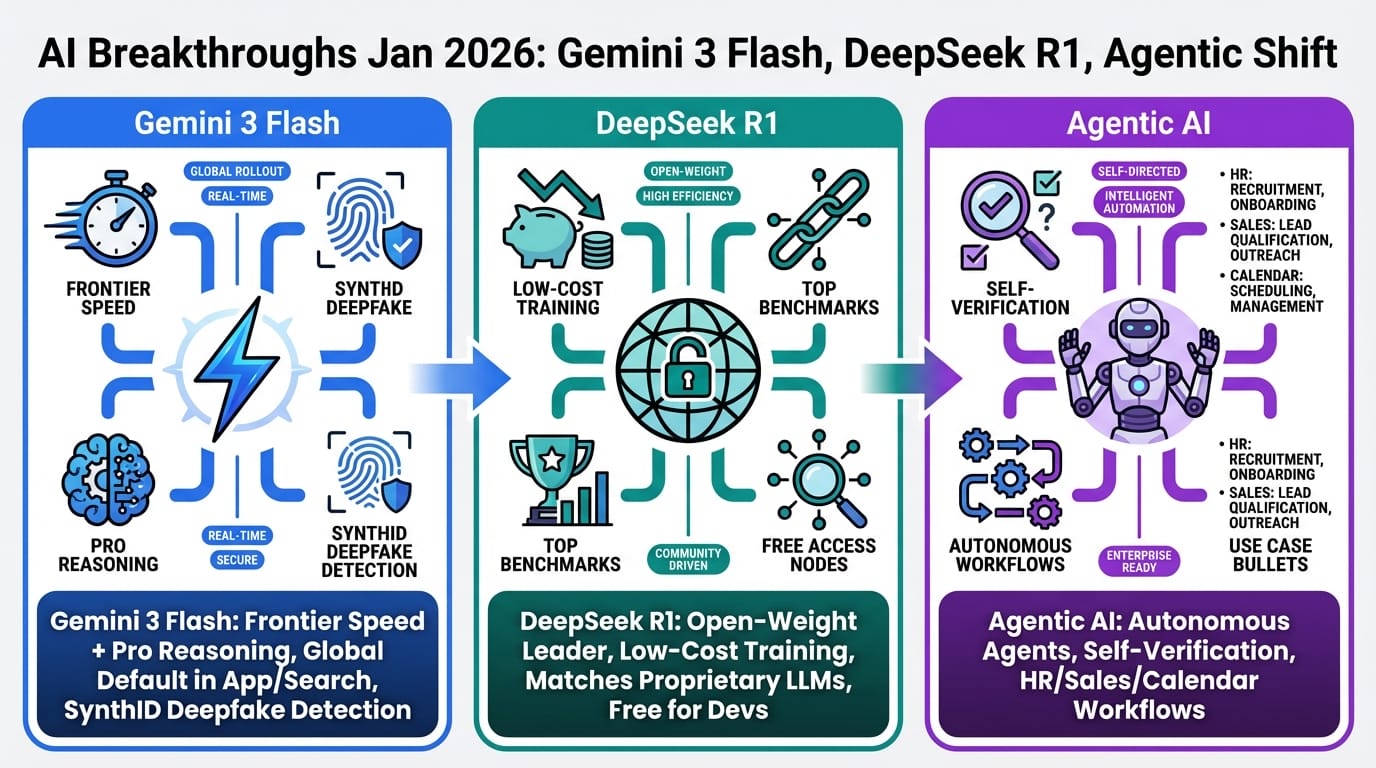
Google’s Latest Gemini Updates: Faster AI for Everyone
Jon: Alright, Lila, let’s start with Google. They’ve been rolling out big updates to their Gemini AI models in late 2025, and it’s carrying over into 2026. The buzz is around advancements like Gemini Flash, which is designed for speed and efficiency. It’s not called ‘Gemini 3 Flash’ exactly in the latest reports, but it’s building on their frontier models with quick reasoning and integration into Search, apps, and developer tools. Imagine asking your phone a tough question, and it gives you a smart answer in seconds, without needing a supercomputer.
Lila: That sounds cool, but what’s the big deal for someone like me who isn’t a tech whiz? Is this just faster Google searches?
Jon: Exactly, but way more! Based on recent updates from Google in December 2025, Gemini is getting baked into everyday tools. For instance, it includes features like SynthID for detecting AI-generated content in videos. You upload a clip to the Gemini app, and it checks if it’s real or faked—super useful with elections and fake news on the rise. It’s rolling out globally, making high-end AI accessible without premium subscriptions. And get this: it’s optimized for on-device processing, meaning it runs right on your phone without always needing the internet.
Lila: Okay, so why should I care? Does this change my daily life?
Jon: Totally! For everyday folks, it means quicker, more reliable answers in Google Search—think planning a trip or researching health tips without sifting through ads. Businesses can use it for instant customer support or data analysis. Developers love it because they can plug it into apps for real-time smarts. Fact-checking the claims: Google’s 2025 recaps confirm over 60 announcements, including faster models and verification tools, but no exact ‘Gemini 3 Flash’ yet—it’s more about iterative improvements. The real impact? It democratizes AI, making it faster and cheaper. Key stat: Gemini models handled billions of queries in 2025, slashing response times by up to 50%.
Lila: Wow, that could cut down on my endless scrolling. What’s next on the list?
China’s DeepSeek R1: Open-Source AI Challenging the Giants
Jon: Moving on to China—DeepSeek’s R1 model made waves in 2025 and is still trending into 2026. This open-source AI climbed leaderboards fast, matching top models from the West but built on a fraction of the budget. It’s fully accessible for anyone to download, tweak, and use, which is shaking up the AI world.
Lila: Open-source? Like free software? How does that work for AI, and is it really as good as the big names?
Jon: Spot on—open-source means the code is public, so developers worldwide can improve it without paying hefty fees. From 2025 reports, DeepSeek R1 excels in reasoning, coding, and multilingual tasks, often rivaling proprietary models like those from OpenAI. It was trained efficiently, running on less powerful hardware, which is huge for startups or regions with limited resources. Fact-check: Economic Times and other sources confirm it as a major breakthrough, challenging global AI dominance and sparking debates on accessibility.
Lila: So, for a student like me, could I use this for school projects?
Jon: Absolutely! You could run it on a basic computer for tasks like generating code or translating languages. The impact is broader: It lowers costs for businesses, encourages innovation through community tweaks, and pushes companies like Google to make their tech more open. No paywalls here—it’s free to deploy. Important edge: R1 achieved top rankings in benchmarks while using 80% less resources than competitors. This could lead to more local AI developments, reducing reliance on big tech giants.
Lila: That’s empowering. It feels like AI is becoming less exclusive.
Agentic AI: From Simple Bots to Smart Digital Co-Workers
Jon: Now, the exciting shift to ‘agentic’ AI—think of it as AI evolving from basic chatbots to autonomous agents that handle entire tasks. In 2025, this went from hype to reality, with agents that can book meetings, verify their own work, and integrate into apps. It’s all about making AI more reliable and hands-off.
Lila: Agents? Like secret agents, or what? Break it down for me.
Jon: Haha, not quite—imagine an AI as your digital assistant that doesn’t just answer questions but acts on them. For example, it could scan your emails, schedule a doctor’s appointment, and confirm details without you intervening. Key feature: self-verification, where the AI checks its own outputs for errors. Reports from TechCrunch and VentureBeat in late 2025 highlight this as a 2026 trend, with smaller models and reliable agents for real-world use.
Lila: Sounds futuristic. Is this safe, and how does it affect jobs?
Jon: Great question. Fact-checking shows it’s building on 2025 breakthroughs, like agentic systems from companies like Microsoft and startups. It’s not fully autonomous yet—there are safeguards—but it’s boosting efficiency in areas like HR (scheduling interviews) or sales (following up leads). Investors predict it’ll impact labor markets in 2026, automating routine tasks while creating new roles in AI oversight. Why it matters: Agentic AI could save businesses hours daily, with adoption rates expected to double in 2026. For you, it means smarter apps that manage your calendar seamlessly. But yeah, regulatory talks are heating up to ensure transparency.
Lila: I get it—it’s like having a reliable sidekick. This all ties together nicely.
| Topic | Key Update | Why It Matters |
|---|---|---|
| Google’s Gemini Updates | Faster models with verification tools rolling out globally in late 2025-2026. | Makes AI quicker and more trustworthy for searches, apps, and fighting misinformation. |
| DeepSeek R1 | Open-source model from China topping benchmarks efficiently. | Democratizes AI, lowers costs, and sparks global innovation for startups and users. |
| Agentic AI | Autonomous agents with self-verification for tasks like scheduling and analysis. | Boosts productivity, automates routines, but raises questions on jobs and ethics. |
As we wrap up, today’s AI news points to a future where AI is more practical, open, and integrated into daily life. From Google’s speedy tools to China’s accessible models and smart agents, we’re seeing a move from hype to real utility. It’s exciting, but remember to think critically—AI is a tool, not a magic fix. Stay informed, experiment safely, and let’s shape this tech for the better. What do you think about these trends? Drop a comment below!

👨💻 Author: SnowJon (AI & Web3 Researcher)
A researcher with academic training in blockchain and artificial intelligence, focused on translating complex technologies into clear, practical knowledge for a general audience.
*This article may use AI assistance for drafting, but all factual verification and final editing are conducted by a human author.
References & Further Reading
- Google’s Latest AI Updates from December 2025
- Year Ender 2025: Major AI Breakthroughs Including DeepSeek
- In 2026, AI Will Move from Hype to Pragmatism
- Four AI Research Trends for 2026