
It seems the Windows Rust plan is about gradual safety steps rather than a total rewrite.#Windows #Rust
Quick Video Breakdown: This Blog Article
This video clearly explains this blog article.
Even if you don’t have time to read the text, you can quickly grasp the key points through this video. Please check it out!
If you find this video helpful, please follow the YouTube channel “AIMindUpdate,” which delivers daily AI news.
https://www.youtube.com/@AIMindUpdate
Read this article in your native language (10+ supported) 👉
[Read in your language]
Is Microsoft Really Rewriting Windows in Rust? The Truth Behind the Buzz
👍 Recommended For: Casual tech enthusiasts curious about software trends, beginner programmers exploring languages like Rust, and Windows users wondering about future updates.
Imagine you’re scrolling through your feed, sipping coffee, and you see headlines screaming about Microsoft overhauling Windows with some fancy new programming language called Rust. Your mind races: “Is my computer about to change forever? Will my apps break? What’s Rust anyway—sounds like something from an old car!” If that’s you, relax. This isn’t some sci-fi plot twist. Let’s unpack the real story in a way that’s easy to follow, like chatting over lunch about why your phone gets security updates.
The “Before” State: Why C and C++ Have Been the Kings (But Not Without Drama)
Picture this: Building software is like constructing a massive city. For decades, languages like C and C++ have been the bricks and mortar for giants like Windows. They’re fast, powerful, and let developers squeeze every ounce of performance from hardware. But here’s the catch—they’re also prone to “cracks” in the foundation. Think memory leaks, where programs hog resources like a forgetful chef leaving the oven on, or security vulnerabilities that hackers exploit like weak spots in a fortress wall.
Traditionally, fixing these meant endless manual tweaks, debugging sessions that drag on for weeks, and updates that sometimes introduce new bugs. It’s like patching a leaky roof during a storm—effective but messy and risky. Microsoft knows this all too well; Windows has billions of lines of code in C and C++, and vulnerabilities have led to real-world headaches, from crashes to cyber attacks. The pain point? Maintaining security and reliability in an ever-evolving digital world without starting from scratch.
Core Mechanism: Rust’s Safety Net Explained Like a Seatbelt in a Race Car
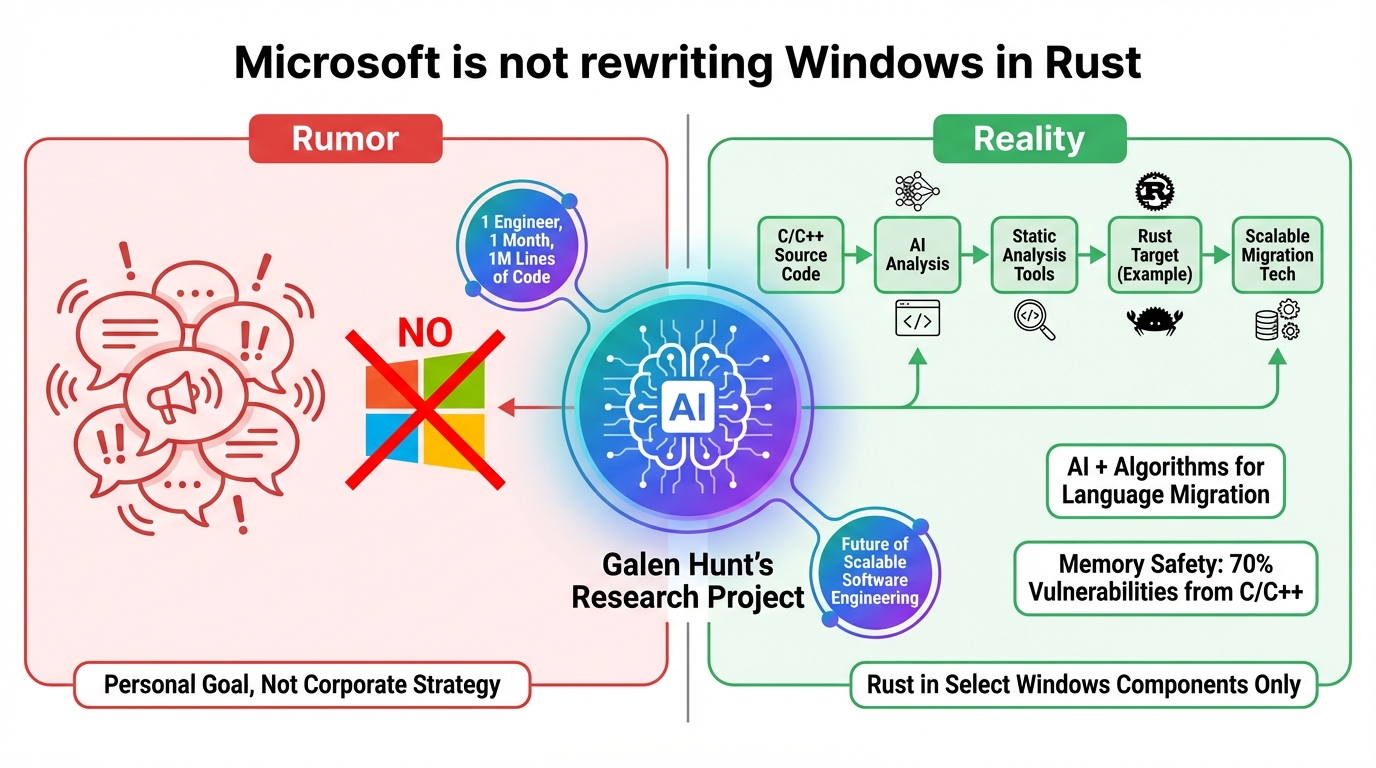
Okay, let’s break it down simply. Rust is like a modern car with built-in safety features—think automatic braking to prevent crashes—while C and C++ are like classic muscle cars: thrilling but requiring expert handling to avoid wipeouts. Rust’s big win is “memory safety,” which means it catches errors at compile time, before the code even runs. No more rogue pointers causing chaos!
But here’s where the news gets interesting. Microsoft isn’t tossing out Windows and rebuilding it in Rust overnight. Instead, they’re exploring AI-powered tools to translate code from C/C++ to Rust gradually. Imagine a magical translator that converts an old recipe book into a digital app, keeping the flavors but adding safety checks. This isn’t about a full rewrite; it’s a research project to make migration feasible, potentially handling millions of lines per month. The key benefits? Enhanced security (fewer hacks), better reliability (stable apps), and future-proofing without massive disruptions.
Use Cases: Where This Could Make a Real Difference in Your World
First, think about everyday Windows users like you and me. If Microsoft integrates more Rust into Windows components, your OS could become more secure against viruses—picture fewer “blue screen of death” moments during updates, all thanks to Rust’s error-proofing.
Second, for app developers building tools for Windows, this means easier debugging. Say you’re coding a simple game; with Rust elements, you avoid common pitfalls, speeding up development like upgrading from a bicycle to an e-bike.
Third, in the broader tech scene, open-source projects could benefit. Communities already using Rust (like parts of Linux) might collaborate with Microsoft, leading to cross-platform tools that run smoother on both Windows and other systems—imagine seamless file sharing without compatibility headaches.
| Aspect | Old Method (C/C++ Dominated) | New Solution (Rust Migration with AI) |
|---|---|---|
| Security | Prone to memory vulnerabilities, requiring constant patches | Built-in safety reduces exploits, AI aids seamless transitions |
| Development Speed | Manual debugging slows things down | AI translation handles bulk work, freeing devs for innovation |
| Maintenance Cost | High due to ongoing fixes and legacy code | Lower long-term, with more reliable codebases |
| Scalability | Limited by error-prone expansions | Easier to scale with safe, modular code |
Wrapping It Up: What’s Next for You and Windows?
In summary, the hype about a full Windows rewrite in Rust is overblown—it’s more like Microsoft testing a smart toolkit for gradual improvements, not a demolition job. This could lead to a safer, more efficient Windows without upending your daily life. If you’re intrigued, start by dipping your toes into Rust via free online tutorials—it’s beginner-friendly and might just spark your next hobby. Remember, tech evolves, but it’s all about making things better, one line of code at a time. Keep an eye on official Microsoft updates, and don’t believe every viral post!
John: Alright, folks, as the battle-hardened tech lead here at AI Mind Update, I’ve seen my share of overhyped tech trends. This Rust thing? It’s not snake oil—it’s legit engineering progress. But let’s roast the misinformation: No, AI isn’t magically rewriting Windows overnight like some Hollywood script. It’s research, people!
Lila: Exactly, John. For beginners, think of it as upgrading your home’s wiring for safety without tearing down the house. Start small, learn the basics, and you’ll see why it’s exciting without the panic.
[Important Insight] The real win is in trade-offs: Rust adds safety but might require learning curves—worth it for long-term gains.
References & Further Reading
- Microsoft is not rewriting Windows in Rust | InfoWorld
- Microsoft wants to replace its entire C and C++ codebase • The Register
- Microsoft wants AI to eliminate C and C++ code by 2030 | Windows Central
- ‘1 engineer, 1 month, 1 million lines of code’: Microsoft wants to replace C and C++ code with Rust by 2030 – but a senior engineer insists the company has no plans on using AI to rewrite Windows source code | IT Pro