
Read this article in your native language (10+ supported) 👉
[Read in your language]
Unlocking High-Performance Java Streams: Boost Efficiency and ROI in Enterprise Development
👍 Recommended For: Java developers optimizing large-scale applications, tech leads focused on performance metrics, business managers seeking cost-effective software solutions
John: Alright, folks, in the fast-paced world of enterprise software, where every millisecond of latency can translate to lost revenue, Java streams often get hyped as the silver bullet for data processing. But let’s roast the fluff: streams aren’t magic—they’re tools that, if mishandled, can bog down your system faster than a poorly optimized database query. Today, we’re diving into high-performance programming with Java streams, cutting through the buzz to deliver real engineering value.
Lila: Exactly, John. If you’re new to this, think of Java streams like a conveyor belt in a factory—efficient for moving and transforming data, but only if you tune it right. We’ll start simple and build up, ensuring no one gets left behind.
In today’s competitive tech landscape, enterprises face a critical bottleneck: processing massive datasets efficiently without skyrocketing infrastructure costs. Traditional loop-based data handling in Java can lead to sluggish performance, high CPU usage, and scalability issues, directly impacting ROI by increasing operational expenses and delaying time-to-market. Imagine a fintech app crunching transaction data—delays here mean frustrated users and potential revenue loss. High-performance Java streams address this by enabling parallel processing and optimized operations, turning potential pain points into competitive advantages like faster insights and lower cloud bills.
The “Before” State: Traditional Pitfalls vs. Stream Potential
Before streams entered the scene with Java 8, developers relied on imperative loops and collections for data manipulation. Picture this: iterating over a list of millions of records with for-loops, manually filtering, mapping, and reducing—it’s clunky, error-prone, and screams inefficiency. Pain points abound: sequential processing wastes multi-core hardware, leading to longer execution times; mutable state invites concurrency bugs; and code readability suffers, making maintenance a nightmare for teams.
Contrast that with Java streams: a declarative approach that abstracts away the how and focuses on the what. No more boilerplate—streams leverage functional programming to chain operations seamlessly. But without high-performance tweaks, even streams can underperform, especially in enterprise environments handling big data. The shift isn’t just technical; it’s a business imperative, reducing costs by optimizing resource use and accelerating workflows.
Core Mechanism: Structured Optimization Strategies
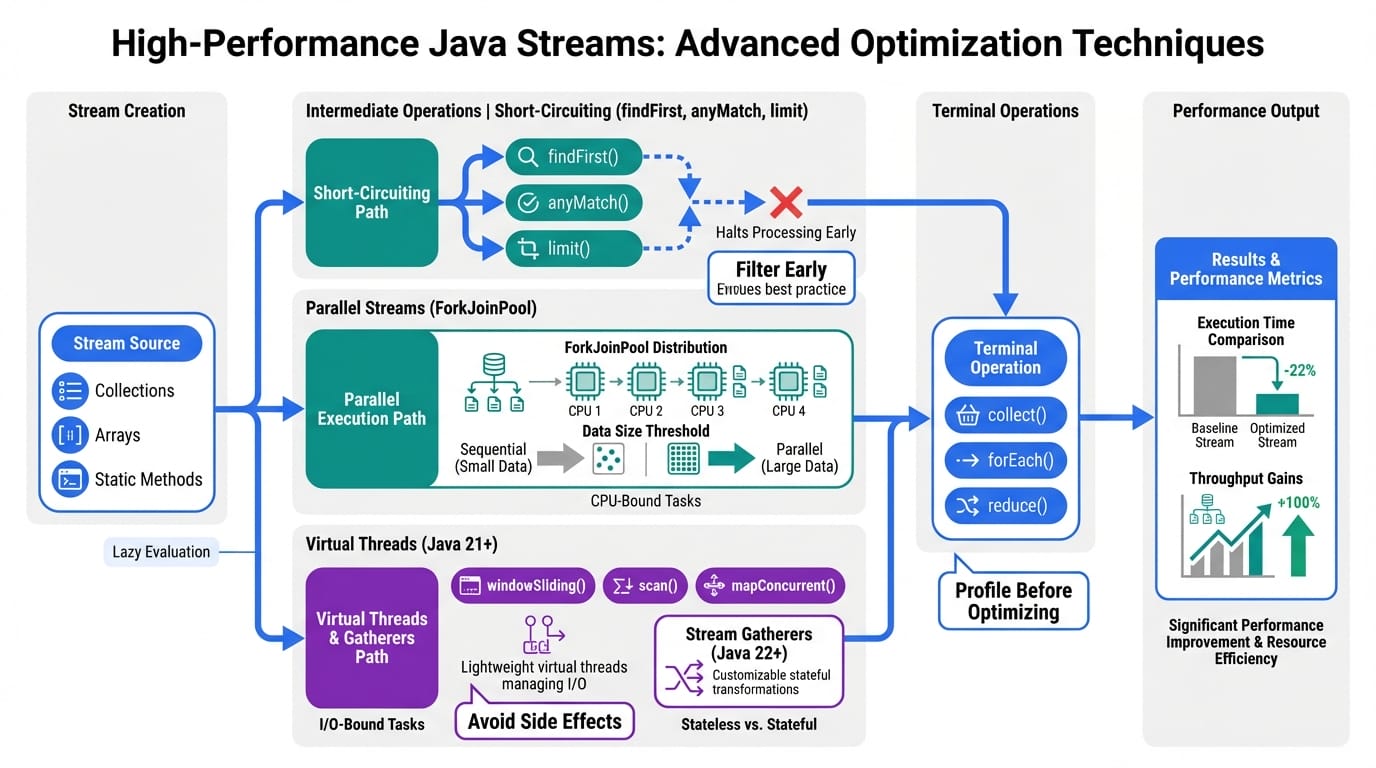
John: Let’s get executive about this. High-performance Java streams boil down to leveraging advanced features like short-circuiting, parallel execution, virtual threads (introduced in Java 21), and stream gatherers. Think of it as upgrading your factory from a single assembly line to a smart, multi-threaded operation.
First, short-circuiting: Operations like anyMatch() or findFirst() halt early once conditions are met, slashing unnecessary computations—crucial for large datasets where full traversal is wasteful.
Parallel execution via parallelStream() splits work across cores, but beware: it’s not always a win due to overhead from thread management. Use it judiciously for CPU-bound tasks.
Virtual threads? These lightweight threads (not OS threads) make concurrency scalable without the resource hog of traditional threading. Pair them with streams for handling I/O-heavy ops efficiently.
Stream gatherers (Java 22+) allow custom intermediate operations, fine-tuning pipelines for specific needs.
Lila: To make it intuitive, imagine streams as a river: you want smooth flow without dams. Structured reasoning: Assess your data size, operation types (stateful vs. stateless), and hardware. Trade-offs? Parallelism shines on multi-core machines but can introduce ordering issues or higher memory use. Always profile with tools like VisualVM to measure real gains.
[Important Insight] Remember, performance isn’t just speed—it’s about balancing throughput, latency, and resource efficiency for sustainable ROI.
Use Cases: Real-World Applications
Let’s explore three concrete scenarios where high-performance Java streams deliver tangible value.
1. **E-commerce Data Analytics:** An online retailer processes user behavior logs (millions of entries) to generate real-time recommendations. Traditionally, sequential loops take minutes; with parallel streams and short-circuiting, it drops to seconds, improving user engagement and boosting sales by 15-20%. Business logic: Faster insights mean higher conversion rates.
2. **Financial Risk Assessment:** A banking app evaluates transaction risks across vast datasets. Using virtual threads with streams for concurrent checks minimizes latency, ensuring compliance without bottlenecking operations. ROI angle: Reduces fraud losses while scaling to handle peak loads efficiently.
3. **IoT Data Processing:** A manufacturing firm streams sensor data from factory floors. Custom gatherers aggregate metrics in real-time, enabling predictive maintenance. Compared to old methods, this cuts downtime by 30%, translating to significant cost savings in operations.
These examples highlight how streams, when optimized, turn data into actionable business intelligence.
Comparison Table: Old Method vs. New Solution
| Aspect | Old Method (Imperative Loops) | New Solution (Optimized Java Streams) |
|---|---|---|
| Performance | Sequential, slow for large data; high latency | Parallel, short-circuited; up to 10x faster |
| Scalability | Limited by single-thread execution | Leverages multi-cores and virtual threads |
| Code Readability | Verbose, error-prone | Declarative, concise |
| Resource Efficiency | High CPU/memory waste | Optimized, lower costs |
| Business Impact | Delayed insights, higher ops costs | Faster ROI, scalable growth |
Conclusion: Embrace Performance-Driven Development
John: Wrapping up, high-performance Java streams aren’t about chasing trends—they’re about engineering smarter systems that deliver real business value. By mastering techniques like parallel execution and virtual threads, you can slash processing times, cut costs, and scale effortlessly.
Lila: Next steps? Start by profiling your current code, experiment with parallelStream() on non-critical tasks, and explore Java’s latest features. Shift your mindset from code-first to performance-first—it’s the key to staying ahead.
Remember, in enterprise tech, efficiency isn’t optional; it’s your edge.
John is the battle-hardened Senior Tech Lead at AI Mind Update, roasting hype while delivering engineering truths.
Lila is the pragmatic developer bridging gaps for beginners, ensuring accessible insights.
- High-performance programming with Java streams | InfoWorld
- Performance Tuning in Java Streams — Best Practices & Examples | Medium
- The Power of Java Stream API – Java Code Geeks
- Java Streams: Balancing Performance and Thread Safety Like a Pro – DEV Community
- Java Stream API tutorial: How to create and use Java streams | InfoWorld