
GPT-5.2 just launched! See how OpenAI is challenging Google & the intensifying global AI chip race will affect your tech.#GPT52 #AIChips #TechRace
Quick Video Breakdown: This Blog Article
This video clearly explains this blog article.
Even if you don’t have time to read the text, you can quickly grasp the key points through this video. Please check it out!
If you find this video helpful, please follow the YouTube channel “AIMindUpdate,” which delivers daily AI news.
https://www.youtube.com/@AIMindUpdate
Read this article in your native language (10+ supported) 👉
[Read in your language]
Daily AI Buzz: GPT-5.2 Drops, Chip Races Heat Up, and What It Means for You
Hey everyone! Imagine waking up to a world where AI isn’t just a buzzword—it’s reshaping how we work, learn, and even compete globally. Today’s biggest trend? The fierce AI arms race between tech giants like OpenAI and Google, with new models launching faster than ever. Why does this matter to you? Well, these updates could make your daily tasks—think smarter chatbots for homework, better tools for your job, or even AI that helps automate boring chores—way more efficient and accessible. And if you’re curious about staying ahead, tools like Genspark can help you dive deeper into AI news without the hassle of endless scrolling.
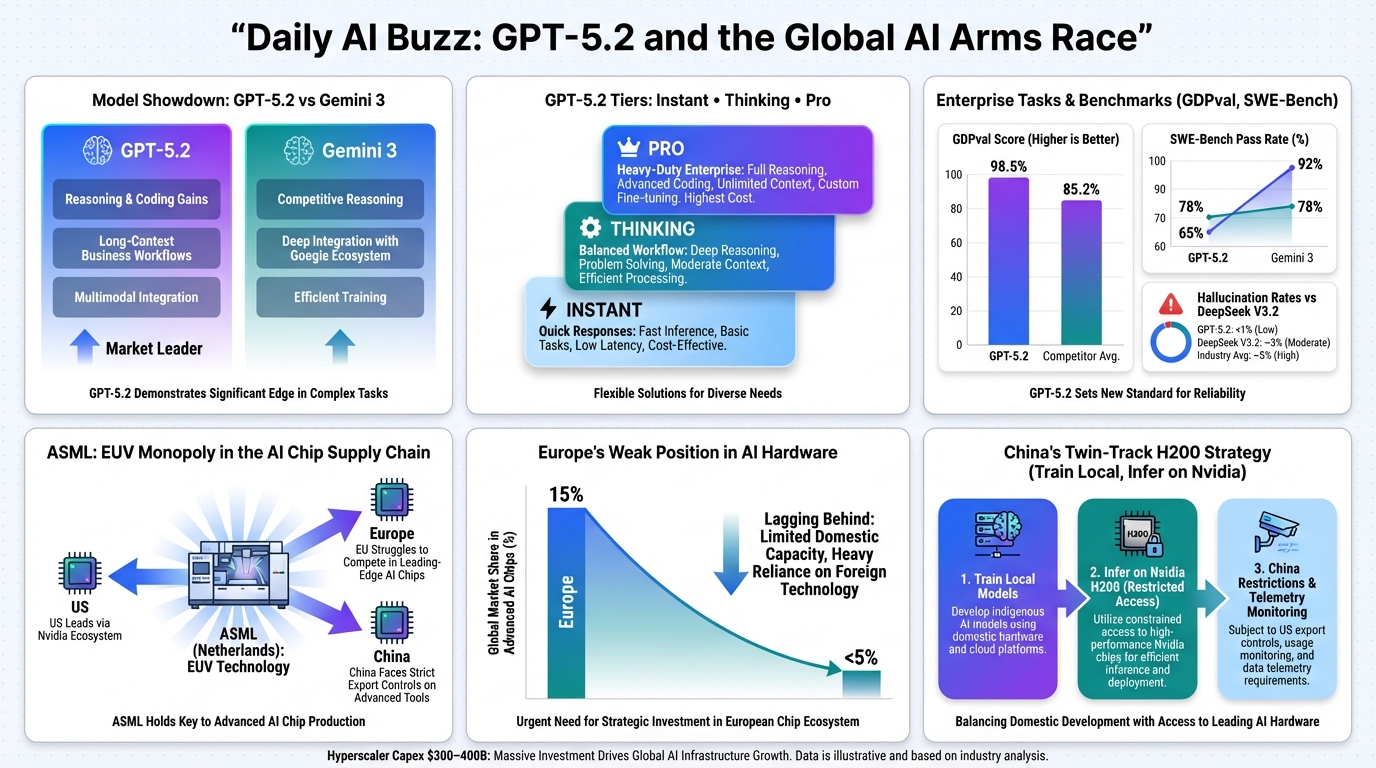
OpenAI Unleashes GPT-5.2 in High-Stakes Battle with Google’s Gemini 3
Jon: Alright, Lila, let’s kick this off with the big one. OpenAI just launched GPT-5.2 on December 11, 2025—that’s literally yesterday! It’s their latest AI model, designed to tackle real-world business tasks like a pro, and it’s a direct shot back at Google’s Gemini 3. Remember how Sam Altman, OpenAI’s CEO, sent out that internal ‘code red’ alert? It basically paused everything else to speed this up because they felt Google was pulling ahead. Now, it’s available in ChatGPT for paid users and through their API, with costs around $1.75 per million input tokens and $14 per million output tokens. They say it’s more efficient, so you might not feel the price pinch as much.
Lila: Whoa, Jon, slow down for us beginners. What’s a ‘token’ anyway? And why should someone like me, who’s just using AI for simple stuff like writing emails, care about GPT-5.2?
Jon: Great question, Lila! Think of tokens as the building blocks of language in AI—each word or part of a word is a token, like LEGO pieces making up a sentence. This new model crushes benchmarks, scoring 70.9% on expert-level business tasks in their GDPval test, up from GPT-5.1’s 38.8%. We’re talking spreadsheets, coding, understanding images, and multi-step projects. It’s like upgrading from a basic calculator to a supercomputer that handles your taxes while debugging your app.
Lila: Okay, that sounds useful. But is it really better than Google’s Gemini 3? And how does this affect everyday folks?
Jon: Spot on—it’s a neck-and-neck race. OpenAI claims GPT-5.2 matches humans on 70% of work tasks and excels in software engineering benchmarks like SWE-Bench. Compared to Gemini 3, early users say it holds onto long conversations better, which is huge for complex work like planning a project or coding. For you? If you’re a student or non-techie, this means AI tools could soon handle more of your homework or reports flawlessly. Oh, and if you’re into creating docs or slides, check out Gamma—it uses similar AI smarts to whip up presentations in seconds.
Lila: Love that! But fact-check time: Is there any downside? I heard about hallucinations—AI making stuff up.
Jon: Yeah, it’s not perfect. Hallucination rates are at 8.4%, higher than some rivals like DeepSeek V3.2’s 6.3%. But the impact is massive for businesses—less manual fixes mean faster adoption. If you’re learning coding, tools like Nolang can help you chat with AI tutors to practice what GPT-5.2 excels at.
ASML CEO Sounds Alarm: Europe Losing the AI Chip Race
Jon: Switching to hardware, Lila. There’s buzz from ASML, the Dutch company that’s basically the king of making machines for advanced chips—think the tech behind Nvidia’s GPUs that power AI like ChatGPT. Their CEO, Christophe Fouquet, in a recent interview, warned that Europe is falling way behind in the AI chip race. No bubble here; it’s an all-out arms race with big tech spending $300-400 billion this year on infrastructure.
Lila: Chips? Like potato chips? Kidding! But seriously, why is ASML so important, and what’s this mean for non-techies?
Jon: Haha, good one. ASML has a monopoly on extreme ultraviolet (EUV) lithography machines—these etch tiny patterns on silicon for super-advanced chips under 2nm. Fact-check: Based on latest reports, the US dominates via Nvidia, China is pushing hard despite restrictions, and Europe is ‘very weak,’ mostly consuming rather than leading. ASML’s investing in AI like a 10% stake in Mistral AI to boost their own tech.
Lila: So, if Europe lags, does that affect my phone or AI apps?
Jon: Exactly! Without strong chip production, innovation slows. For you, it means future AI might be pricier or less accessible if supply chains get geopolitical. But hey, if you’re into video creation from this news, Revid.ai can turn articles like this into quick viral shorts.
China’s Sneaky Nvidia H200 Play Amid US Chip Drama
Jon: Now, the geopolitical twist: China is cleverly using Nvidia’s H200 chips after US President Trump greenlit exports. Companies like ByteDance and Alibaba are ordering them for AI inference—that’s the ‘using’ part after training models. This happened just days ago, around December 9-12, 2025.
Lila: Inference? Break it down—like training a dog versus asking it to fetch?
Jon: Perfect analogy! Training builds the model; inference is deploying it for real tasks. China’s strategy: Train on homegrown chips like Huawei’s Ascend for security, then use efficient H200s for speed. But there’s scrutiny—fears of backdoors, so Nvidia adds tracking. This could narrow the US-China AI gap faster.
Lila: Wow, so global politics affects my AI tools?
Jon: Yep, it might mean better, cheaper AI worldwide, but with tensions. For automating your life amid this, try Make.com to connect apps seamlessly.
| Story | Key Highlight | Impact for You |
|---|---|---|
| GPT-5.2 Launch | Better at business tasks, rivals Gemini 3 | Smarter AI for work and learning |
| ASML Chip Race Alarm | Europe lagging in AI hardware | Potential delays in tech advancements |
| China’s H200 Strategy | Balancing US chips with local tech | Faster global AI progress, but with risks |
In summary, today’s AI news shows how fast things are moving—from model launches to chip battles. Dive in with tools like those mentioned, and stay curious! For more automation, explore Make.com.

👨💻 Author: SnowJon (Web3 & AI Practitioner / Investor)
A researcher who leverages knowledge gained from the University of Tokyo Blockchain Innovation Program to share practical insights on Web3 and AI technologies. While working as a salaried professional, he operates 8 blog media outlets, 9 YouTube channels, and over 10 social media accounts, while actively investing in cryptocurrency and AI projects.
His motto is to translate complex technologies into forms that anyone can use, fusing academic knowledge with practical experience.
*This article utilizes AI for drafting and structuring, but all technical verification and final editing are performed by the human author.
🛑 Disclaimer
This article contains affiliate links. Tools mentioned are based on current information. Use at your own discretion.
▼ Recommended AI Tools for Beginners
- 🔍 Genspark: An AI agent that saves you research time by summarizing search results.
- 📊 Gamma: Create beautiful presentations and docs in seconds just by typing.
- 🎥 Revid.ai: Turn your text or blogs into viral short videos instantly.
- 👨💻 Nolang: Learn coding or any topic by chatting with an AI tutor.
- ⚙️ Make.com: Automate boring tasks by connecting your favorite apps.