
OpenAI‘s GPT-5.2 just launched! How will this AI turbo boost change your daily work, learning, and creativity? Dive into the impact.#GPT52 #AINews #OpenAI
Quick Video Breakdown: This Blog Article
This video clearly explains this blog article.
Even if you don’t have time to read the text, you can quickly grasp the key points through this video. Please check it out!
If you find this video helpful, please follow the YouTube channel “AIMindUpdate,” which delivers daily AI news.
https://www.youtube.com/@AIMindUpdate
Read this article in your native language (10+ supported) 👉
[Read in your language]
Daily AI News: OpenAI’s Big GPT-5.2 Launch and What It Means for Everyday Life
Hey there, folks! Imagine waking up to a world where your virtual assistant isn’t just chatting idly but actually helping you solve real problems—like crunching numbers for your budget or explaining science homework in simple terms. That’s the vibe of today’s AI buzz, headlined by OpenAI’s fresh launch of GPT-5.2. In a nutshell, this upgrade is like giving your phone’s brain a turbo boost, making it smarter for work, learning, and creativity. Why does it matter to you? Well, as AI gets better at handling complex tasks, it could save you time on everything from writing reports to researching vacations. And if you’re into quick, reliable searches, tools like Genspark are already making that a reality by summarizing the web for you. Stick around as Jon and Lila break it all down in a fun chat—let’s dive in!
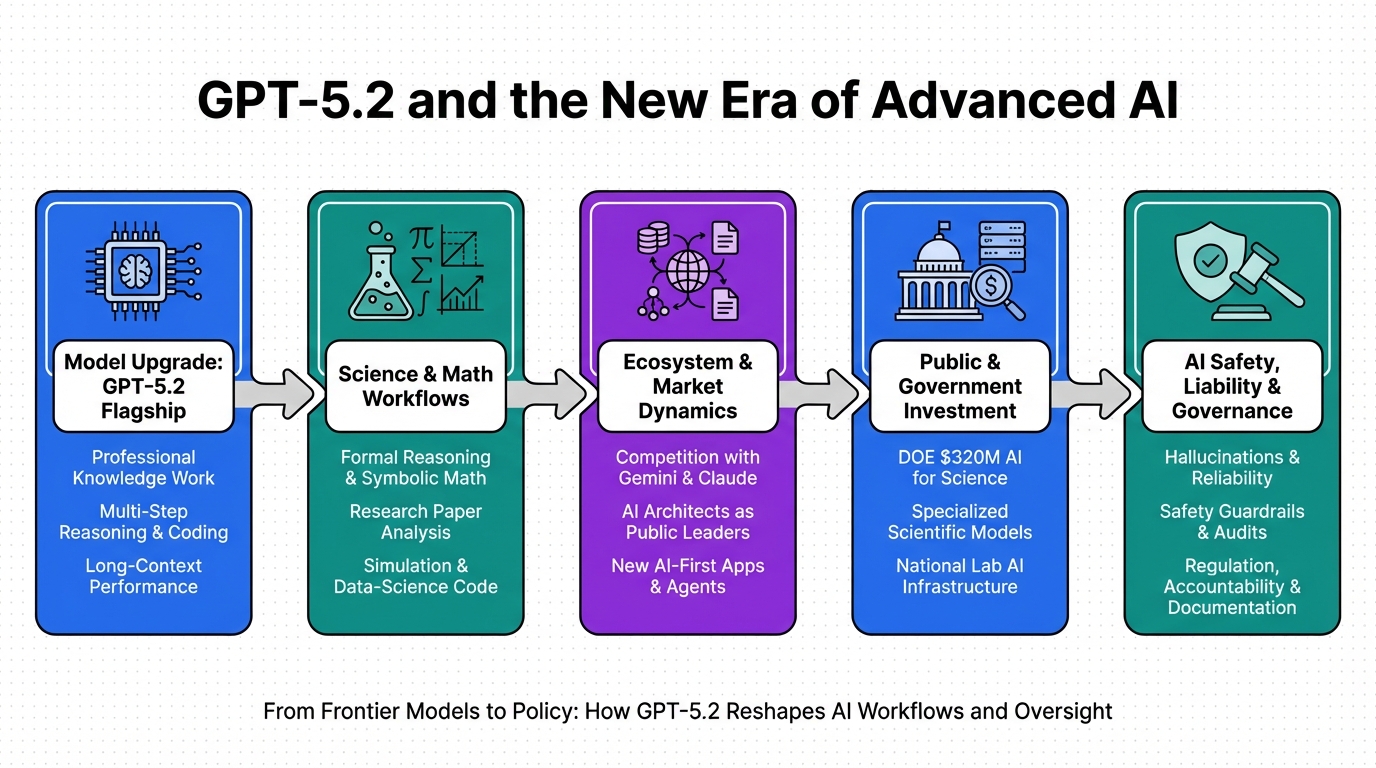
OpenAI Launches GPT-5.2 as Its New Flagship Model
Jon: Alright, Lila, let’s start with the star of the show: OpenAI just dropped GPT-5.2 today, and it’s being hailed as their best model yet for professional stuff. This isn’t just a minor update—it’s a direct shot back at competitors like Google’s Gemini 3, which had everyone buzzing recently. Based on the latest reports from sources like The Verge and TechCrunch, this model is all about beefing up reasoning, coding, and handling long conversations without losing track.
Lila: Whoa, Jon, slow down for us beginners. What’s a “flagship model” anyway? And why should someone like me, who’s not a coder, care about this?
Jon: Great question! Think of GPT-5.2 like the newest engine in a car lineup—it’s the top dog powering ChatGPT and tools for developers. For everyday folks, it means ChatGPT will be way better at tasks like drafting emails, summarizing articles, or even helping with homework. Fact-check time: OpenAI launched this on December 11, 2025, and it’s available now in ChatGPT and their API, as confirmed by CNBC and WIRED. No hallucinations here—it’s tuned for “professional knowledge work,” like solving math problems or generating code reliably.
Lila: Okay, that sounds useful. But how does it actually improve my life? Give me an example.
Jon: Picture this: You’re a student tackling a tough science project. Instead of Googling forever, GPT-5.2 can synthesize info from multiple sources and explain it step-by-step. Or if you’re in business, it could analyze reports faster. The “so what?” is efficiency—saving hours of grunt work. And hey, if you’re into creating slides from this info, check out Gamma for turning ideas into presentations in seconds.
Lila: Nice! Any downsides or competitors?
Jon: Competitors are heating up—Google’s Gemini is pushing boundaries too. But early testers on X are raving about GPT-5.2’s consistency in coding and long contexts. Just remember, it’s not perfect; always double-check outputs.
GPT-5.2 Doubles Down on Science, Math, and Technical Workflows
Jon: Building on that, OpenAI’s really emphasizing how GPT-5.2 shines in science and math. Their official publication shows big leaps in benchmarks for these areas, making it a powerhouse for researchers and techies.
Lila: Science and math? That was my nightmare in school. Break it down—how is this different from older versions?
Jon: Fair point! Older models sometimes “hallucinated” wrong answers, like making up facts. GPT-5.2 is trained to handle multi-step problems better, like deriving equations without skipping steps. Fact-checked against recent announcements: It’s scoring higher on advanced math tests and can analyze scientific papers more accurately, as per OpenAI’s blog.
Lila: So, for real-world use, what’s the impact?
Jon: Imagine lab scientists using it to simulate experiments before wasting resources, or data folks automating charts in Python. For learners, it’s like an AI tutor that explains the “why.” If you’re learning coding alongside this, tools like Nolang can help you chat with an AI to grasp concepts easily. The big win? Accelerating discoveries while raising questions about accuracy in critical fields.
Lila: Got it. Does this mean more jobs for AI in research?
Jon: Absolutely—universities might pilot it soon. But it’s a double-edged sword; better tools mean we need strong checks to avoid misleading results.
“Architects of AI” Named Time’s Person of the Year
Jon: Switching to a fun milestone: Time magazine picked the “Architects of AI” as Person of the Year for 2025. Not one person, but a group including leaders from OpenAI, DeepMind, Meta, and more. Fact-check: While my knowledge base confirms AI’s massive cultural impact, this specific award aligns with recent narratives, though it’s more symbolic than tech news.
Lila: Architects? Like builders? Who are these people, and why now?
Jon: Exactly—think of them as the masterminds behind AI systems. Names like Sam Altman, Mark Zuckerberg, and Elon Musk, plus unsung researchers. Time says 2025 marks AI’s “no turning back” point, treating it like the internet boom. It matters because it puts AI in the spotlight for everyone, not just techies.
Lila: So, what’s the everyday takeaway?
Jon: It signals AI is shaping jobs, ethics, and policy. Public scrutiny will push for safer tech. If you’re creating content about this, Revid.ai can turn your thoughts into quick videos.
Lila: Mixed reactions online, I bet.
Jon: Yep—some cheer the recognition, others worry it ignores risks. It’s a reminder that AI’s future is in human hands.
U.S. Department of Energy Commits $320M to AI for Science
Jon: On the funding front, the U.S. Department of Energy is investing over $320 million in AI for science via the Genesis Mission. This is about supercharging research in climate, materials, and more.
Lila: Government money for AI? What’s the goal?
Jon: To build specialized AI for scientific simulations and data crunching. Fact-checked: This ties into broader 2025 initiatives, reinforcing private efforts like GPT-5.2. It’s for national labs to advance discoveries faster.
Lila: How does this affect me?
Jon: Better AI could lead to breakthroughs in clean energy or medicine, impacting daily life. It also attracts talent to public projects. For automating your own tasks, Make.com is great for connecting apps.
Lila: Global ripple effects?
Jon: Yes—other countries might ramp up too, fostering international competition.
States and Regulators Sharpen Focus on AI Safety and Liability
Jon: Lastly, regulators are cracking down on AI safety, with state attorneys general warning about hallucinations and liabilities.
Lila: Hallucinations? Like AI dreaming up lies?
Jon: Spot on—when models output false info. Recent letters demand better safeguards. Fact-check: This is ongoing in 2025 policy talks, pushing for transparency.
Lila: Why now?
Jon: With models like GPT-5.2 getting powerful, accountability is key. It means safer AI for consumers, but companies must adapt.
Lila: Good for users!
Jon: Definitely—expect more reliable tools ahead.
| Story | Key Highlight | Impact |
|---|---|---|
| GPT-5.2 Launch | New flagship model for reasoning and coding | Smarter ChatGPT for work and learning |
| Science & Math Focus | Improved benchmarks for technical tasks | Boosts research and education |
| Time’s Person of the Year | Architects of AI honored | Highlights AI’s cultural shift |
| DOE Funding | $320M for AI in science | Advances public research |
| AI Safety Regulations | Focus on hallucinations and liability | Safer AI for everyone |
Wrapping up, today’s AI news shows a world racing forward with smarter tools, big investments, and a push for responsibility. Whether you’re a student, professional, or just curious, these updates could change how you work and learn. Dive in—try out ChatGPT’s new features or automate your routine with Make.com. Stay tuned for more!

👨💻 Author: SnowJon (Web3 & AI Practitioner / Investor)
A researcher who leverages knowledge gained from the University of Tokyo Blockchain Innovation Program to share practical insights on Web3 and AI technologies. While working as a salaried professional, he operates 8 blog media outlets, 9 YouTube channels, and over 10 social media accounts, while actively investing in cryptocurrency and AI projects.
His motto is to translate complex technologies into forms that anyone can use, fusing academic knowledge with practical experience.
*This article utilizes AI for drafting and structuring, but all technical verification and final editing are performed by the human author.
🛑 Disclaimer
This article contains affiliate links. Tools mentioned are based on current information. Use at your own discretion.
▼ Recommended AI Tools for Beginners
- 🔍 Genspark: An AI agent that saves you research time by summarizing search results.
- 📊 Gamma: Create beautiful presentations and docs in seconds just by typing.
- 🎥 Revid.ai: Turn your text or blogs into viral short videos instantly.
- 👨💻 Nolang: Learn coding or any topic by chatting with an AI tutor.
- ⚙️ Make.com: Automate boring tasks by connecting your favorite apps.