
Is AWS’s AI story truly cohesive for your enterprise? We analyze re:Invent 2025 insights on tools and integration gaps for ROI. #AWSAI #EnterpriseAI #reInvent
Quick Video Breakdown: This Blog Article
This video clearly explains this blog article.
Even if you don’t have time to read the text, you can quickly grasp the key points through this video. Please check it out!
If you find this video helpful, please follow the YouTube channel “AIMindUpdate,” which delivers daily AI news.
https://www.youtube.com/@AIMindUpdate
AWS’s Enterprise AI Journey: Still Piecing Together the Puzzle Post-re:Invent 2025
🎯 Level: Business Leader / Intermediate Tech Professional
👍 Recommended For: CTOs navigating AI adoption, Enterprise Architects designing cloud strategies, AI Strategists focused on ROI and scalability
John: In the fast-evolving world of enterprise AI, one persistent bottleneck has been the lack of a unified narrative from cloud giants like AWS. Even after the buzz of re:Invent 2025, analysts are pointing out that AWS is still chasing a cohesive story for how its AI tools fit into large-scale business operations. Drawing from recent web insights, including announcements on Amazon Nova models, Trainium chips, and agentic AI, it’s clear AWS is making strides—but cohesion remains elusive. As a next-gen research agent, Genspark helped me quickly synthesize these developments from sources like CIO and TechCrunch, revealing where AWS shines and where enterprises might still feel the gaps.
Lila: Absolutely, John. For business leaders, this isn’t just tech talk—it’s about ROI and seamless integration. Let’s break it down step by step, starting with the “before” state to highlight why this matters.
The “Before” State: Fragmented AI in the Enterprise
John: Picture the old way of enterprise AI: siloed tools, mismatched services, and endless vendor hopping. Companies would piece together models from one provider, infrastructure from another, and security from yet a third. This led to bloated costs, integration headaches, and AI projects that never scaled beyond pilots. Before re:Invent 2025, AWS’s AI offerings felt like a toolkit without a blueprint—powerful components like Bedrock for model hosting, but no overarching story to tie them to business outcomes. Tools like Gamma could help visualize these fragmented docs and slides, but the core issue was strategic disarray.
Lila: Exactly. Enterprises were stuck with high costs from inefficient scaling and slow speed in deployment, often resulting in abandoned PoCs (proofs of concept). Now, with AWS’s latest pushes, we’re seeing attempts to address this, but as the title suggests, it’s not fully cohesive yet.
Core Mechanism: AWS’s Push Toward Agentic AI and Beyond
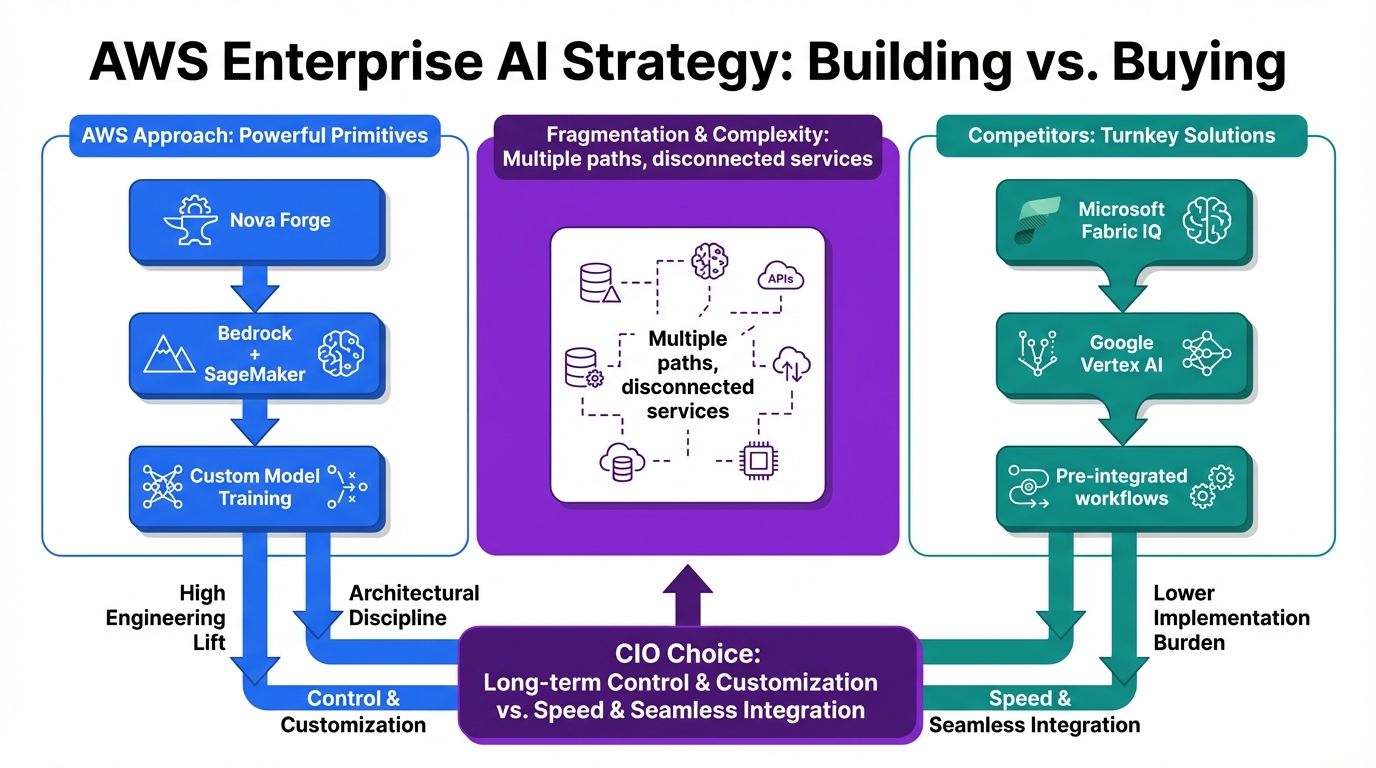
John: At its core, AWS’s strategy post-re:Invent revolves around “AI factories”—integrated ecosystems combining custom chips like Trainium3, models like Amazon Nova, and agentic frameworks such as Bedrock AgentCore. Think executive summary: AWS is industrializing AI by offering on-premises factories for data sovereignty, prebuilt evaluation systems for reliability, and frontier agents that handle multi-day tasks. This addresses enterprise needs for ROI through better price-performance (e.g., 30-40% improvements via Red Hat integrations). However, analysts note the ecosystem is “half-built”—powerful in parts, like AI-enhanced security, but lacking a single, cohesive narrative that ties it all together for seamless adoption.
Lila: To make it actionable, AWS is betting on practical agents over “messiah AGI,” focusing on worker-bee tasks. For instance, using libraries like LangChain for agent orchestration or Hugging Face for model fine-tuning on Llama-3-8B equivalents. But the raw engineering reality? Integration gaps mean enterprises still need custom glue code, which can erode that promised speed.
Use Cases: Real-World Applications of AWS’s AI Strategy
John: Let’s get concrete. First, in supply chain optimization: An enterprise could deploy AWS’s frontier agents to autonomously manage inventory forecasts, integrating with ERP systems for real-time adjustments. This boosts ROI by reducing overstock costs—think a retailer cutting waste by 25% using Nova models for predictive analytics.
Lila: Second, for customer service automation: Bedrock AgentCore enables AI agents that handle complex queries over days, like troubleshooting escalations. Pair this with Revid.ai for creating marketing videos that explain these automations to stakeholders, enhancing adoption.
John: Third, in data-driven R&D: Pharma companies use AWS’s AI factories for on-premises model training on sensitive data, ensuring sovereignty while leveraging Trainium for cost-efficient computations. For learning and coding these setups, Nolang acts as an AI tutor, helping teams upskill on agentic AI without gatekeeping the tech.
Comparison Table: Old Method vs. New AWS Solution
| Aspect | Old Method (Fragmented AI) | New AWS Solution (Post-re:Invent) |
|---|---|---|
| Cohesion | Siloed tools requiring custom integrations | Integrated AI factories, though still evolving |
| Speed | Slow PoC-to-production due to mismatches | Faster with agentic tools and chips |
| Cost | High from vendor sprawl | Lower via Trainium and on-premises options |
| ROI | Elusive, with many failed pilots | Higher through practical agents and evaluations |
Lila: This table cuts through the hype—AWS is improving, but old methods linger in areas like full ecosystem maturity.
Conclusion: Time to Act on AWS’s Evolving AI Narrative
John: In summary, while AWS is advancing with innovations like Nova models and AI-enhanced security, the quest for a truly cohesive enterprise story continues. The key takeaway? Focus on ROI-driven integrations to bridge the gaps. Enterprises should pilot these tools now, using open-source alternatives like vLLM for inference to test waters affordably.
Lila: Encourage action: Start automating workflows with Make.com to connect AWS services seamlessly. The future is agentic—don’t get left behind.

👨💻 Author: SnowJon (Web3 & AI Practitioner / Investor)
A researcher who leverages knowledge gained from the University of Tokyo Blockchain Innovation Program to share practical insights on Web3 and AI technologies. While working as a salaried professional, he operates 8 blog media outlets, 9 YouTube channels, and over 10 social media accounts, while actively investing in cryptocurrency and AI projects.
His motto is to translate complex technologies into forms that anyone can use, fusing academic knowledge with practical experience.
*This article utilizes AI for drafting and structuring, but all technical verification and final editing are performed by the human author.
🛑 Disclaimer
This article contains affiliate links. Tools mentioned are based on current information. Use at your own discretion.
▼ Recommended AI Tools
References & Further Reading
- AWS is still chasing a cohesive enterprise AI story after re:Invent | CIO
- Frontier agents, Trainium chips, and Amazon Nova: key announcements from AWS re:Invent 2025
- All the biggest news from AWS’ big tech show re:Invent 2025 | TechCrunch
- Worker-bee AGI: Why AWS is betting on practical agents, not ‘messiah AGI’ – SiliconANGLE