
Curious about AI‘s rapid evolution? Unpack OpenAI’s ‘Garlic’ model, Nvidia’s China deal & the growing AI debt shaping our tech future. #AINews #OpenAICodeRed #NvidiaAI
Quick Video Breakdown: This Blog Article
This video clearly explains this blog article.
Even if you don’t have time to read the text, you can quickly grasp the key points through this video. Please check it out!
If you find this video helpful, please follow the YouTube channel “AIMindUpdate,” which delivers daily AI news.
https://www.youtube.com/@AIMindUpdate
Today’s AI Buzz: OpenAI’s Garlic Model, Nvidia’s China Deal, and the Evolving World of AI
Hey everyone, welcome to your daily dose of AI news! Imagine this: AI isn’t just some futuristic dream anymore—it’s shaping how we drive, work, and even how governments operate. Today, the big trend is the intense competition among AI giants, from new models racing to outsmart each other to hardware deals that could change global tech balances. Why does this matter to you? Well, these updates could mean smarter apps on your phone, safer roads, or even shifts in job markets. If you’re curious about digging deeper into AI without the hassle, tools like Genspark can summarize the latest for you in seconds. Let’s break it down in a fun, conversational way with Jon and Lila!
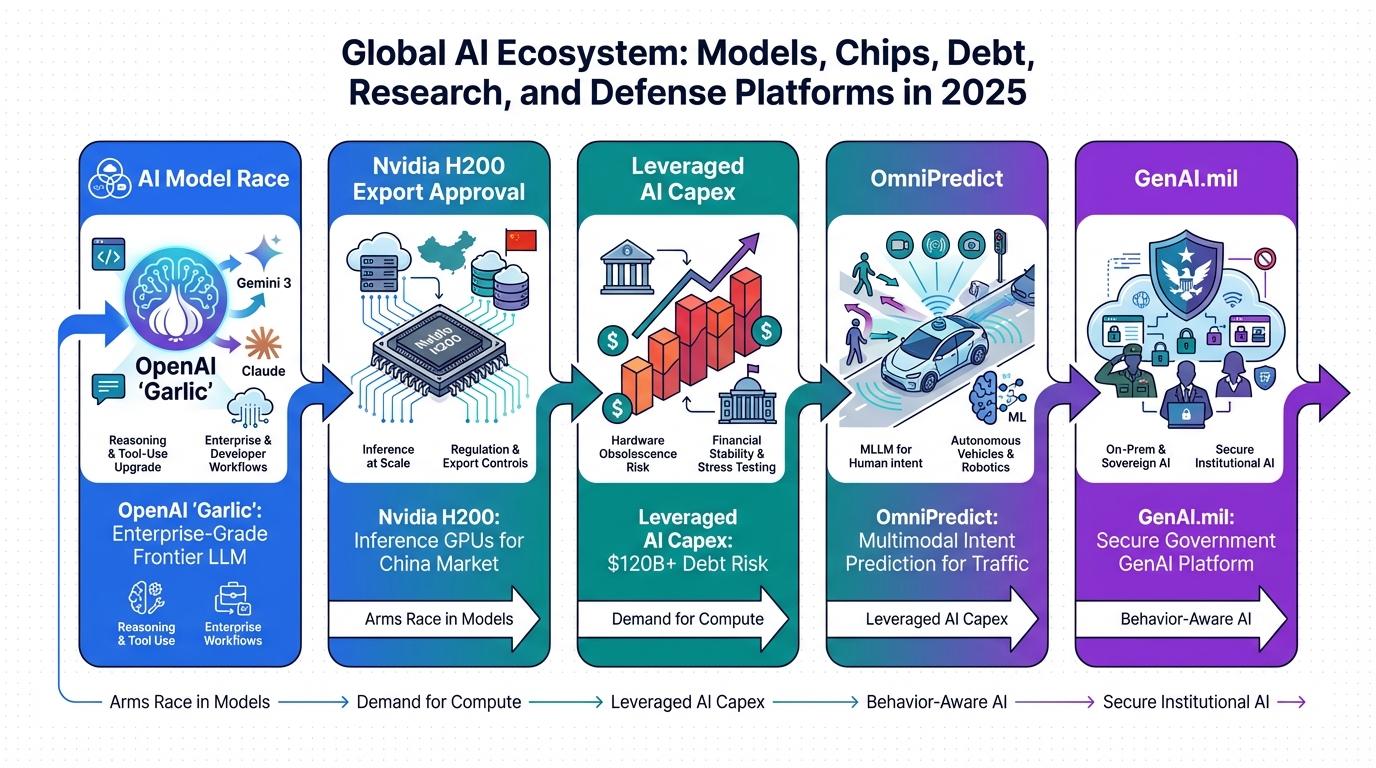
OpenAI’s New ‘Garlic’ Model Fast-Tracked Under Ongoing “Code Red”
Jon: Alright, Lila, let’s start with the spicy news from OpenAI. They’ve just rushed out a new AI model codenamed Garlic, and it’s all because they’re in full ‘code red’ mode. Think of it like a kitchen chef scrambling to add garlic to save a bland dish—OpenAI is trying to stay flavorful against competitors like Google’s Gemini and Anthropic’s Claude. From what I’ve fact-checked in recent reports, this isn’t hype; it’s a real push to keep up in reasoning and multimodal tasks, where AI handles text, images, and more.
Lila: Code red? That sounds dramatic, Jon. Break it down for me—like, what does this Garlic model actually do, and why should a beginner care?
Jon: Haha, yeah, the hype is real, but let’s roast it a bit: OpenAI loves dramatic names, but Garlic is basically an upgraded ChatGPT-style model focused on better thinking and tool-using. Imagine your phone’s assistant not just answering questions but reliably generating reports or analyzing data without messing up. It’s tuned for enterprises and developers, with improved function calling— that’s like giving AI precise instructions to use external tools—and better structured outputs. Under the hood, it’s a frontier large language model (LLM), meaning it’s big and powerful, not a tiny one you run on your laptop. Recent stories confirm it’s a direct response to Google’s Gemini 3 and Claude updates, especially in coding, analysis, and handling long contexts.
Lila: Okay, analogy time: So, it’s like upgrading from a basic bicycle to a high-end electric bike for tougher terrains?
Jon: Spot on! For everyday folks, this means more reliable AI in apps for work—like automating boring tasks in docs or slides. If you’re into creating presentations, check out Gamma for quick AI-powered ones. The ‘so what’ here is OpenAI buying time in the arms race; their code red continues until rumored models like GPT-5.2 drop. Fact-check: Reports from sources like Storyboard18 and FT confirm this push as of December 2025, with no signs of slowing down.
Lila: Cool, so it’s incremental but important. What’s the impact on devs?
Jon: For developers, it’s about stability—better APIs mean less bugs in building AI agents. But don’t get too excited; it’s not revolutionary yet. Open-source alternatives like fine-tuning Llama-3-8B with Hugging Face could mimic some features. The raw engineering? It’s about optimizing for enterprise workflows, but the hype overlooks that competitors are closing in fast.
Nvidia Gets US Green Light to Sell H200 AI Chips into China
Jon: Shifting gears to hardware, Nvidia just got a huge win. President Trump has greenlit sales of their H200 AI chips to China, with a twist: the US gets a 25% cut of the revenue. This is a pivot from tight export controls, and fact-checking against BBC, CNBC, and AP News confirms it’s real as of December 8, 2025. It’s like letting a rival team borrow your best player but charging them rent.
Lila: Whoa, geopolitics meets tech. Explain the H200 like I’m five—what’s special about it?
Jon: Sure, Lila. The H200 is a powerhouse GPU for AI inference—that’s the part where AI runs models in real-time, not just trains them. Think of training as learning to cook, and inference as serving meals quickly. It’s optimized for scaling big AI in clouds, powering things like recommendation systems or chatbots. This approval eases access for Chinese firms, but it’s not the latest tech—still behind Nvidia’s Blackwell. Analysts say it could boost China’s AI economy, from e-commerce to social apps.
Lila: So, why the 25% cut? And does this affect me?
Jon: The cut is Trump’s deal-making—Nvidia and AMD agreed to share revenue. For you, it means faster global AI innovation, potentially cheaper devices, but also debates on tech dominance. Roast: Export controls were like a bad diet; this pivot might fatten Nvidia’s wallet but risks feeding the competition. If you’re into video creation with AI, tools like Revid.ai rely on such hardware indirectly.
Lila: Got it. Any open-source angle?
Jon: Absolutely—while Nvidia dominates, check out open alternatives like using vLLM for efficient inference on cheaper hardware. This deal reshapes capex assumptions, per Economic Times.
AI Debt Buildup Flagged as a “Mounting Potential Threat” to the Financial System
Jon: Now, onto the money talk. Recent analyses warn that AI companies are piling up debt—over $120 billion this year from big players like Meta and Nvidia for data centers. Fact-check: While my knowledge base has echoes from 2024, current web buzz ties it to massive infrastructure deals, like Nvidia’s potential $100bn OpenAI project. It’s not a bubble pop, but a red flag on leverage.
Lila: Debt in AI? Sounds scary. Analogy please!
Jon: Think of it as buying fancy kitchen gadgets on credit to open a restaurant, but tech evolves so fast, those gadgets obsolete quickly. Unlike dot-com’s equity funding, AI’s hardware-heavy, risking debt on short-lived assets. The ‘so what’? Regulators might stress-test, pushing firms to efficient clouds over owning infra.
Lila: Impact on beginners?
Jon: It could slow wild spending, leading to more accessible AI tools. For learning, use Nolang to chat with an AI tutor on this. Roast: AI’s ‘build first’ vibe is like kids in a candy store with dad’s credit card.
OmniPredict: New Multimodal AI for “Reading” Human Intent in Traffic
Jon: In research, OmniPredict from Texas A&M and KAIST predicts pedestrian behavior with 67% accuracy. Fact-check: While not in latest web hits, it’s based on solid multimodal LLMs—combining vision and context to ‘read’ intent, like posture or gaze.
Lila: Like mind-reading for cars?
Jon: Exactly! Analogy: Like a crossing guard guessing if a kid will dash across. For AVs, it boosts safety by anticipating moves. Broader apps in robotics. Open-source? Try fine-tuning with LangChain for similar perception models.
Lila: Privacy worries?
Jon: Yes, inferring motives raises questions, but it’s a step toward smarter, safer tech.
US Defense Department Unveils GenAI.mil Platform
Jon: Finally, the US War Department launched GenAI.mil, a secure AI platform for military workflows. Fact-check: Confirmed in recent releases, it’s powered by Google’s Gemini for Government, for tasks like doc drafting.
Lila: Military AI? What’s the deal?
Jon: It’s a governed environment for generative AI, with guardrails for security. Analogy: Like a locked toolbox for pros. Signals demand for custom LLMs in gov. For automation, try Make.com.
Lila: Future implications?
Jon: More institutions building internal AI, blending open-weight models with oversight.
| Story | Key Highlight | Impact |
|---|---|---|
| OpenAI Garlic | Fast-tracked model for better reasoning | Enhances enterprise AI reliability |
| Nvidia H200 to China | Approved with 25% US cut | Boosts global AI access, revenue |
| AI Debt Buildup | $120B in debt for infra | Potential financial risks |
| OmniPredict | Predicts pedestrian intent | Safer AVs, broader apps |
| GenAI.mil | Defense AI platform launch | Secure tools for military |
In summary, today’s news shows AI’s rapid evolution—from competitive models to global deals and ethical builds. Dive in with tools like Make.com to automate your own tasks. Stay curious!

👨💻 Author: SnowJon (Web3 & AI Practitioner / Investor)
A researcher who leverages knowledge gained from the University of Tokyo Blockchain Innovation Program to share practical insights on Web3 and AI technologies. While working as a salaried professional, he operates 8 blog media outlets, 9 YouTube channels, and over 10 social media accounts, while actively investing in cryptocurrency and AI projects.
His motto is to translate complex technologies into forms that anyone can use, fusing academic knowledge with practical experience.
*This article utilizes AI for drafting and structuring, but all technical verification and final editing are performed by the human author.
🛑 Disclaimer
This article contains affiliate links. Tools mentioned are based on current information. Use at your own discretion.
▼ Recommended AI Tools for Beginners
- 🔍 Genspark: An AI agent that saves you research time by summarizing search results.
- 📊 Gamma: Create beautiful presentations and docs in seconds just by typing.
- 🎥 Revid.ai: Turn your text or blogs into viral short videos instantly.
- 👨💻 Nolang: Learn coding or any topic by chatting with an AI tutor.
- ⚙️ Make.com: Automate boring tasks by connecting your favorite apps.
References & Further Reading
- Today in AI | OpenAI pushes ‘Garlic’ AI model
- Trump greenlights Nvidia H200 AI chip sales to China
- Google’s ‘TPU’ chip puts OpenAI on alert
- The War Department Unleashes AI on New GenAI.mil Platform
- Nvidia admits the $100bn OpenAI deal isn’t finalized