OpenAI‘s Neptune acquisition promises to end fragmented AI model training. See how this move delivers faster development, cuts costs, and boosts enterprise ROI. #OpenAI #AITraining #EnterpriseAI
Quick Video Breakdown: This Blog Article
This video clearly explains this blog article.
Even if you don’t have time to read the text, you can quickly grasp the key points through this video. Please check it out!
If you find this video helpful, please follow the YouTube channel “AIMindUpdate,” which delivers daily AI news.
https://www.youtube.com/@AIMindUpdate
OpenAI’s Strategic Acquisition of Neptune: Revolutionizing AI Model Training for Enterprises
🎯 Level: Business Leader / Intermediate Tech Professional
👍 Recommended For: AI Project Managers, Enterprise Tech Executives, Data Science Teams
In the fast-paced world of AI development, one persistent bottleneck has plagued enterprises: the inefficiency of tracking and optimizing model training processes. As companies scale their AI initiatives, the lack of robust tools for monitoring experiments often leads to wasted resources, prolonged development cycles, and suboptimal model performance. Enter OpenAI’s recent move to acquire Neptune, a specialized platform for AI experiment tracking. This acquisition, announced just days ago, positions OpenAI to supercharge its internal workflows and potentially extend these benefits to its enterprise clients. For those navigating this landscape, tools like Genspark, a next-gen research agent, can help you quickly aggregate insights on such deals and their implications.
The “Before” State: Traditional Challenges in AI Training
Before integrations like Neptune, AI teams relied on fragmented tools—think spreadsheets, custom scripts, and disparate logging systems—to track model training. This “old way” often resulted in chaotic data silos, making it nearly impossible to reproduce experiments or collaborate effectively across teams. Imagine spending weeks fine-tuning a model only to lose track of key hyperparameters, leading to repeated efforts and skyrocketing costs. In contrast, Neptune offers a unified platform for logging, visualizing, and comparing runs, streamlining what was once a manual nightmare. For documenting these processes, consider Gamma, which lets you generate professional docs and slides effortlessly to share your findings.
John: Alright, folks, let’s cut the fluff. As a battle-hardened tech lead who’s seen more failed AI projects than I’d like to admit, the pre-Neptune era was like trying to navigate a storm with a paper map. Teams were drowning in logs, and ROI? Forget about it—most experiments evaporated into the ether without actionable insights.
Lila: Exactly, John. For beginners dipping into AI, think of it like baking without a recipe book. You mix ingredients (data and parameters), but without tracking what worked, you’re just guessing next time. Neptune changes that by acting as your digital notebook.
Core Mechanism: Executive Summary of Neptune’s Integration
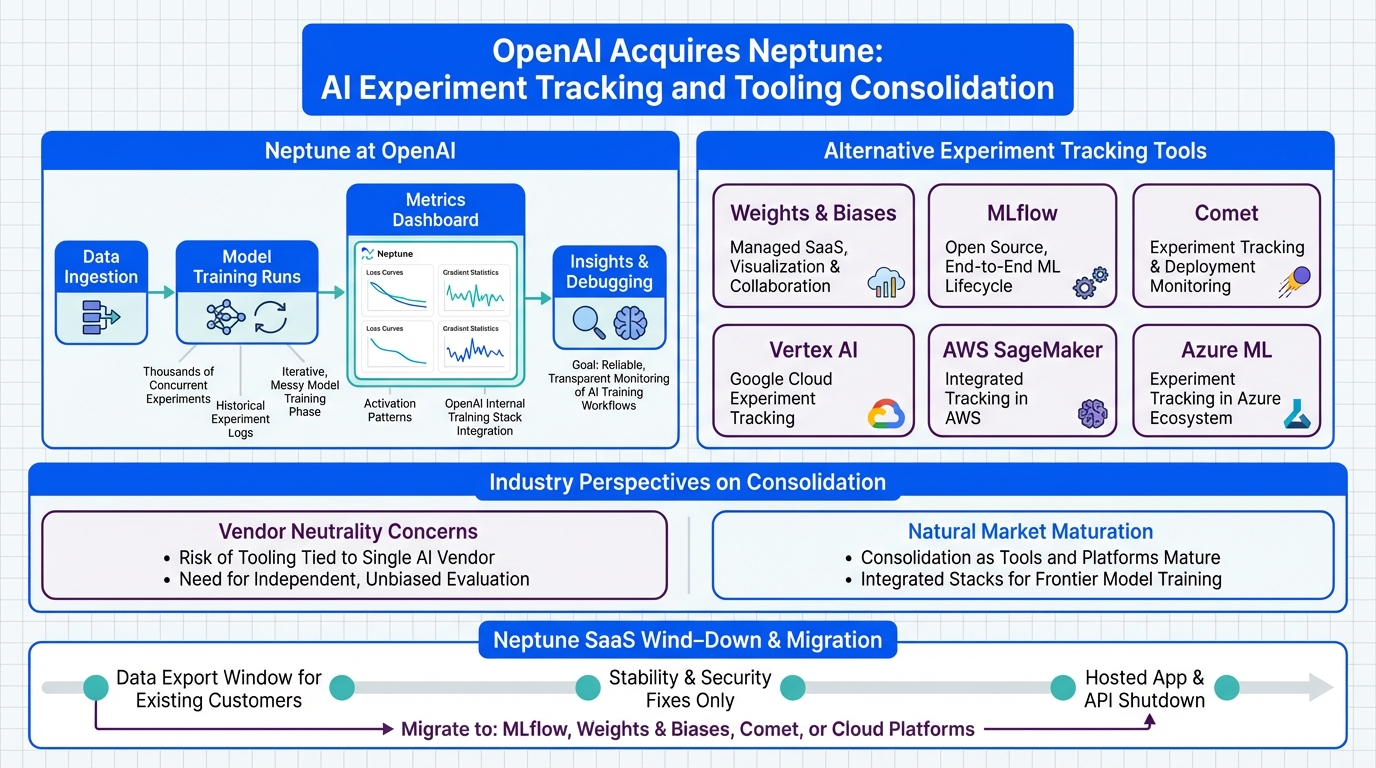
At its core, Neptune functions as an experiment management system tailored for machine learning workflows. It integrates seamlessly with popular frameworks like TensorFlow, PyTorch, and Hugging Face, allowing teams to log metrics, artifacts, and metadata in real-time. From an executive perspective, this translates to enhanced visibility: dashboards for monitoring training progress, version control for models, and collaborative features that reduce silos. OpenAI, already a user of Neptune for debugging GPT models, is acquiring it in an all-stock deal valued under $400 million to internalize these capabilities, accelerating their R&D. The result? Faster iteration cycles, reduced computational costs, and higher ROI through data-driven decisions.
John: Here’s the raw engineering truth: Neptune isn’t some magic wand—it’s built on solid backend tech like MongoDB for storage and React for the UI, making it scalable for enterprise loads. By acquiring it, OpenAI is basically fortifying their training pipeline, much like upgrading from a bicycle to a jet engine in the AI race.
Lila: To bridge this for non-experts, imagine Neptune as the GPS for your AI journey. It tracks every turn (experiment), flags roadblocks (failures), and suggests shortcuts (optimizations), ensuring you reach your destination efficiently.
Use Cases: Real-World Applications Post-Acquisition
Let’s explore three concrete scenarios where Neptune’s integration could transform enterprise AI efforts.
First, in large-scale model development, such as fine-tuning Llama-3-8B for custom applications, teams can use Neptune to compare hundreds of runs side-by-side. This is invaluable for R&D departments at companies like Samsung or HP—former Neptune clients—aiming to optimize for specific industries. For visualizing these comparisons in marketing materials, Revid.ai can turn your data into engaging videos.
Second, for collaborative projects in healthcare AI, where compliance and reproducibility are critical, Neptune ensures every parameter and outcome is logged immutably. This mitigates risks in regulated environments, allowing teams to audit experiments effortlessly.
Third, in educational or upskilling contexts, developers learning AI can leverage Neptune’s free tiers to track personal projects, building portfolios of optimized models. Tools like Nolang complement this by providing AI-guided coding tutorials to get started.
John: I’ve roasted enough hype in my day—Neptune’s real value shines in production. Take a GitHub repo like the Hugging Face Transformers; integrating Neptune means logging via simple APIs, turning chaos into structured insights. No more ‘it worked on my machine’ excuses.
Lila: And for those new to this, it’s like having a coach during a marathon—tracking your pace, hydration (resources), and form to avoid burnout.
Comparison: Old Method vs. New Solution
| Aspect | Old Method (Fragmented Tools) | New Solution (Neptune Integration) |
|---|---|---|
| Tracking Efficiency | Manual logging in spreadsheets; error-prone and time-consuming | Automated, real-time logging with visual dashboards |
| Collaboration | Siloed data; difficult to share experiments | Team-wide access and version control |
| Cost Impact | High due to redundant runs and wasted compute | Lower costs via optimized experiments |
| Scalability | Limited; breaks at enterprise scale | Built for large teams and complex models |
Conclusion: Seize the Opportunity in AI Optimization
OpenAI’s acquisition of Neptune marks a pivotal step in enhancing AI training infrastructure, promising speedier development, cost savings, and superior ROI for enterprises. As the AI landscape evolves, adopting such tools isn’t optional—it’s essential for staying competitive. Start by exploring similar open-source alternatives like MLflow or Weights & Biases, and automate your workflows with Make.com to integrate these seamlessly.
John: Bottom line: This deal is OpenAI flexing its muscles, but the real winners are the engineers who get to build without the headaches. Dive in, experiment, and remember—tech’s only as good as how you wield it.
Lila: Absolutely. If you’re just starting, begin small: Track one project with a free tool, and watch your efficiency soar.

👨💻 Author: SnowJon (Web3 & AI Practitioner / Investor)
A researcher who leverages knowledge gained from the University of Tokyo Blockchain Innovation Program to share practical insights on Web3 and AI technologies. While working as a salaried professional, he operates 8 blog media outlets, 9 YouTube channels, and over 10 social media accounts, while actively investing in cryptocurrency and AI projects.
His motto is to translate complex technologies into forms that anyone can use, fusing academic knowledge with practical experience.
*This article utilizes AI for drafting and structuring, but all technical verification and final editing are performed by the human author.
🛑 Disclaimer
This article contains affiliate links. Tools mentioned are based on current information. Use at your own discretion.
▼ Recommended AI Tools
References & Further Reading
- OpenAI to acquire AI training tracker Neptune | InfoWorld
- OpenAI agrees to acquire AI startup Neptune to boost model training capabilities | Reuters
- OpenAI agrees to buy Neptune – Yahoo Finance