
Unraveling OpenAI‘s Circular Investment Strategy: A Deep Dive into the Thrive Holdings Deal
🎯 Level: Business Leader
👍 Recommended For: Tech Entrepreneurs, Venture Capital Investors, AI Strategy Executives
John: In the high-stakes world of AI investments, one persistent bottleneck has been the tangled web of funding cycles—companies pouring billions into R&D only to chase more capital in endless loops. But OpenAI’s latest move with Thrive Holdings flips the script, creating a symbiotic ecosystem that could redefine enterprise AI adoption. If you’re navigating this space, tools like Genspark, a next-gen research agent, can help you cut through the noise and uncover real-time insights on deals like this.
Lila: Absolutely, John. For those new to this, think of it like a self-sustaining garden: OpenAI invests in a company that’s already invested in them, fostering growth that benefits both. But let’s break it down without the jargon overload.
In the fast-evolving AI landscape, circular investments aren’t new, but OpenAI’s stake in Thrive Holdings marks a bold escalation. Announced in early December 2025, this deal sees OpenAI acquiring an ownership interest in Thrive Holdings—a vehicle created by Thrive Capital, one of OpenAI’s major backers. According to sources like TechCrunch and The Register, Thrive Holdings aims to start and acquire companies that leverage AI for business acceleration, with OpenAI’s tech at the core. This isn’t just about money; it’s a strategic play to boost enterprise adoption of models like GPT variants, potentially driving ROI through integrated services in areas like managed accounting and beyond.
The “Before” State: Traditional Investment Silos vs. Integrated Ecosystems
John: Remember the old days of AI funding? Startups would raise rounds from VCs, burn through cash on isolated projects, and then scramble for the next infusion. It was inefficient, with high costs and slow speed to market. No real synergy—just isolated bets hoping for unicorn status.
Lila: Exactly. Before deals like this, you’d see AI firms operating in silos, leading to duplicated efforts and missed opportunities for cross-pollination. Now, with circular models, it’s like upgrading from a bicycle to a high-speed train. And for visualizing these shifts in your pitches or reports, check out Gamma—it generates docs and slides effortlessly to map out these strategies.
This contrast highlights a shift from fragmented funding to cohesive ecosystems. In the traditional model, investments were linear: VC funds AI startup, startup builds product, hopes for acquisition or IPO. But circular deals create feedback loops, where investments generate mutual value, reducing risk and amplifying growth.
Core Mechanism: Executive Summary of the Circular Deal Logic
John: At its core, this is executive-level chess. Thrive Capital, a key OpenAI investor, spins off Thrive Holdings to incubate AI-powered businesses. OpenAI then invests back, gaining a stake while committing to tech integration. It’s a win-win: OpenAI gets preferred access to enterprise applications, and Thrive leverages cutting-edge AI for its portfolio. Analysts from HSBC and others predict this could help OpenAI address its projected $207 billion funding gap by 2030, as noted in recent Fortune reports, by creating profitable, long-term ventures.
Lila: To simplify, it’s like a business partnership where each side brings unique strengths—OpenAI’s AI muscle meets Thrive’s venture expertise. This isn’t hype; it’s grounded in real engineering, using tools like LangChain for seamless API integrations in Thrive’s services.
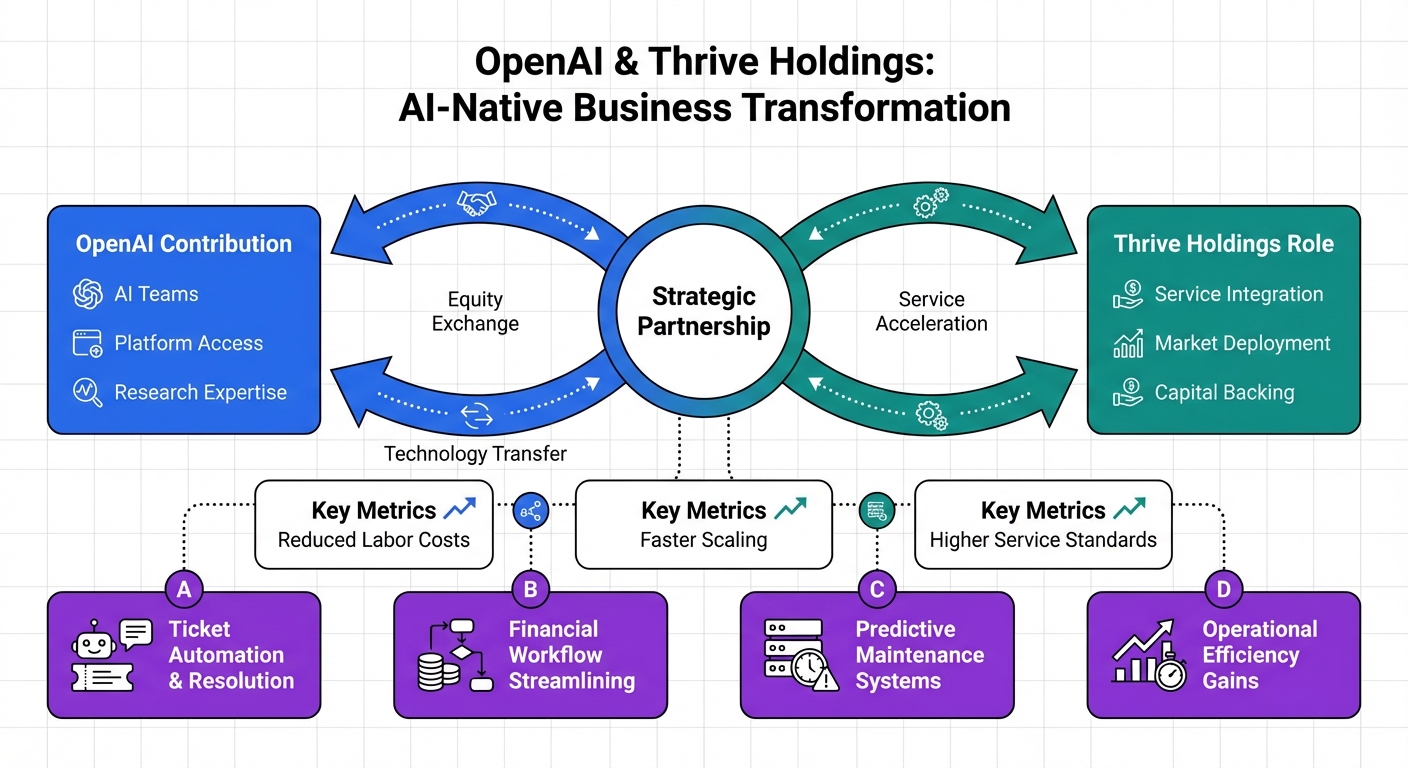
Diving deeper, the mechanism relies on shared intellectual property and accelerated adoption. OpenAI’s models, potentially fine-tuned versions of Llama-3 or custom GPTs via Hugging Face, get embedded into Thrive’s startups. This creates a flywheel effect: faster innovation, lower development costs, and higher ROI through scaled enterprise use. Recent data from Reuters shows similar circular plays, like Nvidia’s pending $100 billion OpenAI deal, underscoring the trend.
Use Cases: Real-World Applications of Circular AI Investments
John: Let’s get practical. First, imagine a fintech startup under Thrive Holdings using OpenAI’s tech for AI-driven fraud detection. This circular setup ensures rapid iteration, with OpenAI gaining real-time feedback to refine models—boosting enterprise trust and adoption.
Lila: Great example. Second, in healthcare analytics: Thrive acquires a company integrating OpenAI’s APIs for predictive diagnostics. The investment loop means shared data insights, accelerating FDA-compliant solutions while OpenAI hones its tech on domain-specific datasets.
John: Third, for marketing firms: Using tools like Revid.ai for AI video creation, a Thrive-backed agency could automate content at scale, with OpenAI’s stake ensuring priority access to advanced features. Or, for skill-building in these ecosystems, Nolang offers AI tutoring to upskill teams on coding for such integrations.
These scenarios illustrate how circular deals optimize workflows, turning speculative investments into tangible business value.
Comparison Table: Old Method vs. New Solution
| Aspect | Old Method (Linear Investments) | New Solution (Circular Deals) |
|---|---|---|
| Funding Efficiency | High dilution, repeated rounds | Mutual stakes reduce external needs |
| Speed to Market | Slow due to silos | Accelerated via integrated tech |
| ROI Potential | Uncertain, high risk | Higher through synergies |
| Cost Management | Escalating R&D expenses | Optimized shared resources |
Lila: See how the new approach dominates? It’s not just theory—it’s transforming AI business models.
Conclusion: Seize the Opportunity in AI’s Circular Economy
John: OpenAI’s Thrive Holdings investment isn’t a gimmick; it’s a blueprint for sustainable AI growth. By fostering these loops, companies can achieve faster innovation and better ROI. If you’re in enterprise AI, explore similar strategies—start by automating your workflows with Make.com to integrate tools seamlessly.
Lila: Dive in, leaders. The future of AI isn’t linear—it’s circular and collaborative.

👨💻 Author: SnowJon (Web3 & AI Practitioner / Investor)
A researcher who leverages knowledge gained from the University of Tokyo Blockchain Innovation Program to share practical insights on Web3 and AI technologies. While working as a salaried professional, he operates 8 blog media outlets, 9 YouTube channels, and over 10 social media accounts, while actively investing in cryptocurrency and AI projects.
His motto is to translate complex technologies into forms that anyone can use, fusing academic knowledge with practical experience.
*This article utilizes AI for drafting and structuring, but all technical verification and final editing are performed by the human author.
🛑 Disclaimer
This article contains affiliate links. Tools mentioned are based on current information. Use at your own discretion.
▼ Recommended AI Tools
References & Further Reading
- OpenAI’s investment into Thrive Holdings is its latest circular deal | TechCrunch
- OpenAI takes stake in Thrive Holdings, which invested in it • The Register
- OpenAI Gets Stake in Thrive Holdings, Adds to Circular Deals
- OpenAI won’t make money by 2030 and still needs to come up with another $207 billion to power its growth plans, HSBC estimates | Fortune