
Google Jobs API — One API to Access Millions of Job Listings Worldwide
Hey there, job hunters, recruiters, and tech enthusiasts! If you’ve ever felt like finding the perfect job is like searching for a needle in a global haystack, buckle up. We’re diving into the Google Jobs API, that powerhouse tool promising to unlock millions of listings with just a few lines of code. But is it all hype, or is there real engineering magic here? I’m John, your no-BS Senior Tech Lead from AI Mind Update, here to roast the fluff and reveal the raw tech. Joining me is Lila, our pragmatic dev who’s all about making this accessible for everyone—from curious newbies to seasoned engineers.
Lila: Let’s start simple. Imagine you’re at a massive job fair with booths from every company worldwide. Without a map, you’d wander endlessly. The Google Jobs API is like that smart map app on your phone—it pulls all the booths (job listings) into one searchable spot, saving you hours of chaos. For beginners, it’s a game-changer; no more manual browsing sites like Indeed or LinkedIn. But John, why does this actually matter in 2025 with all the updates?
John: Spot on, Lila. The hype around “one API to rule them all” sounds like marketing fairy dust, but the engineering underneath is solid—it’s built on Google’s massive search infrastructure, indexing jobs in real-time. Recent developments in 2025, like the shake-up with new Indexing API restrictions, have tightened how job boards submit data, making the API even more crucial for clean, compliant access. No more shady scraping; it’s about structured, efficient data pulls. Let’s break it down step by step.
Why Google Jobs API is a Must in 2025: The Big Picture
With unemployment fluctuating and remote work booming, accessing global job data isn’t just nice—it’s essential. Google Jobs API lets developers tap into listings from sources worldwide, filtered by location, salary, and keywords. But here’s the roast: It’s not truly “one API” for everything; it’s Google’s gateway, and with 2025 updates like enhanced AI integration from Gemini, it’s evolving to suggest personalized matches. Industry analysts predict it’ll handle even more AI-driven queries by 2026, per recent SERPHouse insights.
Lila: For beginners, think of it like ordering takeout via an app instead of calling every restaurant. You get options fast, with filters for “spicy” or “vegetarian” (aka “remote” or “entry-level”). Easy peasy!
John: Exactly. Now, for the engineers: The API uses RESTful endpoints, returning JSON structured with schema.org/JobPosting markup. Why does it work? Because Google’s crawlers index jobs using sitemaps and structured data, ensuring low-latency responses. But watch out—with the August 2025 restrictions on the Jobs Indexing API, direct submissions are limited, pushing more reliance on third-party integrations.
Key Insight: In 2025, ignoring these restrictions could get your app blacklisted—always use official channels!
How Google Jobs API Actually Works
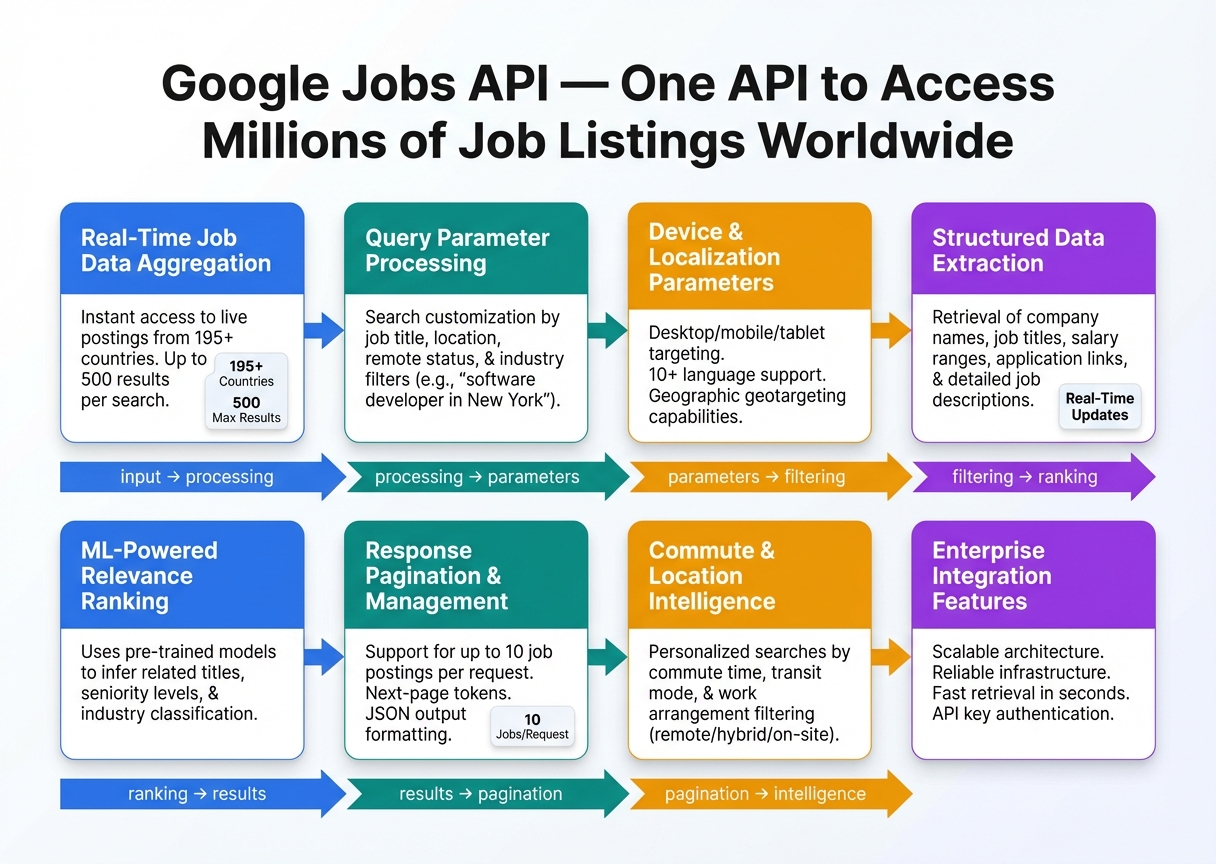
Alright, let’s get technical. The API isn’t magic—it’s engineered on Google’s Cloud Search backbone, processing queries via HTTP GET requests to endpoints like https://jobs.googleapis.com/v4/jobs:search. You authenticate with an API key, then filter with parameters like query=”software engineer” or location=”New York”.
John: Why it works: Under the hood, it’s powered by Google’s knowledge graph, cross-referencing listings with real-time data. For efficiency, it uses pagination and rate limiting to prevent abuse—think of it as traffic control on a busy highway. In 2025, integrations with Gemini AI add “deep think” modes for smarter matching, reducing irrelevant results by analyzing user intent.
Lila: Breaking it down for newbies: It’s like a recipe—ingredients (job data) from various sources get mixed in Google’s “kitchen” (servers), and the API serves the meal (JSON response) ready to eat.
John: For pros, integrate it with libraries like LangChain for AI-enhanced apps. Check out the official GitHub repo for Google APIs (googleapis/google-api-python-client) or open-source wrappers like the one from Scrapingdog for custom scraping alternatives. If you’re building a job aggregator, fine-tune something like Llama-3-8B from Hugging Face to analyze listings—quantization (shrinking the model for your laptop) makes it feasible without massive GPUs.
Specs and Comparisons: Old School vs. Google Jobs API
To see the value, let’s compare traditional web scraping with the Google Jobs API approach in 2025.
| Feature | Traditional Scraping | Google Jobs API (2025) |
|---|---|---|
| Data Access Speed | Slow, prone to blocks | Real-time, low latency |
| Compliance & Legality | Risky, often violates TOS | Official, with 2025 restrictions enforced |
| AI Integration | Manual addition needed | Built-in Gemini AI for smart filters |
| Cost | High maintenance | Free tier available, scales with usage |
| Global Reach | Limited by scrapers | Millions worldwide, updated daily |
Pro Tip: For hands-on, fork the googleapis/google-cloud-python repo on GitHub and experiment with vLLM for faster inference on job data analysis.
Getting Started: Resources for All Levels
Lila: Beginners, start with Google’s official docs— they’re straightforward. For code, try Python with the google-api-python-client library.
John: Engineers, dive into Hugging Face’s datasets hub for job-related models, or use the SERPHouse Google Jobs API wrapper for seamless integration. Recent 2025 updates mean focusing on compliant tools—avoid outdated scrapers.
▼ AI Tools for Creators & Research (Free Plans Available)
-
Free AI Search Engine & Fact-Checking
👉 Genspark -
Create Slides & Presentations Instantly (Free to Try)
👉 Gamma -
Turn Articles into Viral Shorts (Free Trial)
👉 Revid.ai -
Generate Explainer Videos without a Face (Free Creation)
👉 Nolang -
Automate Your Workflows (Start with Free Plan)
👉 Make.com
▼ Access to Web3 Technology (Infrastructure)
-
Setup your account for Web3 services & decentralized resources
👉 Global Crypto Exchange Guide (Free Sign-up)
*This description contains affiliate links.
*Free plans and features are subject to change. Please check official websites.
*Please use these tools at your own discretion.
References & Further Reading
- Google Jobs API — One API to Access Millions of Job Listings Worldwide
- Google Jobs API Explained for 2026 – SERPHouse
- Google Jobs Shake-Up 2025: Navigating the New Indexing API Restrictions
- Google Jobs API – Extract Job Listings Data | Scrapingdog
- Top Benefits of Using Google Job API for Job Listings in 2025