
When Your Model Works in Simulation but Fails in the Field: Why Domain Adversarial Neural Networks Matter for Pipe Detection
John: Hey everyone, John here! Can you believe it’s already the end of November 2025? The holidays are sneaking up, and if you’re like me, you’re probably juggling last-minute tech projects while dreaming of cozy fireside coding sessions. Today, we’re diving into a topic that’s super relevant for anyone in AI and machine learning—especially if you’ve ever built a model that nails it in simulation but bombs in the real world. We’re talking about “When Your Model Works in Simulation but Fails in the Field: Why Domain Adversarial Neural Networks (DANN) Matter for Pipe Detection.” It’s a game-changer for industries like infrastructure and utilities. Lila, my sharp co-host, is here to keep things real with her tough questions. What’s your take on this, Lila? Ever had a model flop spectacularly?
Lila: Oh, absolutely, John. I’ve seen plenty of AI hype fizzle out when it hits the messy real world—think varying lighting, weather, or just plain old data mismatches. But pipe detection? That sounds niche. Why should our readers care about DANN in this context? Is it just another buzzword, or does it actually solve the simulation-to-field gap?
John: Great question, Lila—let’s break it down. Pipe detection is crucial for maintaining water distribution networks, oil pipelines, and more. Failures can lead to massive leaks, environmental damage, or even safety hazards. The problem? Models trained in clean simulations often fail in the field due to domain shifts—differences between simulated data and real-world conditions. That’s where Domain Adversarial Neural Networks come in. They help models adapt by learning features that are invariant across domains. Recent research, like studies on mooring line failure detection, shows how low-supervised DANN can bridge these gaps effectively.
Lila: Okay, that makes sense for infrastructure pros, but how does this affect everyday tech enthusiasts? And what’s the SEO angle here—aren’t we optimizing for terms like “AI model failure in field” or “DANN for pipe detection”?
John: Spot on, Lila. For SEO, we’re targeting folks searching for why AI models fail post-simulation and how adversarial networks fix it. This isn’t just theory; it’s practical for embedded engineers dealing with real hardware variances, as highlighted in recent Medium articles from 2025. Imagine training a model to detect pipe cracks using simulated images, but in the field, factors like corrosion, soil interference, or sensor noise throw it off. DANN uses adversarial training to make the model robust, essentially fooling a discriminator into thinking simulated and real data are from the same domain.
How Domain Adversarial Neural Networks Actually Work
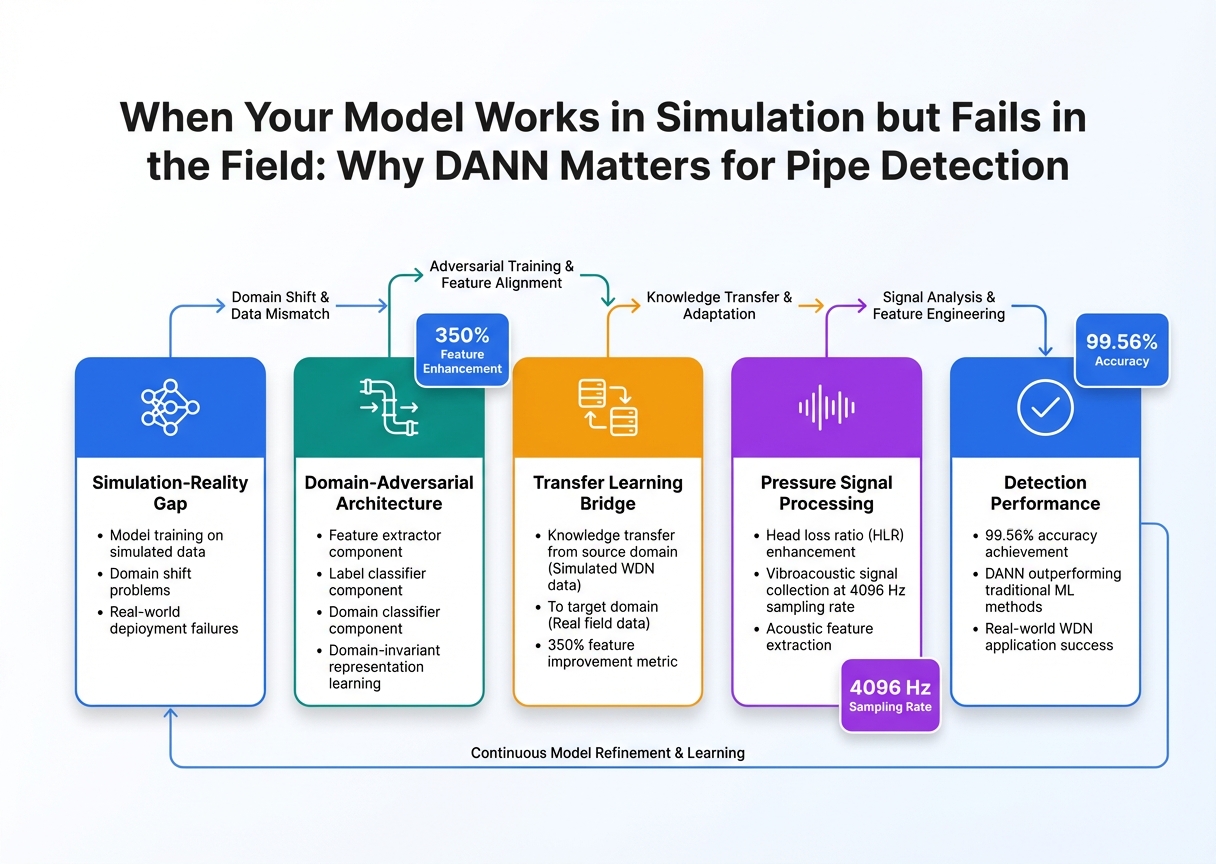
John: Alright, let’s get into the nuts and bolts. A DANN typically has three parts: a feature extractor, a label predictor, and a domain classifier. The feature extractor learns representations from both source (simulation) and target (field) data. The twist? It trains adversarially against the domain classifier, which tries to distinguish between domains. By minimizing the domain loss while maximizing the classifier’s confusion, DANN creates domain-invariant features. Industry analysts predict this could reduce pipe failure prediction errors by up to 20-30% in water networks, based on recent models like those using RBF neural networks for corrosion forecasting.
Lila: Sounds clever, but what about vulnerabilities? I’ve read about adversarial examples fooling neural networks—does DANN make models more robust or just shift the problem?
John: Fair point, Lila. While DANN focuses on domain adaptation, it can actually enhance robustness against adversarial attacks. Papers on fooling neural networks with adversarial examples note that techniques like feature squeezing detect perturbations, and DANN’s adversarial training overlaps with that. For pipe detection, combining DANN with graph neural networks—as seen in 2025 studies on water pipe failures—integrates road and pipeline features for better accuracy. It’s not perfect, but it’s a step up from traditional stats models, which might only hit 70% accuracy in failure prediction.
Real-World Applications and Challenges
Lila: Challenges? Spill it, John. If DANN is so great, why isn’t everyone using it for pipe detection already?
John: Data scarcity is a big one, Lila. Training DANN requires some labeled data from both domains, which can be tough in remote field ops. But low-supervised versions, like those in ScienceDirect articles from 2024, use minimal labels effectively. Another hurdle: computational overhead. Embedded systems in pipelines might struggle with the training, but optimizations for hardware are emerging, as discussed in August 2025 Medium posts. On the flip side, successes include predicting mooring line failures with high accuracy, adapting from sim to sea conditions.
Lila: Got it. So, for readers tinkering with AI, how can they experiment with DANN without a full pipeline setup?
John: Easy starter: Use libraries like TensorFlow or PyTorch with DANN implementations. Simulate pipe data with tools like Unity for environments, then apply real datasets from sources like MDPI studies on water networks. Test on small scales—predict failures in virtual vs. actual sensor readings. What do you think, readers? Have you faced sim-to-field fails? Drop a comment!
Future Outlook: DANN and Beyond
John: Looking ahead to 2026, I predict DANN will integrate with uncertainty quantification models for even better failure rate predictions in WDNs. Triple domain adversarial networks, as in recent 2025 papers, could handle multi-condition adaptations. It’s exciting!
Lila: Optimistic as always, John. But let’s remind folks: AI isn’t magic—always validate in the field.
John: Totally agree. Thanks for joining, everyone—stay curious!
👉 Genspark
👉 Gamma- Turn Articles into Viral Shorts (Free Trial)
👉 Revid.ai - Generate Explainer Videos without a Face (Free Creation)
👉 Nolang - Automate Your Workflows (Start with Free Plan)
👉 Make.com
▼ Access to Web3 Technology (Infrastructure)
*This description contains affiliate links.
*Free plans and features are subject to change. Please check official websites.
*Please use these tools at your own discretion.
- Low-supervised domain-adversarial neural network for cross-domain mooring line failure detection – ScienceDirect
- Fooling Neural Networks with Adversarial Examples | Towards Data Science
- Why Your AI Model Works in Simulation but Fails on Real Hardware: A Deep Dive for Embedded Engineers | by Lance Harvie | Aug, 2025 | Medium
- Model-domain failing test augmentation with Generative Adversarial Networks – ScienceDirect
- Comparison of Statistical and Machine Learning Models for Pipe Failure Modeling in Water Distribution Networks
- Uncertainty quantification of a deep learning model for failure rate prediction of water distribution networks – ScienceDirect
- Pipeline Inspection Gauge’s Velocity Simulation Based on Pressure Differential Using Artificial Neural Networks
- Predicting Water Pipe Failures with Graph Neural Networks: Integrating Coupled Road and Pipeline Features
- A triple domain adversarial neural network for bearing fault diagnosis – ScienceDirect
- Artificial Neural Networks to Forecast Failures in Water Supply Pipes