
Tired of backend headaches? Server-side JavaScript frameworks unlock faster, cheaper, and seamless web development. Discover the magic! #ServerSideJS #Nodejs #WebDev
Quick Video Breakdown: This Blog Article
This video clearly explains this blog article.
Even if you don’t have time to read the text, you can quickly grasp the key points through this video. Please check it out!
If you find this video helpful, please follow the YouTube channel “AIMindUpdate,” which delivers daily AI news.
https://www.youtube.com/@AIMindUpdate
All I Want for Christmas: Unleashing the Magic of Server-Side JavaScript Frameworks
🎯 Level: Beginner / Intermediate
👍 Recommended For: Aspiring web developers, Tech hobbyists, Startup founders looking to prototype quickly
John: Hey folks, it’s John here from AI Mind Update, the battle-hardened tech lead who’s seen more framework wars than holiday feasts. Picture this: You’re a budding developer, staring at your screen on a chilly December evening, wishing for something to make your back-end life easier. No more wrestling with clunky servers or mismatched languages—just pure, seamless JavaScript from front to back. That’s the vibe of this InfoWorld piece titled “All I Want for Christmas is a Server-Side JavaScript Framework.” It’s like Santa delivering Node.js gifts under your tech tree. And if you’re new to this, tools like Genspark can be your elf helper, searching up real-time insights on frameworks without the hassle.
Lila: Exactly, John! As the Bridge for Beginners, I’ll keep things simple. Imagine building a website is like baking cookies—front-end is the icing, but the back-end is the dough that holds it all together. Server-side JavaScript frameworks let you use the same “recipe” (JavaScript) for both, making everything tastier and less messy. No need to switch between languages like flipping cookbooks mid-bake.
Now, let’s talk benefits. These frameworks shine in speed—think lightning-fast API responses that keep users happy. Then there’s cost savings, as you reuse skills across your stack, slashing training time. And for ROI? Businesses see quicker deployments, meaning faster time-to-market and happier stakeholders.
The “Before” State: Life Without Server-Side JS Magic
John: Before these frameworks took off, building web apps was like assembling a puzzle with pieces from different boxes. You’d use JavaScript for the client-side (browser stuff), but switch to something like PHP, Python, or Ruby for the server. That meant context-switching hell—debugging in one language, optimizing in another. Teams wasted hours on integration bugs, and scaling? Forget it; mismatched tech stacks led to bloated codebases and high maintenance costs. Recent trends show developers ditching this chaos for unified JS ecosystems, as highlighted in 2025 reports from DEV Community and LambdaTest.
Lila: Spot on, John. It’s like trying to communicate in two languages without a translator—lots of misunderstandings! The old way slowed down everything, from prototyping to deployment. But now, with server-side JS, it’s streamlined. For visualizing your old vs. new workflows, check out Gamma to whip up quick docs or slides that map this out.
Core Mechanism: How Server-Side JS Frameworks Work Their Holiday Magic
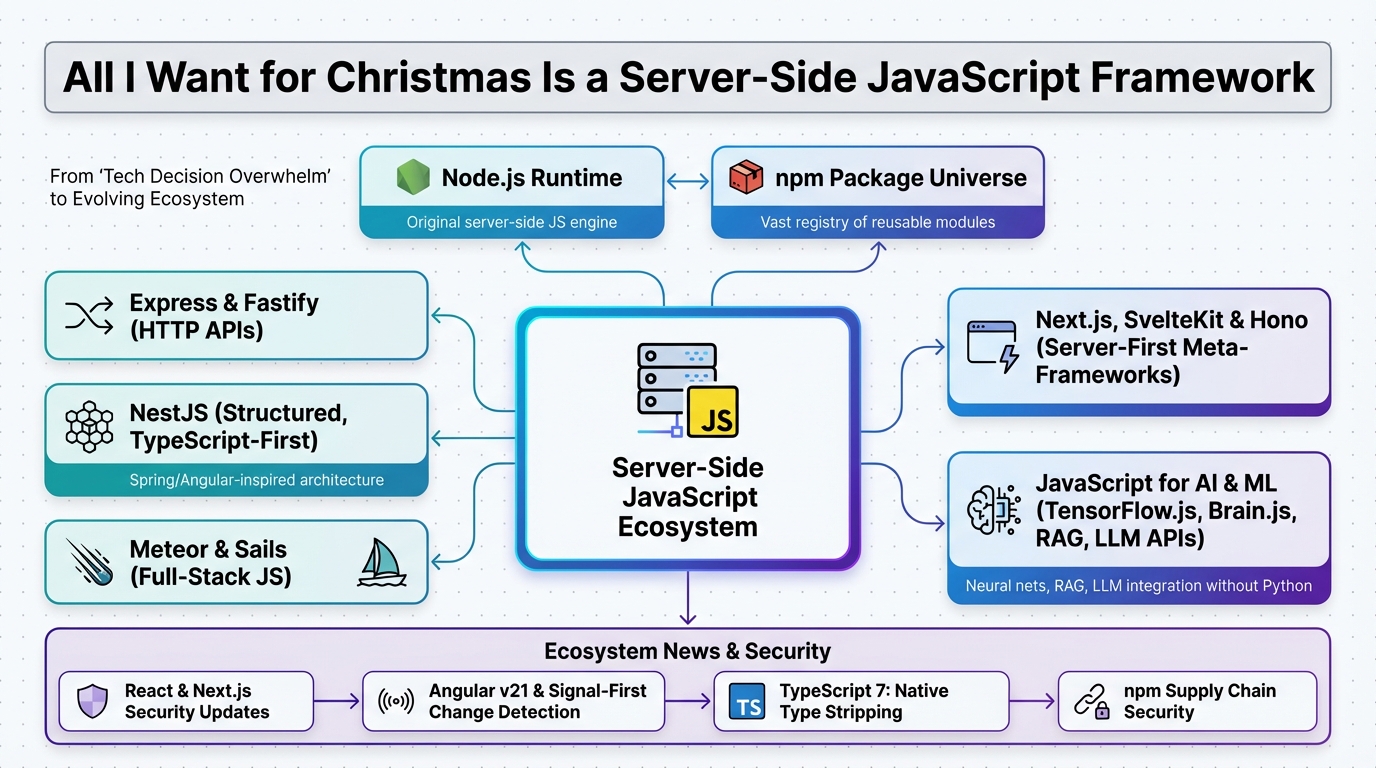
John: Alright, let’s cut through the fluff. At its core, a server-side JavaScript framework runs JS on the server using Node.js as the runtime engine—think of Node as the engine in your car, powering everything behind the scenes. Frameworks like Express (the minimalist OG for quick APIs), Nest.js (an all-in-one powerhouse with TypeScript support for scalable apps), or Next.js (which blends server-side rendering for SEO-boosted sites) provide the architecture. They handle routing, middleware for tasks like authentication, and database integrations seamlessly. It’s not hype; it’s engineering genius—leveraging event-driven, non-blocking I/O from Node to handle thousands of requests without breaking a sweat. For instance, Next.js uses React Server Components (watch out for those recent CVEs like CVE-2025-55182, but patches are rolling out fast).
Lila: Great breakdown, John. To ELI5 it: Imagine the server as a busy kitchen. Without a framework, chefs (developers) are juggling pots manually. With one, it’s like having a smart oven that automates timing and temperature—Express is your basic stove, Nest.js adds fancy timers and sensors, and Next.js even pre-bakes parts for faster serving. Metaphor aside, the architecture typically involves an entry point (like app.js), routes for handling HTTP requests, and modules for business logic. Tools from Hugging Face or LangChain can even integrate AI if you’re going advanced, but start simple with vanilla Node.
Use Cases: Real-World Scenarios Where These Frameworks Shine
John: Let’s get practical. First use case: Building a real-time e-commerce backend. With Nest.js, you set up RESTful APIs for inventory management, integrating with databases like MongoDB via Mongoose. It’s scalable for Black Friday rushes, and recent 2025 trends from GeeksforGeeks show it’s topping backend lists for its modularity.
Lila: Second: Prototyping a social media app. Next.js handles server-side rendering for fast initial loads, perfect for user feeds. Pair it with video tools like Revid.ai to generate marketing clips showcasing your app’s features.
John: Third: Enterprise API services. Express is lightweight for microservices, but for structured growth, Nest.js wins with its dependency injection—like LEGO blocks that snap together perfectly. If you’re learning, Nolang can tutor you on coding these without the overwhelm. Industry analysts predict by 2026, these will dominate, per InfoWorld and Medium posts.
| Aspect | Old Method (Multi-Language Stacks) | New Solution (Server-Side JS Frameworks) |
|---|---|---|
| Development Speed | Slow due to language switching | Fast with unified JavaScript |
| Scalability | Limited by integration issues | High with Node’s event loop |
| Cost Efficiency | Higher training and maintenance | Lower, reusable skills |
| Learning Curve | Steep for multi-tech teams | Gentler for JS pros |
Conclusion: Time to Unwrap Your Framework Gift
John: Wrapping up, server-side JavaScript frameworks like those in the InfoWorld article are game-changers, turning back-end drudgery into delightful efficiency. From Express’s simplicity to Next.js’s power, they’re set to dominate 2026, as per recent web trends. Don’t just read—dive in, experiment with a small project, and watch your dev life transform.
Lila: Absolutely! Start automating your setup with Make.com to connect your tools effortlessly. Whether you’re a newbie or seasoned, this is your Christmas upgrade. Happy coding!

👨💻 Author: SnowJon (Web3 & AI Practitioner / Investor)
A researcher who leverages knowledge gained from the University of Tokyo Blockchain Innovation Program to share practical insights on Web3 and AI technologies. While working as a salaried professional, he operates 8 blog media outlets, 9 YouTube channels, and over 10 social media accounts, while actively investing in cryptocurrency and AI projects.
His motto is to translate complex technologies into forms that anyone can use, fusing academic knowledge with practical experience.
*This article utilizes AI for drafting and structuring, but all technical verification and final editing are performed by the human author.
🛑 Disclaimer
This article contains affiliate links. Tools mentioned are based on current information. Use at your own discretion.
▼ Recommended AI Tools
References & Further Reading
- All I want for Christmas is a server-side JavaScript framework | InfoWorld
- 17 Best JavaScript Frameworks for 2026: Front, Back-End and Testing | LambdaTest
- Intro to Nest.js: Server-side JavaScript development on Node | InfoWorld
- JavaScript Frameworks – Heading into 2025 – DEV Community
- Top 7 JavaScript Frameworks In 2025 (Most Popular + When To Use Them)