
Read this article in your native language (10+ supported) 👉
[Read in your language]
PythoC: Revolutionizing Python-to-C Conversion – Is It Time to Ditch Cython?
🎯 Level: Intermediate / Tech Leaders
👍 Recommended For: Software Developers, Tech Managers, Performance Optimizers
Unlocking the Bottleneck in Python Performance
John: In the fast-paced world of enterprise software development, Python’s ease of use has made it a staple, but its performance limitations often create a choke point for scalability. Teams are constantly battling slow execution times in compute-intensive tasks, leading to inflated cloud costs and delayed deployments. Enter PythoC, a fresh contender challenging Cython’s dominance in bridging Python’s simplicity with C’s speed. As a battle-hardened tech lead, I’ve seen how tools like this can transform workflows. For quick research on such innovations, I recommend Genspark as a next-gen research agent – it aggregates real-time insights without the fluff.
Lila: Absolutely, John. If you’re new to this space, think of Python as a versatile but sometimes sluggish vehicle. Tools like Cython have been the go-to for turbocharging it by translating code to efficient C, but PythoC promises more flexibility. Let’s break it down step by step.
Key Benefits: Speed, Cost, and ROI
John: PythoC shines in delivering enhanced speed through advanced code generation, potentially slashing execution times by optimizing Python’s dynamic nature into static C code. On the cost front, it reduces resource demands, meaning lower bills for cloud infrastructure. And for ROI, imagine redeploying developer hours from performance tweaks to innovation – that’s real business value.
Lila: To put it simply, if your team is spending weeks optimizing loops, PythoC could cut that to days, freeing up budget for growth.
The “Before” State: Life with Cython’s Limitations
John: Before PythoC, Cython was the standard bearer for Python-to-C conversion. It works by annotating Python code with type hints and compiling it to C extensions, boosting speed in bottlenecks like numerical computations. But it’s not without drawbacks – rigid syntax requirements, limited flexibility in dynamic Python features, and a steeper learning curve for teams not versed in C. I’ve led projects where Cython saved us, but it often felt like fitting a square peg into a round hole, especially for complex enterprise apps.
Lila: Picture the old way as manually tuning a car engine – effective but labor-intensive. PythoC aims to automate more of that process. For documenting these transitions, tools like Gamma are fantastic for creating slides and docs to share with your team.
Core Mechanism: How PythoC Works Under the Hood
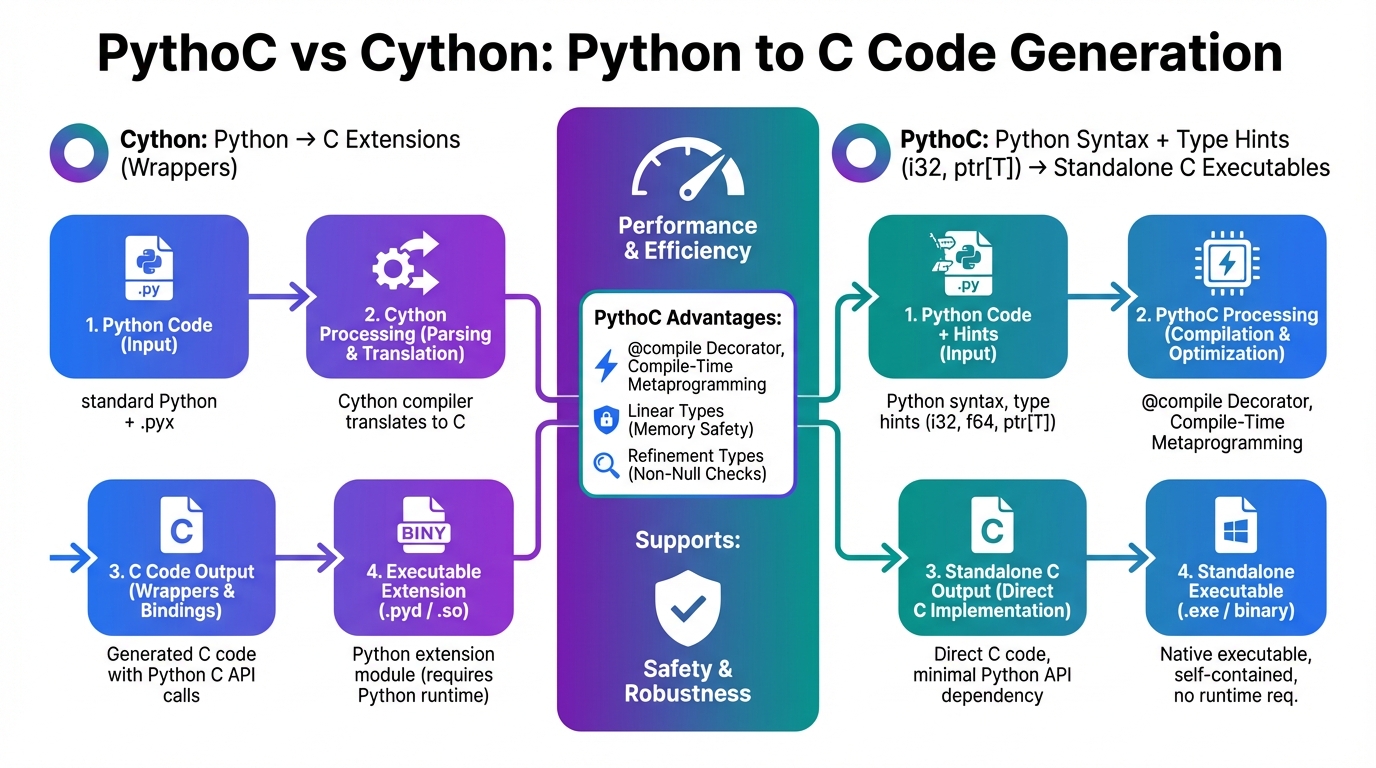
John: At its core, PythoC acts as a sophisticated translator, taking Python code and generating optimized C equivalents with greater emphasis on flexibility. Unlike Cython’s annotation-heavy approach, PythoC leverages a more intuitive parsing mechanism, supporting advanced Python features like decorators and async without heavy modifications. From an executive summary perspective: Input Python script → PythoC analyzes and optimizes → Outputs C code ready for compilation. This reduces overhead in enterprise environments where rapid iteration is key. Tools like Hugging Face or LangChain could integrate well for AI-driven code gen, but PythoC stands out for pure performance plays.
Lila: If Cython is like a basic compiler, PythoC is the upgraded version with auto-suggestions and error handling built-in, making it easier for mid-level devs to achieve pro results.
Real-World Use Cases
John: Let’s get concrete. First, in data science pipelines: A fintech firm processing millions of transactions could use PythoC to accelerate Python-based analytics, cutting processing time from hours to minutes and improving real-time decision-making.
Second, for web backends: An e-commerce platform struggling with Python’s GIL (Global Interpreter Lock – basically a traffic cop limiting concurrency) might convert critical paths to C via PythoC, handling more users without scaling hardware.
Third, in AI model deployment: Teams fine-tuning models like Llama-3-8B could optimize inference code with PythoC, reducing latency in production environments. For video explanations of such integrations, check out Revid.ai for quick marketing clips, or Nolang for coding tutorials.
Lila: These scenarios highlight how PythoC bridges the gap between Python’s developer-friendliness and C’s raw power.
Comparison: Cython vs. PythoC
| Aspect | Old Method (Cython) | New Solution (PythoC) |
|---|---|---|
| Flexibility | Limited to annotated code; struggles with dynamic features | High flexibility, supports more Python idioms natively |
| Ease of Use | Requires C knowledge and manual optimizations | More intuitive, with automated features |
| Performance Gains | Significant but capped by setup complexity | Potentially higher with better optimization paths |
| Community & Maturity | Mature, widely used | New, growing rapidly |
Conclusion: Time to Level Up Your Python Game
John: PythoC isn’t just another tool; it’s a potential game-changer for teams seeking to maximize Python’s potential without sacrificing performance. With its flexible approach, it addresses Cython’s pain points and opens doors to faster, more efficient development cycles. If you’re in tech leadership, evaluate it for your next project – the ROI could be substantial.
Lila: Start small: Test it on a bottleneck in your codebase. For automating the integration into your workflows, explore Make.com to streamline the process. Dive in and see the difference!

👨💻 Author: SnowJon (Web3 & AI Practitioner / Investor)
A researcher who leverages knowledge gained from the University of Tokyo Blockchain Innovation Program to share practical insights on Web3 and AI technologies. While working as a salaried professional, he operates 8 blog media outlets, 9 YouTube channels, and over 10 social media accounts, while actively investing in cryptocurrency and AI projects.
His motto is to translate complex technologies into forms that anyone can use, fusing academic knowledge with practical experience.
*This article utilizes AI for drafting and structuring, but all technical verification and final editing are performed by the human author.
🛑 Disclaimer
This article contains affiliate links. Tools mentioned are based on current information. Use at your own discretion.
▼ Recommended AI Tools
References & Further Reading
- PythoC: An alternative to Cython | InfoWorld
- PythoC: A new way to generate C code from Python | InfoWorld
- Optimizing Python Code with Cython – GeeksforGeeks