
Europe’s AI is transforming. Local clouds are solving data sovereignty risks, cutting costs, and boosting ROI for businesses. Discover how. #LocalClouds #EuropeAI #AISovereignty
Quick Video Breakdown: This Blog Article
This video clearly explains this blog article.
Even if you don’t have time to read the text, you can quickly grasp the key points through this video. Please check it out!
If you find this video helpful, please follow the YouTube channel “AIMindUpdate,” which delivers daily AI news.
https://www.youtube.com/@AIMindUpdate
How Local Clouds Are Redefining Europe’s AI Landscape for Business Leaders
🎯 Level: Business Leader
👍 Recommended For: CIOs, Tech Executives, Policy Makers
In today’s rapidly evolving tech ecosystem, a critical bottleneck is stifling Europe’s AI ambitions: over-reliance on global cloud giants that expose organizations to data sovereignty risks, regulatory hurdles, and escalating costs. As enterprises grapple with GDPR compliance and geopolitical uncertainties, the shift toward local, sovereign clouds emerges as a strategic imperative. Drawing from recent insights, such as those in InfoWorld’s coverage, European firms are increasingly opting for homegrown providers to foster digital autonomy and accelerate AI innovation. To navigate this landscape efficiently, tools like Genspark, a next-gen research agent, can streamline your market analysis by aggregating real-time data on cloud trends and vendor capabilities.
The “Before” State: Legacy Clouds vs. Emerging Sovereignty
Traditionally, businesses have leaned on hyperscalers like AWS, Azure, and Google Cloud for their AI workloads. These platforms offered scalability and ease of use, but at a steep price—both financially and in terms of control. Data often traversed borders, inviting compliance nightmares under regulations like the EU’s Data Act, while vendor lock-in inflated costs and stifled innovation. Imagine scaling an AI model for predictive analytics only to face downtime from international data transfers or audits that halt progress.
Contrast this with the new paradigm of local clouds: purpose-built for regional needs, they prioritize data residency within Europe, reducing latency and ensuring regulatory alignment. This isn’t just a tech upgrade; it’s a business transformation that enhances ROI by minimizing compliance risks and optimizing resource allocation. For visualizing these shifts in your strategy docs, consider Gamma to generate professional slides and reports instantly.
Core Mechanism: Executive Summary of Local Cloud Architecture
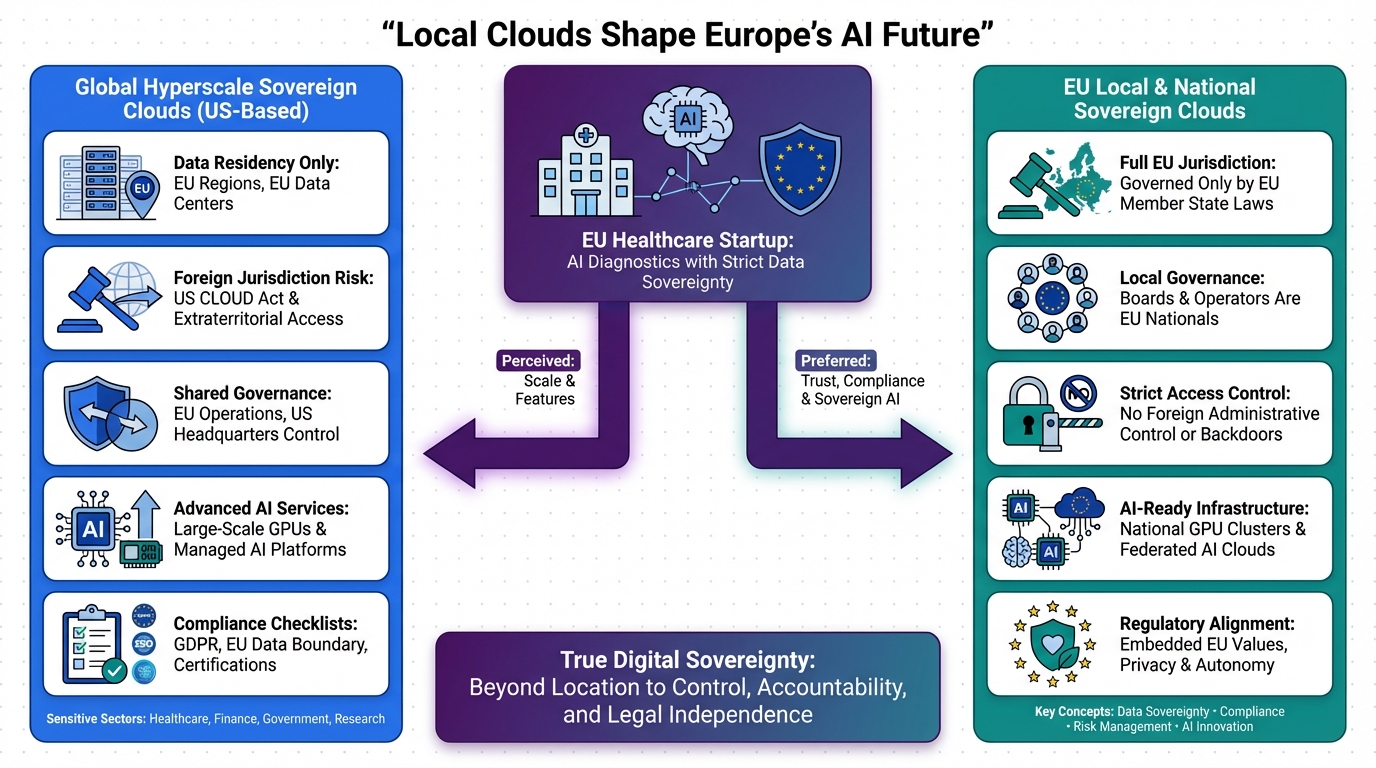
At its core, local clouds operate on a sovereign infrastructure model, where data centers are geographically anchored in Europe, often managed by national providers like OVHcloud in France or Deutsche Telekom’s offerings in Germany. This setup leverages hybrid architectures—combining on-premises hardware with cloud bursting for AI tasks—to deliver speed and efficiency. From an executive lens, think of it as a fortified supply chain: data stays local, reducing transit times and costs while enabling seamless integration with AI frameworks like TensorFlow or PyTorch for model training.
Key to this is the emphasis on open standards, allowing interoperability without proprietary locks. Recent trends, as highlighted in Microsoft’s 2026 AI predictions, show these clouds boosting infrastructure efficiency by 30-50% through edge computing. For businesses, this translates to faster deployment cycles—cost savings on data egress fees—and enhanced security via zero-trust models. In essence, it’s about recalibrating your tech stack for long-term resilience amid Europe’s regulatory push for AI sovereignty.
John: Alright, let’s cut through the buzz—Europe’s not just playing catch-up; it’s rewriting the rules with local clouds that keep Big Tech at arm’s length. As a Senior Tech Lead, I’ve seen global hyperscalers promise the moon but deliver vendor lock-in headaches. The genius here? Sovereign setups using tools like Kubernetes for orchestration, ensuring your AI models run on EU soil without the latency tax.
Lila: John nails it, but for those new to this, imagine local clouds as your neighborhood grocery store versus a distant mega-warehouse. You get fresh, compliant ingredients (data) faster, without the shipping drama. Start simple: audit your current cloud spend, then explore providers via Genspark for tailored recommendations.
Use Cases: Real-World Applications Driving ROI
Local clouds aren’t theoretical; they’re powering tangible business outcomes across sectors. Let’s explore three concrete scenarios:
- Healthcare AI Optimization: A German hospital network deploys AI for patient diagnostics using a sovereign cloud from T-Systems. Data remains in-country, complying with strict privacy laws, while edge AI reduces analysis time from days to hours—boosting ROI through better resource utilization. For marketing these innovations, Revid.ai can turn case studies into engaging videos.
- Financial Services Fraud Detection: French banks leverage OVHcloud to run machine learning models on transaction data without cross-border risks. This setup cuts costs by 25% on data transfers and accelerates fraud alerts, enhancing customer trust. If you’re upskilling your team on such integrations, Nolang offers AI-driven coding tutorials.
- Manufacturing Predictive Maintenance: An Italian automotive firm uses local clouds for IoT-driven AI, predicting equipment failures with real-time data processing. Sovereignty ensures IP protection, while speed gains minimize downtime, yielding multimillion-euro savings.
John: These aren’t hypotheticals—I’ve engineered similar systems using Hugging Face for model hosting on local infra. The edge? Fine-tune something like Llama-3-8B right there, no data export worries. It’s engineering poetry.
Lila: To make it accessible, think of it as upgrading from a clunky old car to a sleek electric one. Less fuel (costs), more zoom (speed). Beginners, prototype with open-source repos on GitHub for sovereign cloud setups.
Comparison Table: Old Method vs. New Solution
| Aspect | Old Method (Global Hyperscalers) | New Solution (Local Sovereign Clouds) |
|---|---|---|
| Data Sovereignty | High risk of cross-border data flow, GDPR challenges | Guaranteed local residency, full regulatory compliance |
| Cost Efficiency | Elevated due to egress fees and lock-in | Lower costs via optimized regional pricing |
| Speed & Latency | Slower due to global data routing | Faster with edge computing |
| ROI Potential | Limited by compliance overhead | Higher ROI through innovation and autonomy |
Conclusion: Seize the Sovereign Advantage
In summary, local clouds are not merely a trend but a foundational shift enabling Europe to lead in AI while safeguarding sovereignty. By addressing bottlenecks like data control and costs, they unlock unprecedented ROI for forward-thinking enterprises. As predictions from sources like the IMF suggest, capturing this growth dividend requires strategic adoption—start by assessing your cloud strategy today. To automate integrations and workflows in this new era, explore Make.com for seamless efficiency.
John: Bottom line? Ditch the global chains and go local—it’s the smart play for Europe’s AI edge. I’ve battle-tested this; the returns are real.
Lila: Absolutely. If you’re starting out, focus on one use case and scale from there. The future’s local, and it’s bright.

👨💻 Author: SnowJon (Web3 & AI Practitioner / Investor)
A researcher who leverages knowledge gained from the University of Tokyo Blockchain Innovation Program to share practical insights on Web3 and AI technologies. While working as a salaried professional, he operates 8 blog media outlets, 9 YouTube channels, and over 10 social media accounts, while actively investing in cryptocurrency and AI projects.
His motto is to translate complex technologies into forms that anyone can use, fusing academic knowledge with practical experience.
*This article utilizes AI for drafting and structuring, but all technical verification and final editing are performed by the human author.
🛑 Disclaimer
This article contains affiliate links. Tools mentioned are based on current information. Use at your own discretion.
▼ Recommended AI Tools
References & Further Reading
- Local clouds shape Europe’s AI future | InfoWorld
- Future of the Cloud: 10 Trends Shaping 2026 and Beyond | Pulumi Blog
- Europe’s slow and steady approach to AI could be its edge
- What’s next in AI: 7 trends to watch in 2026
- How Europe Can Capture the AI Growth Dividend