Watch: Generative AI Explained – Complete Beginner’s Guide
Curious about how AI creates art, writes stories, and generates videos? Watch our latest podcast episode where John and Lila break down Generative AI in simple terms. From GANs to ChatGPT, discover the technology revolutionizing creativity and learn about the exciting future of multimodal AI. Perfect for beginners who want to understand the AI tools shaping our world today.
“Generative AI.” It’s the buzzword defining our decade. But beyond the hype, the memes, and the viral threads on X (formerly Twitter), do you truly understand what it is? Is it just a chatbot? A tool for cheating on essays? Or is it the most significant technological shift since the internet itself?
In this comprehensive guide, Jon, a veteran tech journalist who has covered Silicon Valley since the dot-com boom, sits down with Lila, a digital-native junior writer obsessed with the latest X trends. Together, they break down the mechanics, the history, the risks, and the explosive future of Generative AI in 2025.
Whether you are a complete beginner or looking to deepen your knowledge, this conversation covers everything you need to know.
Chapter 1: What is Generative AI? (And How is it Different?)
Lila: Jon, thanks for sitting down with me. My X timeline is absolutely exploding this week. Everyone is talking about “GenAI” this and “new models” that. Honestly, it’s getting hard to keep up. Let’s strip it back: What makes Generative AI so different from the AI we’ve had for years?
Jon: Great to be here, Lila. You’re right—the velocity of information on X is overwhelming right now. But let’s simplify it.
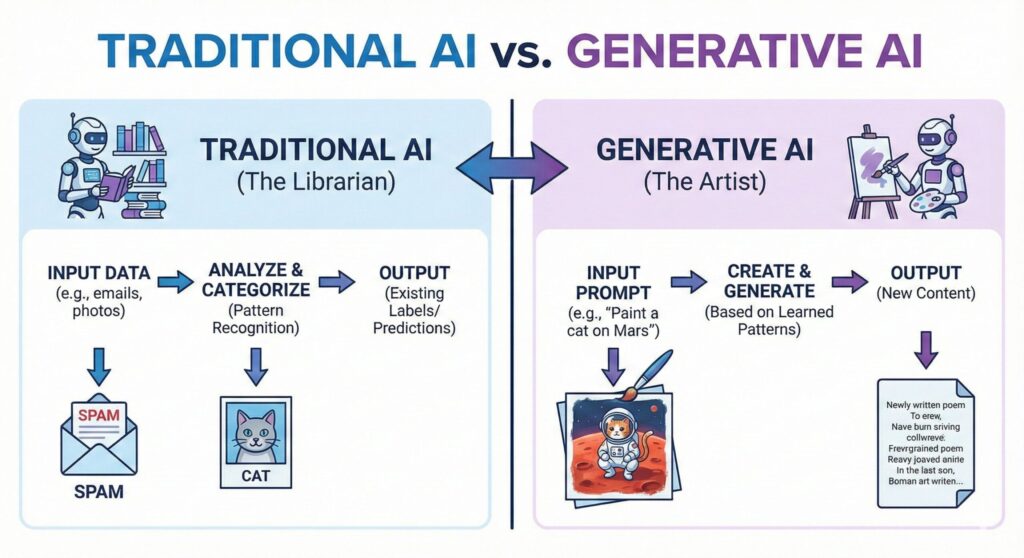
If I had to describe the difference between traditional AI (Discriminative AI) and Generative AI in one sentence, it would be the difference between a Librarian and an Artist.
Lila: A librarian and an artist?
Jon: Exactly. Traditional AI, which we’ve used for a decade, acts like a hyper-efficient librarian. It looks at data and categorizes it.
“Is this email spam or not?” “Is this a photo of a cat or a dog?” “Will this customer buy this product?”
It analyzes existing data to find a correct answer.
Generative AI, on the other hand, is a creator. It takes what it has learned and creates something entirely new that never existed before.
If you ask it to “Paint a cat surfing on Mars in the style of Van Gogh,” it doesn’t search Google for that image. It paints it, pixel by pixel. If you ask it to write a poem about quantum physics, it writes it from scratch. That is the “Generative” part.
Lila: I see! So it’s not just “finding” answers; it’s “making” them.
I saw a thread on X by Dr. Khulood Almani discussing how AI is shifting from automation to “Augmented Intelligence.” That fits perfectly—it’s about extending human creativity, not just organizing our files.
Jon: Precisely. As of 2025, we are seeing a shift where AI is no longer just a tool for efficiency; it’s a partner in “Scalable Creativity.” It solves the “blank page problem” for writers, coders, and designers globally.
Chapter 2: Under the Hood—Demystifying the “Magic”
Lila: Okay, but how? When I see Sora create a video or GPT-4o write code, it feels like magic. What is actually happening inside the machine?
Jon: “Any sufficiently advanced technology is indistinguishable from magic,” as Arthur C. Clarke said. But let’s ruin the magic with some math.
At the core, we are dealing with Neural Networks. These are digital structures inspired by the human brain, consisting of layers of nodes (neurons).
There are two main technologies driving the current boom you see on X: LLMs and Diffusion Models.
1. Large Language Models (LLMs): The Probability Game
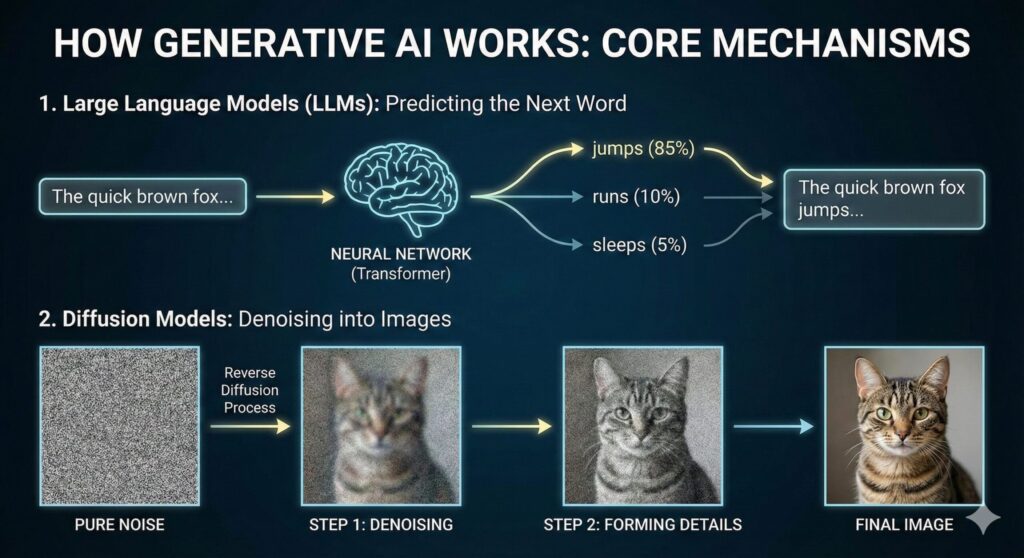
Jon: Think of ChatGPT, Claude, or Gemini. These are LLMs. They don’t “know” facts in the way humans do. They are playing a massive, high-stakes game of “Guess the Next Word.”
They have been trained on petabytes of text from the internet. They learn patterns. If I say, “The quick brown fox…”, the AI knows statistically that the next word is likely “jumps.”
Lila: So… it’s just fancy autocomplete?
Jon: In a way, yes. But in 2017, Google researchers introduced the “Transformer” architecture. This was the game-changer.
Before Transformers, AI read text linearly and often forgot the beginning of a sentence by the time it reached the end. Transformers allowed the AI to pay “Attention” (that’s the technical term) to the entire context at once. It understands that “bank” means something different in “river bank” versus “bank account” based on the surrounding words.
2. Image Generation: The Diffusion Process
Lila: And what about those AI images?
Jon: That’s usually Diffusion Models. Imagine taking a clear photograph and slowly adding static (noise) until it’s just random grey snow.
The AI is trained to reverse this process. It learns how to take random noise and “denoise” it back into a clear image.
When you give it a prompt like “A futuristic city,” it starts with static and slowly sculpts the pixels until a city emerges.
Lila: That’s fascinating. It’s like sculpting from a block of digital marble!
Chapter 3: The Timeline (2014–2025)
Lila: It feels like this all happened overnight, but I know that’s not true. Some OGs on X keep mentioning 2014. What happened then?
Jon: Let’s look at the brief history of the GenAI revolution:
- 2014: The Birth of GANs: Ian Goodfellow invented Generative Adversarial Networks (GANs). Two AIs fighting each other—one creates a fake image, the other tries to spot the fake. This made generated images look realistic for the first time.
- 2017: The Transformer Era: The paper “Attention Is All You Need” was published. This is the foundation of modern Generative AI.
- 2020: GPT-3: OpenAI released GPT-3. This was the first time an AI could write paragraphs that felt eerily human.
- 2022: The Breakout Year: ChatGPT and Stable Diffusion were released to the public. AI moved from research labs to our living rooms.
- 2025 (Now): The Age of Agents & Multimodality: We are no longer just chatting. AI is now Multimodal (seeing, hearing, speaking simultaneously) and Agentic (taking actions on our behalf, like booking flights or coding entire apps).
Lila: It’s wild to think that ChatGPT is only a few years old. The pace of innovation is terrifyingly fast.
Chapter 4: The Ecosystem—Who are the Key Players?
Lila: On X, I see so many names. OpenAI, Google, Anthropic… Who should we be paying attention to?
Jon: It’s a “Game of Thrones” out there, Lila. Here are the factions:
- The Giants (Closed Source):
- OpenAI: Still the household name with ChatGPT and Sora.
- Google (DeepMind): With Gemini, they are leveraging their massive data ecosystem.
- Microsoft: Through Copilot, they are integrating AI into every PC on the planet.
- The Rebels (Open Source):
- Meta (Llama): Mark Zuckerberg took a different route. They release their powerful “Llama” models for free. This powers the open-source community you see on X.
- Mistral: The European champion, punching above its weight.
- The Safety First:
- Anthropic (Claude): Founded by former OpenAI employees, focusing heavily on “Constitutional AI” and safety.
- The Wildcard:
- xAI (Grok): Elon Musk’s AI. Its superpower is real-time access to X data. It knows what’s trending now, unlike others with knowledge cutoffs.
Lila: And we can’t forget the community! The developers on Hugging Face and the thread-writers on X who test these models the second they drop. That “hive mind” feels like the real engine of innovation right now.
Chapter 5: Use Cases—What Can We Actually Do?
Lila: Okay, let’s get practical. Beyond writing funny tweets, how is this actually changing the world in 2025?
Jon: The use cases are deepening.
- Coding & Software Development: This is arguably the biggest impact. AI acts as a “pair programmer.” It writes boilerplate code, debugs errors, and translates languages. One developer can now do the work of three.
- Hyper-Personalized Education: Platforms mentioned by users like TulipsTechAI are creating custom textbooks for students. If a student loves soccer, the AI explains physics using soccer analogies.
- Generative Design: In manufacturing and architecture, AI generates thousands of design iterations for a chair or a building frame to find the strongest, lightest option—shapes a human would never invent.
- Content Creation: From marketing copy to storyboarding for films. It’s not replacing creativity; it’s accelerating the “drafting” phase.
Lila: I read a prediction that “90% of online content could be AI-generated soon.” That sounds both efficient and a little dystopian.
Chapter 6: The Dark Side—Risks & Ethics
Jon: You’re right to be worried. We cannot talk about GenAI without addressing the elephants in the room.
Lila: What are the biggest red flags you see?
Jon:
- Hallucinations: AI models are confident liars. Because they predict the next likely word, not the truth, they can invent facts, court cases, or historical events. Fact-checking is no longer optional; it is mandatory.
- Bias: If the internet is biased (which it is), the AI will be biased. We see this in image generators defaulting to stereotypes (e.g., CEOs are always men).
- Deepfakes & Disinformation: With tools like Sora, seeing is no longer believing. The barrier to creating convincing fake news or non-consensual explicit imagery has dropped to zero.
- Copyright: The legal battles between artists/writers and AI companies are the defining lawsuits of our time. Is training on data “fair use” or theft?
Lila: This is why I see so many arguments on X between the “e/acc” crowd (who want to accelerate AI at all costs) and the “decels” (who want to slow down for safety). It’s a philosophical war.
Chapter 7: FAQ—Your Starter Kit
Lila: Let’s wrap up with some quick advice for our readers who want to jump in.
Q1: What’s the best way to start learning?
Jon: Stop reading about it and start using it. Create a free account on ChatGPT, Claude, or Gemini. Use it for low-stakes tasks: planning a meal, summarizing a long article, or brainstorming gift ideas.
Q2: Will AI take my job?
Jon: The golden rule of 2025: “AI won’t replace you. A person using AI will replace you.” Learn how to integrate it into your workflow. Become the “pilot,” not the passenger.
Q3: How do I get better results? (Prompt Engineering)
Jon: Treat the AI like a talented but literal-minded intern. Give it:
- Role: “You are an expert travel agent.”
- Context: “I am planning a trip to Tokyo for 5 days.”
- Constraint: “Keep the budget under $2000 and focus on food.”Don’t just say “Plan a trip.”
Conclusion: Riding the Wave
Lila: Jon, this has been incredibly clarifying. I feel less overwhelmed and more excited. It feels like we are living through a history book chapter.
Jon: We absolutely are, Lila. Generative AI is a tool of immense power. It can amplify human potential or flood us with noise. The difference lies in how we choose to use it.
My advice? Stay curious, stay skeptical, and keep watching those X trends. The future isn’t just happening to us; we are generating it.
🚀 What’s Your Next Step?
Don’t let this be just another article you read. Take action today:
- Pick one AI tool you haven’t used before (try an image generator like Midjourney or a research tool like Perplexity).
- Follow 3 new experts on X (Twitter) to diversify your feed beyond the hype.
- Experiment: Try to automate one boring task in your daily life this week using AI.
Did you find this guide helpful? Share it with your network and join the conversation!
Disclaimer: This article is for informational purposes only. AI technology evolves rapidly; always verify information with primary sources. (DYOR)
📚 References & Further Reading
Below is a selection of official sources, tools, and foundational research papers mentioned in this guide, organized for easy navigation.
Key AI Research Labs & Companies
These are the major organizations driving the development of the Generative AI models discussed.
- OpenAI:https://openai.com/
- Creators of ChatGPT (LLM), Sora (video generation), and DALL·E (image generation).
- Google DeepMind:https://deepmind.google/
- Google’s primary AI research division responsible for the Gemini family of multimodal models.
- Microsoft AI:https://www.microsoft.com/en-us/ai
- Information on Microsoft Copilot and their extensive integration of AI across their product suite.
- Meta AI:https://ai.meta.com/
- The hub for Meta’s AI research, including access to their powerful open-source Llama models.
- Anthropic:https://www.anthropic.com/
- An AI safety and research company founded by former OpenAI members, creators of Claude.
- xAI:https://x.ai/
- The company behind Grok, an AI model with unique real-time access to data from the X platform.
Popular Generative AI Tools & Community Platforms
Explore these platforms to try Generative AI yourself or connect with the developer community.
- Hugging Face:https://huggingface.co/
- The central hub for the open-source AI community, hosting thousands of models, datasets, and demos.
- Midjourney:https://www.midjourney.com/
- A leading independent research lab known for its high-quality artistic image generation tool.
- Perplexity AI:https://www.perplexity.ai/
- An “answer engine” that uses AI to provide detailed, cited answers to search queries.
- Stability AI:https://stability.ai/
- The company behind Stable Diffusion, a pioneering open-source text-to-image model.
Foundational Research Papers (For Technical Deep Dives)
For those who want to understand the mathematical and technical foundations mentioned by Jon.
- “Attention Is All You Need” (Google, 2017):Read on arXiv
- The groundbreaking paper that introduced the Transformer architecture, which powers virtually all modern LLMs like ChatGPT.
- “Generative Adversarial Networks” (Ian Goodfellow et al., 2014):Read on arXiv
- The original paper that introduced GANs, a major breakthrough in early generative image modeling.
Trend Tracking on X
To stay current with the fast-moving discussions mentioned by Lila, track these hashtags on X (formerly Twitter):
#GenerativeAI#AITrends#MachineLearning#LLM#OpenSourceAI