
Drowning in info? Discover how AI is transforming news with Google, powering the Pentagon, and boosting creativity with Adobe.#AINews #GenerativeAI #GoogleAI
Quick Video Breakdown: This Blog Article
This video clearly explains this blog article.
Even if you don’t have time to read the text, you can quickly grasp the key points through this video. Please check it out!
If you find this video helpful, please follow the YouTube channel “AIMindUpdate,” which delivers daily AI news.
https://www.youtube.com/@AIMindUpdate
Read this article in your native language (10+ supported) 👉
[Read in your language]
Daily AI News: Google’s AI News Overviews, Defense Goes All-In on AI, and More – Explained Simply
Hey everyone, welcome to today’s AI Mind Update! Imagine scrolling through your news feed and getting a quick, smart summary that tells you exactly why you should care about a story—before you even click. That’s the big trend bubbling up today with Google’s latest AI experiments in news. Why does this matter to you? In a world where we’re drowning in info, these tools could save you time, help you spot fake news faster, and make staying informed feel less overwhelming. For everyday folks like students or busy parents, it’s like having a personal news butler. And if you’re into smarter searching, check out Genspark—it’s an AI agent that summarizes web results to cut down your research hassle.
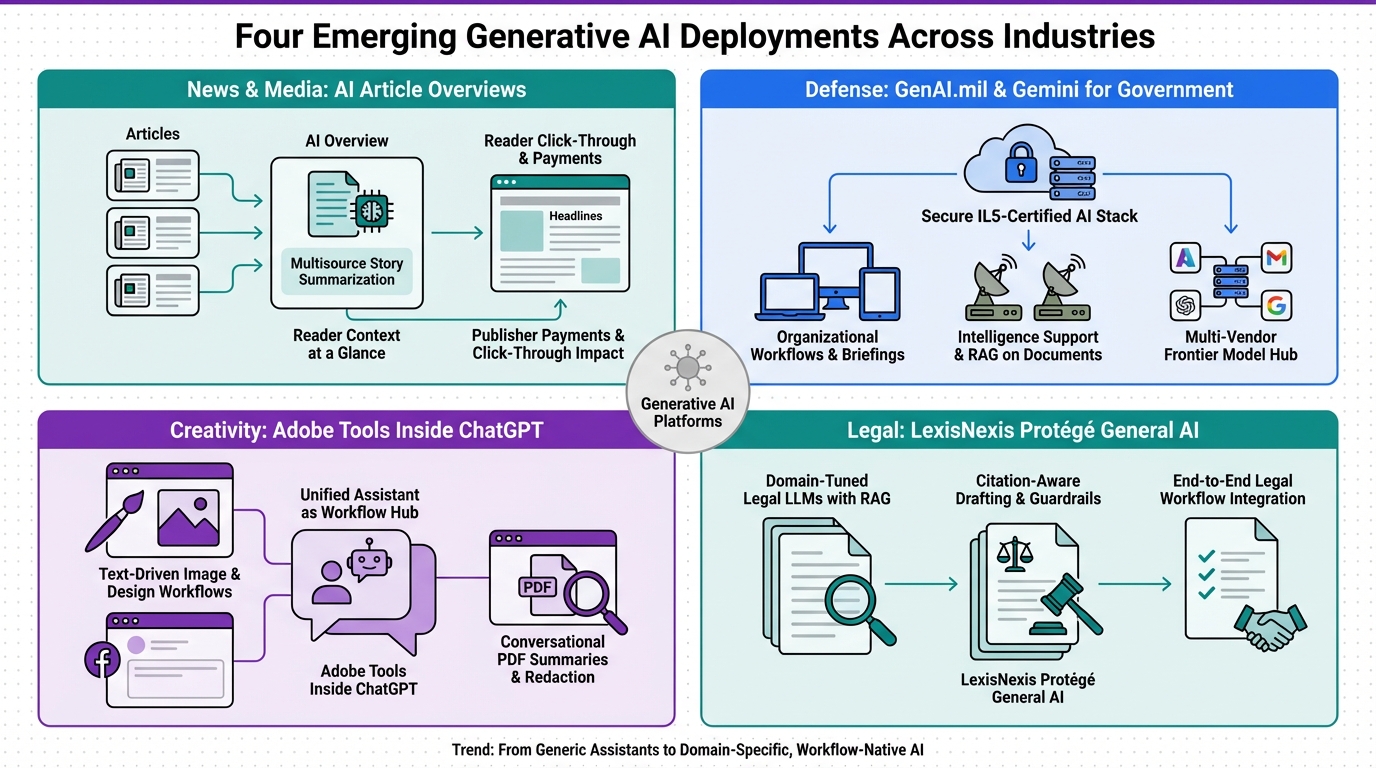
Google Tests AI-Powered Article Overviews in Google News
John: Alright, Lila, let’s roast this one a bit. Google loves to hype up their AI as the next big thing that ‘revolutionizes’ how we read news. But honestly, it’s just them sprinkling some generative magic on top of what we already do—scrolling through headlines. The real story? Google’s testing AI-powered article overviews on specific publishers’ pages in Google News. Think of it like a movie trailer for news articles: a quick AI-generated snapshot that gives you the gist before you dive in. This is a pilot with big names like The Guardian, The Washington Post, and others, and it’s all about adding context without stealing the show from the original writers.
Lila: Okay, John, that sounds handy, but break it down for me like I’m five. What’s the analogy here?
John: Sure thing—imagine you’re at a buffet. Instead of guessing what’s in each dish by poking around, there’s a little sign (the AI overview) that says, ‘This is spicy chicken curry with these key ingredients.’ It helps you decide if you want the full plate. Technically, Google’s using their in-house models, probably something like Gemini, to pull headlines and facts from multiple stories into one coherent summary. It’s not replacing the article; it’s teasing it. And fact-check time: Based on recent web updates, this started rolling out just hours ago on December 10, 2025, with pilots involving publishers like Der Spiegel and El País too. No hallucinations here—it’s legit, as per TechCrunch and Google’s own blog.
Lila: Got it. So, why should a normal person care? Does this change how I read news on my phone?
John: Absolutely. For you, it means faster decisions—do I read this or skip? It could cut down on clickbait frustration. Publishers get paid directly by Google to join this, which offsets any lost clicks, but it’s a double-edged sword: more money now, but deeper ties to Big Tech. Engineering-wise, this is built on retrieval-augmented generation (RAG—fancy term for fetching real data to back up AI responses, reducing made-up stuff). If you’re a dev tinkering with similar summaries, check out open-source alternatives like Hugging Face’s Transformers library—fine-tune a model like BART or T5 for your own news aggregator. And hey, if you’re creating docs or slides about news trends, tools like Gamma can whip them up in seconds.
Lila: Cool, but is there any downside? Like, does the AI get things wrong?
John: Fair point—AI can hallucinate, but Google grounds these in actual article content. The ‘so what’ for users: More engaged reading, potentially. For publishers, it’s a test of AI-revenue sharing. Regulators are watching too, especially with EU probes into Google’s AI practices from just yesterday. Overall, it’s a step toward AI as your news co-pilot.
U.S. Defense Department Rolls Out GenAI.mil with Google Gemini for Government
John: Now, let’s shift to something that sounds like sci-fi but is very real: The Pentagon’s betting big on AI with GenAI.mil. They’re deploying commercial-grade AI to nearly 3 million people—civilians, contractors, even warfighters. Google’s Gemini for Government is the star here, certified for secure use up to Impact Level 5. Hype alert: DOD calls it ‘pushing all chips in on AI as a fighting force.’ But let’s cut through—it’s basically souped-up chatbots for military paperwork and intel.
Lila: Whoa, military AI? Analogize this for me—I’m picturing robots taking over, but that’s probably not it.
John: Haha, not quite. Think of it like upgrading from a clunky old toolbox to a smart power tool set. Gemini is Google’s AI model, hardened with security layers for government data. It handles drafting reports, summarizing docs, and querying intel— all while being ‘web-grounded’ to fact-check against real sources. Fact-check: This launched recently, with Google Cloud confirming it. No outdated info; it’s fresh as of 2025. Architecture? It’s retrieval-augmented (pulling in external data) on top of Gemini’s large language model, probably the 1.5 Pro variant, running in isolated environments.
Lila: So, impact on daily life? I’m not in the military, but does this affect me?
John: Indirectly, yes—better AI in defense means faster innovation that trickles down to civilian tech, like secure AI for businesses. For devs, it’s a multi-vendor hub; Anthropic and OpenAI are joining. Open-source alt? Try Llama-3 from Meta, fine-tuned with LangChain for RAG setups. If you’re learning coding for AI security, chat with an AI tutor via Nolang. The big ‘so what’: AI is now department-wide, not just pilots, signaling a shift to AI defaults in massive orgs.
Adobe Launches Photoshop, Express, and Acrobat Integrations for ChatGPT
John: Adobe’s playing nice with ChatGPT now—integrating Photoshop, Express, and Acrobat right into it. The hype? ‘Creativity for everyone!’ Reality: It’s turning ChatGPT into a hub for editing images, making social posts, and handling PDFs without leaving the chat.
Lila: Analogy time—how’s this like something everyday?
John: Like having a Swiss Army knife where one tool (ChatGPT) calls on specialists (Adobe apps). Powered by Adobe’s Firefly AI for gen tasks. Fact-check: Adobe announced this; it’s accurate. For creators, no more app-switching—prompt ‘edit this image’ and boom. If you’re making videos from text, try Revid.ai for quick shorts. The impact: Streamlines workflows, pressures indie tools.
LexisNexis Unveils Protégé General AI for Legal Workflows
John: Last up, LexisNexis drops Protégé General AI for lawyers—integrated into research, drafting, and more. Hype: ‘Most integrated legal AI.’ True engineering: Domain-tuned LLMs over legal databases.
Lila: Analogy?
John: Like a legal librarian who also writes your briefs. Fact-check: Recent announcement holds. For pros, deeper integration than generic bots. Open alt: Fine-tune Mistral with legal data via Hugging Face. ‘So what’: Makes legal work faster, but adoption varies by firm size.
| Story | Key Highlight | Impact |
|---|---|---|
| Google AI Overviews | Summaries on news pages | Faster context for readers |
| GenAI.mil | AI for 3M DOD users | Modernizes defense workflows |
| Adobe in ChatGPT | Creative tools integration | Easier content creation |
| Protégé AI | Legal workflow AI | Streamlines law practices |
In summary, today’s AI news shows tech giants pushing boundaries in news, defense, creativity, and professions. Dive in—try automating your tasks with Make.com to feel the power yourself!

👨💻 Author: SnowJon (Web3 & AI Practitioner / Investor)
A researcher who leverages knowledge gained from the University of Tokyo Blockchain Innovation Program to share practical insights on Web3 and AI technologies. While working as a salaried professional, he operates 8 blog media outlets, 9 YouTube channels, and over 10 social media accounts, while actively investing in cryptocurrency and AI projects.
His motto is to translate complex technologies into forms that anyone can use, fusing academic knowledge with practical experience.
*This article utilizes AI for drafting and structuring, but all technical verification and final editing are performed by the human author.
🛑 Disclaimer
This article contains affiliate links. Tools mentioned are based on current information. Use at your own discretion.
▼ Recommended AI Tools for Beginners
- 🔍 Genspark: An AI agent that saves you research time by summarizing search results.
- 📊 Gamma: Create beautiful presentations and docs in seconds just by typing.
- 🎥 Revid.ai: Turn your text or blogs into viral short videos instantly.
- 👨💻 Nolang: Learn coding or any topic by chatting with an AI tutor.
- ⚙️ Make.com: Automate boring tasks by connecting your favorite apps.
References & Further Reading
- TechCrunch – “Google is testing AI-powered article overviews on select publications’ Google News pages”
- DefenseScoop – Coverage of the Pentagon’s GenAI.mil rollout and Google Gemini deployment
- Google Cloud Press Corner – “Chief Digital and Artificial Intelligence Office Selects Google Cloud’s AI to Power GenAI.mil”
- War Department official release – “The War Department Unleashes AI on New GenAI.mil Platform”
- Adobe Newsroom – “Adobe Makes Creativity Accessible for Everyone with Adobe Photoshop, Adobe Express and Adobe Acrobat in ChatGPT”
- LexisNexis Pressroom – “LexisNexis Unveils Next-Generation Protégé General AI, the Most Integrated Legal AI Workflow Solution”