
Curious about the future of AI? Google’s Gemini 3 Flash is here, funding’s exploding, and the battle against Nvidia heats up. Get the scoop!#Gemini3Flash #AIFunding #NvidiaAI
Quick Video Breakdown: This Blog Article
This video clearly explains this blog article.
Even if you don’t have time to read the text, you can quickly grasp the key points through this video. Please check it out!
If you find this video helpful, please follow the YouTube channel “AIMindUpdate,” which delivers daily AI news.
https://www.youtube.com/@AIMindUpdate
Read this article in your native language (10+ supported) 👉
[Read in your language]
Daily AI News: Gemini 3 Flash Speeds Ahead, Funding Surges, and the Race to Challenge Nvidia
Hey everyone, welcome back to AI Mind Update! Today’s biggest buzz in AI is all about speed and efficiency meeting smarts—Google’s just launched Gemini 3 Flash, a new model that’s fast, cheap, and powerful enough to handle complex tasks without breaking a sweat. Why does this matter? In our everyday lives, it means AI tools that respond instantly, like a super-smart assistant that doesn’t make you wait, potentially transforming how we work, search, and even create. But that’s not all—funding is pouring into AI like never before, and there’s a heated race to shake up the hardware game. Let’s dive in with Jon and Lila breaking it down simply.
Google Launches Gemini 3 Flash: A Speedy AI Powerhouse Now Available Worldwide
Jon: Alright, Lila, let’s start with the star of the show today—Google’s Gemini 3 Flash. It’s their latest AI model, rolling out globally, and it’s all about being fast while still being incredibly smart. Think of it like a sports car that’s not just quick off the line but also handles sharp turns with expert precision. Google claims it’s a “frontier” model, meaning it’s at the cutting edge, but optimized for speed and low cost.
Lila: Whoa, sounds exciting! But break it down for me—what makes this different from other AI models I’ve heard about, like the ones from OpenAI?
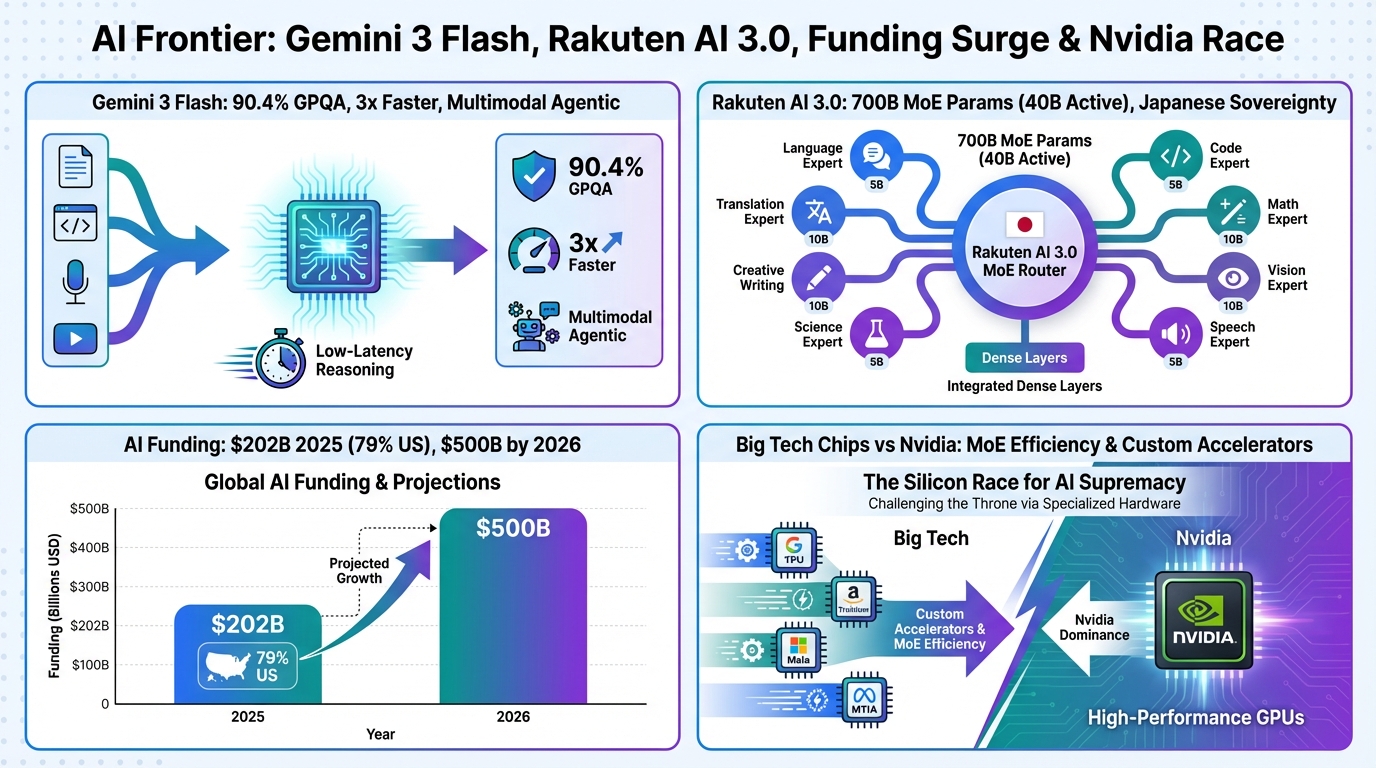
Jon: Great question. Gemini 3 Flash is part of Google’s Gemini family, but it’s tuned specifically for low latency—that’s tech speak for minimal delay in responses. Based on recent updates, it’s now the default model in the Gemini app and even in Google’s AI Mode for Search. It’s designed to give you top-tier reasoning at a fraction of the cost and speed of bigger, heavier models. For example, on tough benchmarks like GPQA Diamond, which tests PhD-level reasoning, it’s hitting around 90.4% accuracy. And on something called “Humanity’s Last Exam,” it’s over 33% without any extra tools. That’s impressive for something built to be efficient.
Lila: Okay, analogies help—it’s like having a genius friend who answers your questions instantly instead of pondering for ages. But how does this affect regular people like me?
Jon: Exactly! In real life, this means smoother experiences in apps. Imagine typing code and getting suggestions right as you go, or chatting with a customer service bot that feels natural and quick. Google is integrating it into tools like AI Studio for developers, Android Studio for app makers, and even Vertex AI for businesses. It’s great for multimodal stuff too—handling text, images, videos, and audio all at once. The big win? It makes advanced AI affordable and fast enough for everyday use, differentiating Google from slower competitors.
Lila: So, why should I care if I’m not a developer?
Jon: For you, it could mean faster searches on Google that understand complex questions better, or apps on your phone that plan your day or edit photos seamlessly. It’s pushing AI towards being truly helpful without the frustration of waiting.
Rakuten Unveils Rakuten AI 3.0: Japan’s Massive Push for Homegrown AI
Jon: Moving east, Lila—Rakuten, the big Japanese e-commerce giant, just unveiled Rakuten AI 3.0. This is a huge language model backed by Japan’s government through initiatives like GENIAC, METI, and NEDO. It’s positioned as Japan’s largest high-performance AI for Japanese language, aiming to build national AI infrastructure.
Lila: Japan building its own AI? That sounds like a sovereignty thing. What’s under the hood?
Jon: Spot on. It’s a Mixture-of-Experts (MoE) model—think of it like a team of specialists: instead of one big brain handling everything, it routes tasks to expert sub-parts. Total parameters? About 700 billion, but only around 40 billion activate per task, making it efficient. Each input goes through eight experts plus a shared one, with some dense layers for heavy lifting. This setup gives massive capacity without the full cost every time.
Lila: Like calling in the right chef for the dish instead of having one cook everything? Cool. What’s Rakuten doing with it?
Jon: They’re integrating it into their own systems via Rakuten AI Gateway and an internal platform for tasks in e-commerce, fintech, and telecom. But the exciting part is the plan to release it as an open-weight model in spring 2026. That means developers and businesses worldwide could use a Japanese-tuned AI that’s strong in local language and culture.
Lila: Real-world impact?
Jon: For folks in Japan or dealing with Japanese markets, better copilots for shopping, support, and content. Globally, it promotes AI diversity—less reliance on U.S.-centric models, especially in regulated industries. It’s a step towards “AI sovereignty,” where countries control their tech destiny.
AI Funding Hits Record Highs: Nearly Half of Global VC Capital in 2025
Jon: Now, let’s talk money, Lila. New data shows AI funding is exploding—accounting for close to 50% of all global venture capital in 2025, with over $200 billion invested. That’s a 75% jump from 2024.
Lila: Whoa, that’s a ton of cash! Where’s it all going?
Jon: Mostly to the U.S., with $159 billion there, and the Bay Area snagging $122 billion alone. It’s funding everything from AI infrastructure like chips to apps. Analogy: It’s like investors betting big on the next industrial revolution, pouring money into factories (compute) and products (AI tools).
Lila: Why the surge, and what does it mean for me?
Jon: The hype is real, but so is the potential. It means faster innovation—new models, better tools. But beware of bubbles; not every startup will survive. For you, expect more AI in daily life, like smarter apps, but also competition driving down costs.
AI Investment Forecasts Soar: Heading to $500 Billion by 2026
Jon: Building on that, analysts predict AI investments could hit $500 billion annually by 2026, focused on productivity gains in enterprises.
Lila: That’s double this year’s! What’s driving it?
Jon: Companies are shifting budgets to AI for automation—internal tools for coding, ops, finance. It’s like upgrading from manual labor to machines. The pitch: Use AI to boost margins and stay competitive.
Lila: Impact on jobs or society?
Jon: It could automate routine tasks, freeing time for creative work, but we need to watch for disruptions. For readers, it’s a signal to learn AI basics to adapt.
Big Tech Ramps Up the Fight Against Nvidia’s AI Dominance
Jon: Lastly, the hardware race is heating up. Big Tech like Google and Meta are pushing to erode Nvidia’s lead in AI chips, with projects like TorchTPU to make alternatives compatible with popular frameworks.
Lila: Nvidia’s the king of GPUs, right? Why challenge them?
Jon: Yes, Nvidia dominates training and inference, but others want cheaper, custom options. Analogy: It’s like car makers building their own engines instead of buying from one supplier. This could lead to better pricing and specialized chips.
Lila: So what?
Jon: More accessible compute means faster AI advancements for everyone, from startups to users.
| Topic | Key Update | Why It Matters |
|---|---|---|
| Gemini 3 Flash | Google’s fast, efficient AI model now default in apps and Search, with strong benchmarks. | Makes AI quicker and more accessible for daily tasks, pushing innovation in apps and search. |
| Rakuten AI 3.0 | Japan’s 700B-parameter MoE model, open-weight release in 2026. | Boosts local AI capabilities, promotes global diversity in tech. |
| AI Funding 2025 | $200B invested, nearly 50% of global VC. | Drives rapid AI growth, but risks overhype and consolidation. |
| AI Investment Forecast 2026 | Projected $500B annually for productivity tools. | Shifts business to AI-first, impacting jobs and efficiency. |
| Race Against Nvidia | Big Tech developing alternatives to Nvidia’s chips. | Could lower costs and speed up AI development for all. |
In summary, today’s AI news points to a future where AI is faster, more funded, and less dominated by a few players. It’s an exciting time, but let’s stay informed and think about how these changes shape our world. Keep questioning the hype and exploring ethically!

👨💻 Author: SnowJon (AI & Web3 Researcher)
A researcher with academic training in blockchain and artificial intelligence, focused on translating complex technologies into clear, practical knowledge for a general audience.
*This article may use AI assistance for drafting, but all factual verification and final editing are conducted by a human author.
References & Further Reading
- Introducing Gemini 3 Flash: Benchmarks, global availability
- Google launches Gemini 3 Flash, makes it the default model in the Gemini app | TechCrunch
- Exclusive: Google works to erode Nvidia’s software advantage with Meta’s help | Reuters
- Gemini 3 gives Google a boost in the AI race against OpenAI and Nvidia | CNN Business
- Google Releases More Efficient, Affordable Gemini 3 AI Model – Bloomberg