
Read this article in your native language (10+ supported) 👉
[Read in your language]
Daily AI News: Why AI’s Big Dreams Are Hitting Real-World Roadblocks in 2025
Hey there, folks! Imagine this: You’re excited about the latest AI gadget that promises to make your life easier, like chatting with a virtual assistant or translating languages on the fly. But behind the scenes, building the massive tech infrastructure to power it all is like trying to construct a skyscraper during a materials shortage. Today’s top AI trend? Delays in huge data center projects and upgrades to everyday tools like translation apps. Why does this matter to you? Well, these hiccups could slow down new AI features reaching your phone, but they’re also pushing companies to get smarter about efficiency. It’s a reminder that AI isn’t just magic—it’s built on real stuff like power and money. If you’re curious about staying ahead, tools like Genspark can help you quickly research these trends without the hassle.
Oracle’s AI Data Center Plans Face Delays Due to Shortages
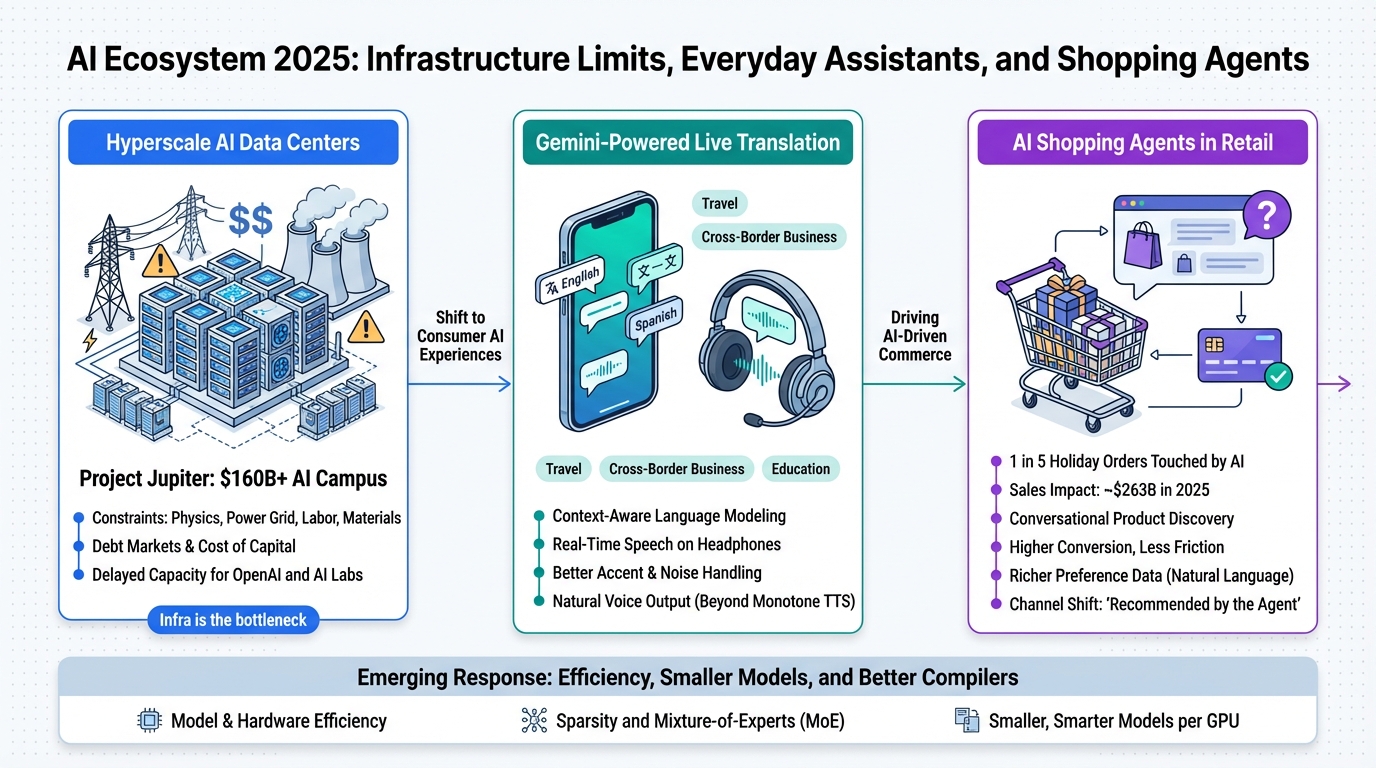
Jon: Alright, Lila, let’s dive into the biggest story buzzing in the AI world right now. Oracle, a major player in cloud computing, is hitting some serious snags with their ambitious data center projects for AI giants like OpenAI. According to recent reports from Bloomberg and Tom’s Hardware, some of these data centers, originally slated for completion in 2027, are now pushed back to 2028 because of labor and material shortages. It’s like planning a massive road trip but finding out there’s a shortage of gas and mechanics—everything slows down.
Lila: Whoa, that sounds frustrating. But why are these data centers such a big deal? And how does this affect everyday people who aren’t building AI models?
Jon: Great question! Think of data centers as the giant factories where AI “brains” live and work. Oracle’s Project Jupiter in New Mexico is a $160 billion-plus mega-project designed to house tens of thousands of GPUs—these are like super-powered graphics cards that train and run AI models. But building them fast is clashing with real-world limits: not enough skilled workers, materials like steel and chips, and even power grid issues. Oracle’s stock dropped sharply after their quarterly report showed $12 billion in capital spending last quarter, with plans for up to $50 billion this fiscal year. They’re even borrowing money to fund it, which is raising eyebrows on Wall Street.
Lila: So, it’s not just about delays—it’s about the physics and money side of AI. Does this mean AI progress will slow down for things like chatbots or image generators?
Jon: Exactly. For us non-techies, this could mean slower rollouts of new AI features in apps you use daily. If OpenAI can’t get the computing power they need on time, their next big model updates might be delayed. But here’s the silver lining: it pushes the industry toward efficiency. Instead of just building bigger, companies are focusing on smarter tech like Mixture of Experts (MoE)—that’s where parts of the AI activate only when needed, saving energy—or better compilers that optimize code. If you’re into creating docs or slides with AI, tools like Gamma already use efficient models to make beautiful presentations in seconds without needing massive data centers.
Lila: That makes sense. So, the “so what” is that AI is real, but building it sustainably is the new challenge?
Jon: Spot on. Investors are getting skeptical, which might boost open-source projects that run on less hardware. For example, fine-tuning models like Llama-3-8B with libraries from Hugging Face can let you build AI apps on a laptop, dodging these big infra bottlenecks.
Google Translate Levels Up with Gemini AI for Smarter Translations
Jon: Shifting gears to something more fun and practical—Google just upgraded Translate with their Gemini AI, making translations more accurate and natural. Based on Google’s blog and reports from The Times of India, this includes better text translations and real-time speech features, even on headphones. It’s like having a personal interpreter in your pocket, but way smarter than the old robotic versions.
Lila: Cool! I’ve used Translate for trips, but it sometimes sounds awkward. How does Gemini fix that?
Jon: Imagine translation as cooking a meal: old methods followed a strict recipe, but Gemini adds context like who’s eating and what ingredients are fresh. It uses Gemini’s advanced language models for context-aware phrasing, handling accents better in noisy spots, and producing natural-sounding voices. The upgrade rolled out recently, with live speech translation in the app and on compatible headphones—perfect for travelers or international calls.
Lila: Why does this matter for students or non-techies?
Jon: For you, it means easier learning or business across languages. Picture a student watching a lecture in Spanish with real-time English subs, or chatting with global friends without mix-ups. Google is weaving Gemini into everyday tools, making AI “just there.” If you’re learning coding or any topic, something like Nolang uses similar AI tutoring to explain concepts conversationally.
Lila: And the impact? Is this a game-changer?
Jon: Absolutely—it’s breaking down language barriers faster. With updates to Gemini 2.5 for native audio, translations feel more human. For creators, if you’re turning blogs into videos, Revid.ai can handle multilingual content seamlessly.
AI Agents Are Powering Holiday Shopping Behind the Scenes
Jon: No massive model launches today, but AI is quietly revolutionizing holiday shopping. Recent reports, like from the Associated Press, say AI agents could handle $263 billion in sales this season, assisting one in five orders. Retailers like Walmart are integrating ChatGPT-style interfaces for conversational shopping.
Lila: Like asking AI for gift ideas? How does that work?
Jon: Yep, think of it as a helpful elf: You say, “Find a $50 science gift for a 10-year-old,” and the agent searches, compares prices, and suggests deals. It uses natural language processing from models like those in OpenAI, merging search and checkout into one flow.
Lila: So, for shoppers, it’s about saving time and money?
Jon: Right! It reduces friction, gives personalized recs, and hunts deals. Businesses get richer data from chats. This previews 2026, where AI handles routine decisions. For automating your own tasks, Make.com connects apps to streamline workflows.
| Story | Key Highlight | Impact |
|---|---|---|
| Oracle Data Center Delays | Pushed to 2028 due to shortages | Slower AI rollouts, push for efficiency |
| Google Translate Upgrade | Gemini for natural text/speech | Easier global communication |
| AI Shopping Agents | Handling $263B in sales | Smarter, faster shopping |
In summary, today’s AI news shows the tech world balancing big ambitions with practical limits. From Oracle’s delays teaching us about real constraints to Google’s upgrades making life easier, it’s all about progress. Dive in with tools like Make.com to automate your own AI experiments—start small and build from there!

👨💻 Author: SnowJon (Web3 & AI Practitioner / Investor)
A researcher who leverages knowledge gained from the University of Tokyo Blockchain Innovation Program to share practical insights on Web3 and AI technologies. While working as a salaried professional, he operates 8 blog media outlets, 9 YouTube channels, and over 10 social media accounts, while actively investing in cryptocurrency and AI projects.
His motto is to translate complex technologies into forms that anyone can use, fusing academic knowledge with practical experience.
*This article utilizes AI for drafting and structuring, but all technical verification and final editing are performed by the human author.
🛑 Disclaimer
This article contains affiliate links. Tools mentioned are based on current information. Use at your own discretion.
▼ Recommended AI Tools for Beginners
- 🔍 Genspark: An AI agent that saves you research time by summarizing search results.
- 📊 Gamma: Create beautiful presentations and docs in seconds just by typing.
- 🎥 Revid.ai: Turn your text or blogs into viral short videos instantly.
- 👨💻 Nolang: Learn coding or any topic by chatting with an AI tutor.
- ⚙️ Make.com: Automate boring tasks by connecting your favorite apps.