
Are new AI gadgets an epic fail? Logitech’s CEO thinks so. Discover why devices like the Humane AI Pin are struggling and what real innovation looks like. #AIGadgets #TechFails #LogitechAI
Quick Video Breakdown: This Blog Article
This video clearly explains this blog article.
Even if you don’t have time to read the text, you can quickly grasp the key points through this video. Please check it out!
If you find this video helpful, please follow the YouTube channel “AIMindUpdate,” which delivers daily AI news.
https://www.youtube.com/@AIMindUpdate
Why Logitech’s CEO Thinks AI Gadgets Are Epic Fails: A Beginner’s Guide to the Hype vs. Reality
🎯 Level: Beginner
👍 Recommended For: Tech enthusiasts curious about gadgets, Everyday consumers shopping for smart devices, Beginners exploring AI trends without the jargon
Imagine you’re at a party, and someone shows up with a flashy new gadget that promises to revolutionize your life—like a self-tying shoe that also brews coffee. Sounds cool, right? But then you realize it doesn’t tie well, the coffee tastes like mud, and you could’ve just used your phone for both. That’s kinda what’s happening in the world of AI gadgets, according to Logitech’s CEO. If you’re new to this, tools like Genspark can help you dive deeper into real-time tech news without getting overwhelmed. Let’s break it down in a fun, storytelling way.
The Hype Machine: Before AI Gadgets Crashed and Burned
Remember the good old days when gadgets were straightforward? You’d buy a mouse or keyboard from Logitech, plug it in, and it just worked—no promises of changing the world, just reliable tools for your computer. Back then, if you wanted “smart” features, you’d rely on your smartphone or apps. But enter the AI boom: companies started pumping out standalone devices like the Humane AI Pin or Rabbit R1, hyping them as the next big thing. The “before” state was simple—clunky, maybe, but effective. Now, with these ill-conceived gadgets, we’re seeing massive failures because they chase buzz without solving real problems. For visualizing this evolution, check out Gamma to create quick slides comparing old tech to new flops.
Core Mechanism: AI Gadgets Like Overhyped Party Tricks
Think of these AI gadgets as that friend who brings a fireworks show to a quiet picnic—lots of flash, but it scares the dogs and sets the blanket on fire. In simple terms, devices like the Humane AI Pin are standalone hardware packed with generative AI (GenAI), meant to be your pocket assistant without needing a phone. But as Logitech CEO Hanneke Faber puts it, they’re “solutions looking for a problem that doesn’t exist.” It’s like inventing a spoon that talks to you while you eat soup—who asked for that? The core issue? These gadgets isolate AI into new hardware instead of integrating it into what we already use, leading to poor user adoption and quick market flops.
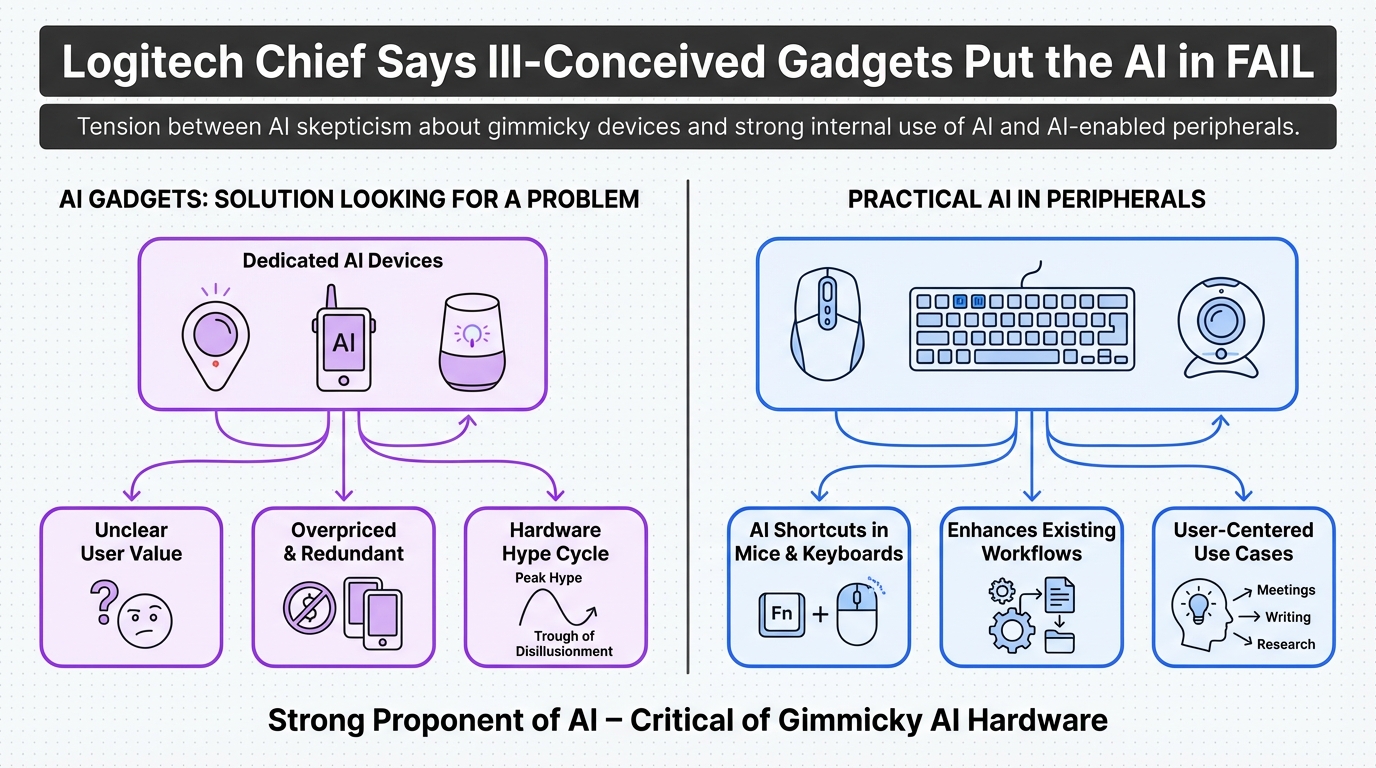
John: Alright, folks, as a battle-hardened tech lead, I’ve seen hype cycles come and go. These AI gadgets? They’re like building a Ferrari engine for a bicycle—overkill and unstable. The engineering reality is they’re cramming large language models (think fine-tuned versions of Llama-3-8B from Hugging Face) into tiny hardware without proper optimization, leading to battery drains and lag. No wonder they fail!
Lila: John, let’s keep it simple for our beginners. Imagine AI as a super-smart butler. In these gadgets, the butler is locked in a fancy box you have to carry around, instead of just living in your existing phone or computer. That’s why Logitech is smart to integrate AI into peripherals like keyboards and mice—practical, not flashy.
Use Cases: Where AI Gadgets Went Wrong (And How to Avoid the Trap)
Let’s look at three real-world scenarios where these gadgets promised the moon but delivered dust. First, picture a busy parent trying to use the Rabbit R1 for quick voice queries on the go. It sounds great, but the device often misunderstood commands and drained battery fast—zero ROI compared to just asking Siri on your phone. For creating marketing videos from such fails, Revid.ai can turn your story into engaging clips.
Second, a student learning about tech trends grabs a Humane AI Pin to “augment reality” with AI insights. But it glitches in noisy environments and lacks integration with school apps. Better off using your laptop with built-in AI features. If you’re coding your own AI experiments, Nolang is a great AI tutor to learn without the hardware hassle.
Third, a professional at a conference pins on an AI gadget for real-time translations. Cool idea, but connectivity issues make it unreliable—stick to apps on your device for faster, cheaper results. These cases show the pitfalls: high cost, low reliability, and no real speed boost over traditional methods.
| Aspect | Old Method (Smartphones/Apps) | New Solution (Standalone AI Gadgets) |
|---|---|---|
| Problem-Solving | Addresses real needs like navigation or reminders efficiently. | Creates artificial problems; often redundant. |
| Cost | Affordable apps on existing devices. | High upfront price with quick obsolescence. |
| Reliability | Proven ecosystems with updates. | Frequent glitches and short lifespan. |
| User Adoption | Billions use daily. | Low; many discontinued quickly. |
John: See that table? It’s black-and-white proof these gadgets are DOA. From an engineering view, they’re ignoring basics like quantization (shrinking models for efficiency) and relying on hype. I’d recommend starting with open-source tools via Hugging Face repos instead.
Lila: Totally, John. For beginners, it’s like comparing a reliable bike to a jetpack that explodes—stick to the bike until the jetpack is ready.
Wrapping It Up: Learn from the Fails and Build Smarter
In summary, Logitech’s CEO nails it: AI gadgets often put the “FAIL” in AI by chasing problems that aren’t there. The key takeaway? Focus on integrated, practical AI that boosts speed and ROI without the fluff. If you’re inspired to automate your own workflows around smarter tech choices, try Make.com—it’s a game-changer for connecting tools efficiently. Don’t fall for the hype; research with tools like Genspark and build your tech stack wisely!

👨💻 Author: SnowJon (Web3 & AI Practitioner / Investor)
A researcher who leverages knowledge gained from the University of Tokyo Blockchain Innovation Program to share practical insights on Web3 and AI technologies. While working as a salaried professional, he operates 8 blog media outlets, 9 YouTube channels, and over 10 social media accounts, while actively investing in cryptocurrency and AI projects.
His motto is to translate complex technologies into forms that anyone can use, fusing academic knowledge with practical experience.
*This article utilizes AI for drafting and structuring, but all technical verification and final editing are performed by the human author.
🛑 Disclaimer
This article contains affiliate links. Tools mentioned are based on current information. Use at your own discretion.
▼ Recommended AI Tools
References & Further Reading
- Logitech CEO says AI devices are just “solutions looking for a problem” | TechRadar
- AI gadget makers are chasing problems that don’t exist, Logitech CEO says — also details supply chain and pricing strategy | Tom’s Hardware
- Logitech CEO Says AI Gadget Makers Are Chasing Problems That Don’t Exist | HotHardware
- Logitech says no to AI gadgets, calls them solutions looking for a problem – India Today
- The 3 biggest AI fails of 2025 | Mashable